
In March 2026, Monaco's exotic garden reopened after being closed for six years and undergoing a renovation costing over 18 million euros. The clifftop garden with thousands of succulents, a stalactite cave and perhaps the best view in the principality – here's how to experience it now.
The cliff that rises behind Fontvieille has looked the same for almost a hundred years: a vertical limestone wall covered in cacti, agaves and tree-like euphorbias, with narrow paths and walkways clinging to the rock. But for six years it was closed. Jardin Exotique de Monaco shut during the pandemic in 2020, and what was meant to be a short break turned into an extensive renovation. On 30 March 2026, the garden finally reopened, Monaco Tribune reported.
The work has involved securing the cliff, replacing the footbridges and building a new entrance designed by the architect Frédéric Genin. The bill came to 17 million euros from the state and 1.5 million from the municipality. The garden is located in the district that bears its name; our guide to the Jardin Exotique district takes you further, street by street.
From a gardener's hobby to a botanical institution
Succulents came to Europe from Mexico in the late 1860s, following the second French intervention there. In Monaco, Augustin Gastaud, head of the state gardens, became fascinated by them and began cultivating them in 1895 in part of the Jardins Saint-Martin on Le Rocher. Prince Albert I, who often passed by on his way to his oceanographic museum, became equally enamoured with them.
In 1912 Albert I bought the rocky headland by the observatory and commissioned the state's chief engineer, Louis Notari, to build a new garden for exotic plants. Notari designed naturalistic rock formations and footbridges along the narrow paths. Construction began in 1913, and the garden opened to the public in 1931. On 7 February 1933 it was officially inaugurated by Prince Louis II.
It was the Monegasque agronomist Louis Vatrican, the first director, who turned the garden into a scientific institution. His successor Marcel Kroenlein complemented the American plants with African succulents and made collecting expeditions to, among other places, Mexico, South America, Madagascar and Yemen; he himself contributed over 2,000 plants. Today the collection comprises over 1,000 species and around 6,000 varieties.
What you see in the garden
The paths zigzag downwards along the cliff, and with every bend both the plants and the view change. Here you'll find cacti from the south-western USA, Mexico and South and Central America, and succulents from southern and eastern Africa. Some are enormous and several decades old; others are small and almost imperceptible amongst the stones.
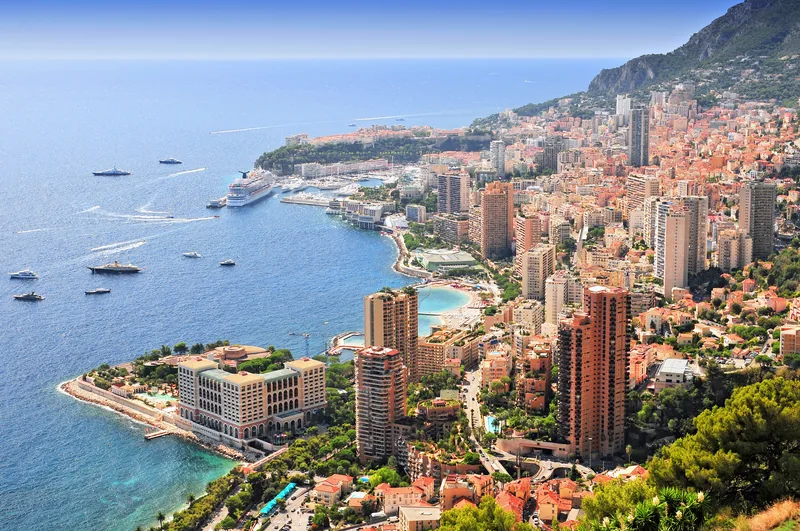
And then the view. From the highest parts of the garden you look out over the entire Principality: the port of Fontvieille directly below, Le Rocher with the Prince's Palace, Port Hercule and Monte Carlo, and the sea all the way to the horizon. It's one of the few places where you truly understand how small and dense Monaco actually is.
Grotte de l'Observatoire – down into the mountain
Beneath the garden, a natural cave opens up in the limestone, with stalactites, stalagmites, draperies and columns shaped by water over thousands of years. It was discovered in 1916, during the construction of the garden, and contained remains of many animal species and traces of early humans. The cave was opened to the public in 1950, and the guided tours have run between 98 and 40 metres above sea level. Check whether the cave is included in the visit after the reopening.
The finds are displayed at the Musée d'Anthropologie Préhistorique, founded by Albert I in 1901 and relocated here in 1959. Just nearby lies Villa Paloma, part of the Nouveau Musée National de Monaco, and the small Parc Princesse Antoinette – two reasons to combine the visit with a walk along Boulevard du Jardin Exotique.
How to plan your visit
At the reopening, the garden was open from 9am to 6pm, and the address is 62 boulevard du Jardin Exotique. Come early in the day, when the light is soft and the cliff has not yet warmed up, or late in the afternoon when the sun hangs low over Fontvieille. The paths are steep with many steps. Feel free to combine it with our morning walk in Monaco-Ville or a visit to Fontvieille below. You'll find more destinations at metromode.co.
Jardin Exotique over the years
| Year | Event |
|---|---|
| 1895 | Augustin Gastaud begins growing succulents at Jardins Saint-Martin |
| 1912 | Albert I buys the rocky headland |
| 1916 | Discovery of the cave |
| 1933 | Official opening (7 February) |
| 2020 | Closed during the pandemic |
| 2026 | Reopening after renovation (30 March) |
Jardin Exotique de Monaco
Succulents on the rock
A clifftop garden from 1931 with over 1,000 species of succulents and views over the entire principality.
62 boulevard du Jardin Exotique, Monaco
Reopened 30 March 2026.
Musée d’Anthropologie Préhistorique
Finds from the cave
The museum founded by Albert I in 1901, featuring prehistoric finds from Monaco and the cave.
Boulevard du Jardin Exotique, Monaco
Villa Paloma
Nouveau Musée National de Monaco
One of Monaco's national museum buildings, just next to the garden.
56 boulevard du Jardin Exotique, Monaco
Parc Princesse Antoinette
Small park in the neighbourhood
Green park near the garden, good for a break.
Monaco, every street of it
Every MICHELIN table and the grand hotels – Metro Mode with VERA PI.