
La Condamine is Monaco's living room: the harbour quarter between the Prince's Rock and Monte Carlo, with market trading since 1880, a church where a boat is burnt every January, and the quay where the Grand Prix starts. A portrait of the principality's second-oldest quarter.
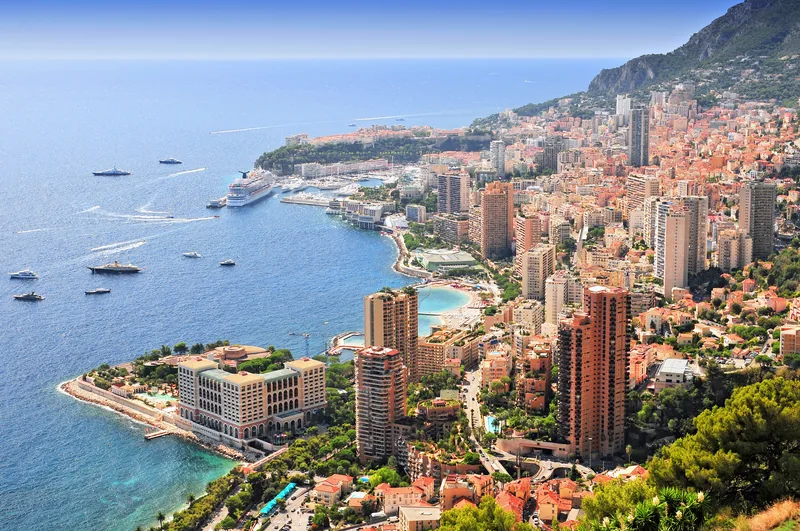
La Condamine is the central district of Monaco, a small valley between the cliff with Monaco-Ville and the slope up towards Monte-Carlo. The name is medieval and comes from vulgar Latin condominium, land near the castle reserved for the feudal lord and exempt from tax. It is the principality's second-oldest area after Monaco-Ville, and according to VERA PI's survey it consists of 65 streets, 230 buildings and 127 places, with four storeys as the typical height.
In the 19th century, the Principality's archivist Gustave Saige described the quarter as an amphitheatre sloping down towards the small semicircular harbour. In the early 1900s, travel writers recommended the quarter's hotels as considerably cheaper than those of Monte-Carlo and as close to the old town as one could stay. It is still here that Monaco shops, works and goes to school – a real town beneath the walls of the palace.
Port Hercule – the harbour since antiquity
Port Hercule is Monaco's only deep-water harbour and has been used since antiquity. Phocaean Greeks from Massalia, present-day Marseille, founded the colony of Mònoikos in the 6th century BC, and the name is connected with the worship of Heracles, who according to legend built the ancient road between Spain and Italy. Virgil called the place "Monoecus by the sea", and the harbour is mentioned in the works of both Pliny the Elder and Tacitus.
The modern harbour was completed in 1926 and was significantly expanded in the 1970s. It has room for up to 700 vessels, with water depths ranging from seven metres at the regular berths to 40 metres at the outer piers and the cruise quay. In 2011, the old fixed piers were replaced with floating concrete pontoons. In autumn, from October to November, the Foire de Monaco is held on the quay.
Place d’Armes – the market since 1880
The heart of the quarter is Place d'Armes at the foot of the cliff, where the farmers' market has been held since 1880. Around the square and along the streets towards the harbour lie the everyday shops, cafés and small restaurants – the most everyday Monaco there is. From the square, Rampe Major leads up to Monaco-Ville and the palace.
Sainte-Dévote – the saint and the burnt boat
In the valley lies the chapel of Sainte-Dévote, dedicated to Monaco's patron saint, who was martyred in Corsica in the 3rd century. According to tradition, the boat carrying her body was about to be wrecked in a storm, but a dove guided it to the shore of Monaco. When thieves in the Middle Ages stole her relics and tried to flee by sea, they were caught and their boat was burnt. Every year on 26 January, a boat is therefore burnt on the site in front of the church, and the following day a grand procession takes place.
The chapel is first mentioned in documents from 1070. Prince Honoré II extended it in 1606 and added a portal in 1637; the façade was rebuilt in 1870 and 1891. Since 1887, it has been the parish church. According to Monegasque tradition, the prince's bride lays her wedding bouquet here after the ceremony – and the chapel has given the Grand Prix circuit's first corner its name.
Grand Prix on the quay
It is in La Condamine that the Monaco Grand Prix starts and finishes, along the quay by the harbour. The municipal pool Stade Nautique Rainier-III on Route de la Piscine – a heated, Olympic-sized saltwater pool with a diving tower and a 45-metre-long slide – has lent its name to the circuit's swimming pool chicane, today known as Virage Louis Chiron. From December to March, the pool becomes a 1,000-square-metre ice rink. The harbour is also home to Rainier III's car collection, comprising around a hundred vehicles.
The viaduct and the road to Monte-Carlo
The valley was once crossed by a railway viaduct. Today the trains run in a tunnel, and the viaduct has become a road between the quarter and Monte-Carlo. Under the 1911 constitution, La Condamine was one of the principality's three communes, until a single commune was reinstated in 1918. The quarter is also home to the Bibliothèque Louis-Notari, Monaco's national library, and the Théâtre Princesse Grace on Avenue d'Ostende.
Streets, houses and places in the district can be found in VERA PI's guide to La Condamine and on VERA PI's Monaco. Plan the whole stay with 48 hours in Monaco and Metro Mode's Monaco guide.
Monaco, every street of it
Every MICHELIN table and the grand hotels – Metro Mode with VERA PI.