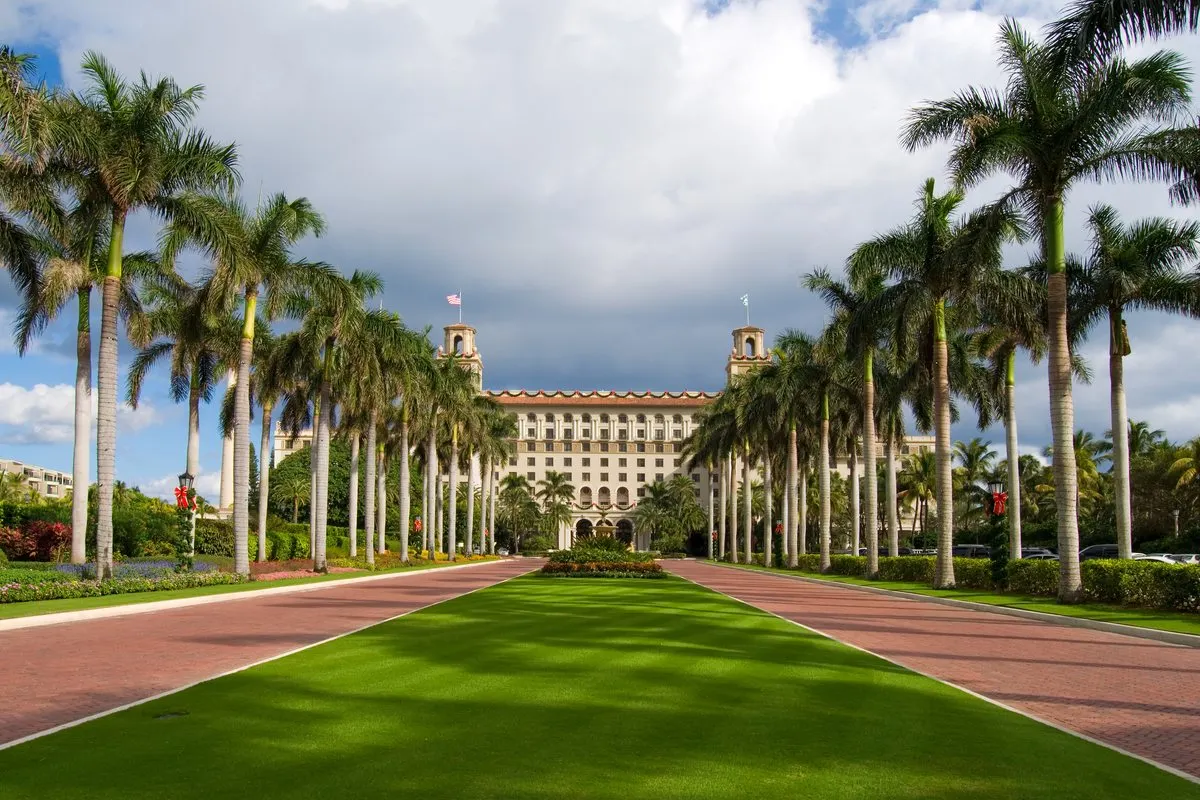
America's grand hotels were built by railway magnates, property speculators and bankers – and have survived fires, depressions and changes of ownership. The Breakers in Palm Beach, The Plaza on Central Park and The Carlyle on Madison Avenue are three of the most talked-about. Here are their histories.
In this story · 3 sections
American grand hotels were born of two forces: the railway, which made it possible to travel to places such as Palm Beach, and the big city's new upper class, who began living in hotels instead of their own townhouses. The Breakers, The Plaza and The Carlyle each represent a different era – the Gilded Age seaside resort, the Edwardian city palace and the Art Deco years – and all three are still in operation today.
01The Breakers, Palm Beach – Flagler's hotel by the waves
Henry Flagler, one of the founders of Standard Oil, had extended his Florida East Coast Railway to Palm Beach and built the Royal Poinciana Hotel on Lake Worth. It became so popular that in 1895 he began building a second hotel, the Palm Beach Inn, in Georgian style – the only oceanfront hotel south of Daytona Beach. A 300-metre pier was built, from which steamships left for Havana, Nassau and Key West. In 1901 the hotel was extended and renamed The Breakers, after guests had asked for rooms "over by the breakers". It also gained Florida's first 18-hole golf course.
On 9 June 1903, a fire broke out in the casino's kitchen, and the hotel burned down. Flagler promised to rebuild it, and a new wooden hotel with 425 rooms opened on 1 February 1904. Among the guests were Andrew Carnegie, William Randolph Hearst, J. P. Morgan and members of the Astor, Rockefeller and Vanderbilt families. Flagler banned motor vehicles from the grounds, so guests were moved between the hotels in wheeled chairs pushed by staff. When he fell down the stairs at his home, Whitehall, in 1913, he spent his final months in the hotel's Nautilus Cottage, where he died on 20 May.
The second hotel also burned down, in 1925. The third, in stone and in Renaissance style, opened in December 1926 and is the one standing today, at 1 South County Road. It has 534 rooms, employs more than 2,300 people and has been on the US National Register of Historic Places since 1973. The Royal Poinciana closed for good during the Depression in the 1930s; The Breakers remained as Palm Beach's grand hotel.
02The Plaza, New York – the palace by Central Park
The Plaza stands on Grand Army Plaza, on the corner of Fifth Avenue and Central Park South, at 768 Fifth Avenue. A first hotel of the same name was built in 1883–1890 but was replaced in 1905–1907 by the present building: 18 storeys in a French Renaissance-inspired château style, designed by Henry Janeway Hardenbergh – the architect of The Dakota. The façade is marble at the base and white brick above, with a mansard roof and round corner turrets. Warren and Wetmore, the architects of Grand Central Terminal, extended the hotel in 1919–1921.
The ground-floor rooms are the heart of the hotel. The Palm Court, formerly the tea salon, was inspired by the Palm Court at the Carlton Hotel in London and has walls of Caen stone, mosaic floors and a glass ceiling that was removed in the 1940s and restored in the mid-2000s. The Oak Room from 1907, originally the hotel's bar, is in German Renaissance style with oak panelling and frescoes of Bavarian castles. In the Oak Bar hang three murals by Everett Shinn from 1945 depicting the neighbourhood as it looked in 1907.
The hotel has changed owners many times – Conrad Hilton and Donald Trump among them – and has been owned since 2018 by Katara Hospitality, with Fairmont as operator since 2005. Since the 2008 renovation, the building has housed 282 hotel rooms and 181 condominiums. The exterior and several interiors are protected by the city, and the building is a National Historic Landmark. In literature, the Plaza is forever Eloise's home: Kay Thompson and Hilary Knight's 1955 children's book, about the girl who lives at the hotel with her nanny, her dog and her turtle, sold 150,000 copies in two years.
03The Carlyle, New York – Art Deco on Madison Avenue
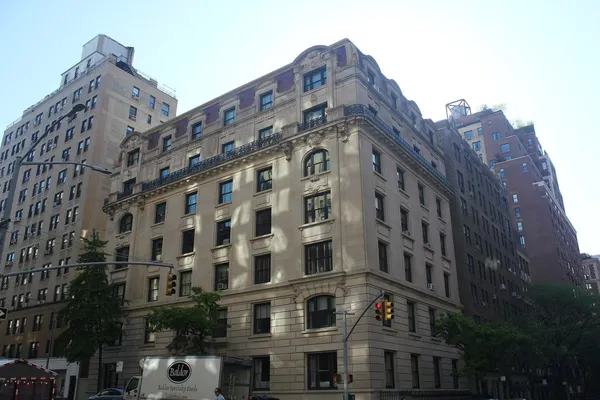
The Carlyle stands on Madison Avenue between 76th and 77th Streets on the Upper East Side. It opened in 1930 as a residential hotel – a form of living that had become popular among wealthy New Yorkers after the First World War, when owning a townhouse began to go out of fashion. The building was designed by Sylvan Bien and Harry M. Prince in Art Deco style, with interiors by Dorothy Draper, and was named after the Scottish writer Thomas Carlyle. It consists of a 40-storey tower and a lower residential building facing 77th Street.
The developer Moses Ginsberg lost the hotel within two years of its opening. It was Robert W. Dowling, who took over in 1944, who gave it its cultural life: Bemelmans Bar in 1947 and the Café Carlyle in 1955, where the pianist Bobby Short played for so long that the corner of 76th Street and Madison Avenue is also named Bobby Short Way. Since 2001 the hotel has been owned by Rosewood. It has around 190 rooms and suites and 60 condominiums.
Bemelmans Bar is the hotel's most famous room. The walls are covered by Central Park, a pale yellow mural that Ludwig Bemelmans, the creator of the Madeline books, painted in 1947. It shows Madeline, her eleven classmates and their headmistress in the park through the seasons, among ice-skating elephants and cigar-smoking rabbits, and is his only artwork still on display in its original location. The bar has an Art Deco interior with a gold-leaf ceiling, 21 small glass-topped tables and a grand piano; the bartenders wear red jackets.
More about the cities can be found in VERA PI's guides to New York City and Palm Beach County. More hotels and destinations can be found among Metro Mode's destinations.