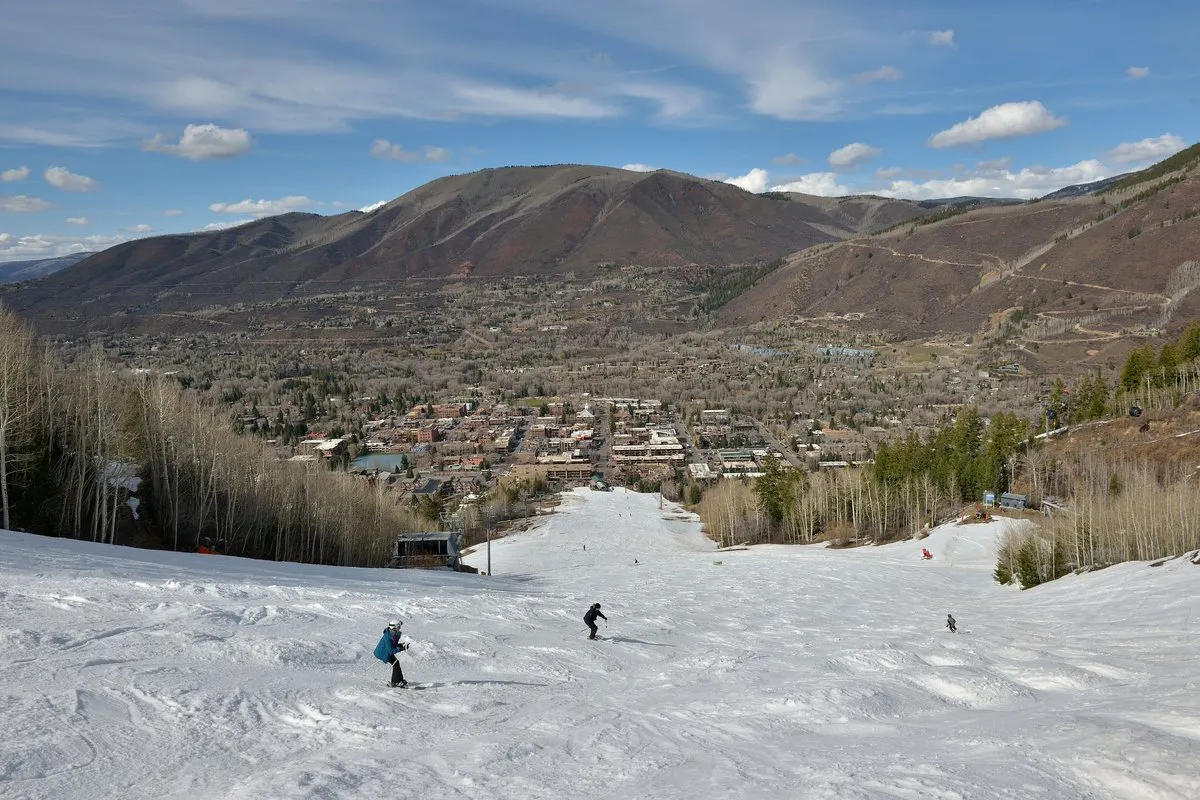
Aspen began as a silver camp, went quiet for half a century and was reinvented after the war as a ski town with a conscience: music, ideas and a mountain that rises straight out of Main Street. A long weekend in Aspen, from the gondola to the J-Bar.
In this story · 6 sections
Aspen sits high in the Rocky Mountains of Colorado, along the Roaring Fork River, a little west of the Continental Divide. It is a small place – 7,004 people at the 2020 census – yet few mountain towns carry as much weight. Prime residential property here is the most expensive of any ski resort in the world per square foot, according to a study of 44 resorts, and the town is home to three institutions of international standing: the Aspen Music Festival and School, the Aspen Institute and the Aspen Center for Physics. Few of the other destinations we cover pack quite so much history into so few streets.
This is a plan for three winter days: one for the town, one for the mountain and one for the valley that holds Colorado's most photographed view.
01Day one: the silver town
Aspen was founded in 1879 by miners who ignored the governor's pleas to turn back. First called Ute City, it was renamed for the aspen trees around it, incorporated in 1881 and, in its peak years of 1891 and 1892, outproduced Leadville as the most productive silver-mining district in the United States. By 1893 it had banks, a hospital, two theatres, an opera house and electric light. Then the Panic of 1893 collapsed the silver market, the mines closed within weeks, and by 1930 only 705 residents remained. Locals still call the decades that followed "the quiet years".
The boom left a remarkable core of brick buildings. Start on Mill Street, where the Wheeler Opera House and the Collins Block are both on the National Register of Historic Places, then walk two blocks east to the Pitkin County Courthouse. The grid is compact and flat, and every street ends in mountains.
02The Hotel Jerome and the J-Bar
At the corner of Main and Mill stands the Hotel Jerome, built in 1889 by Jerome B. Wheeler, then co-owner of Macy's, who wanted Aspen to have a hotel to equal the grand houses of Europe. It was one of the first buildings west of the Mississippi with full electric lighting, and the only hotel in town to stay open through the quiet years, when a former bartender and his son ran it as Aspen's social centre. It has been on the National Register since 1986 and is operated today by Auberge Collection.
End the day in the J-Bar, in the west storefront. During Prohibition it invented a spiked drink called the Aspen Crud, later adopted by soldiers of the Tenth Mountain Division who trained nearby. After the war Gary Cooper and John Wayne stayed here, and Hunter S. Thompson used the bar as his office; his memorial service was held in the ballroom.
03Day two: Aspen Mountain from Main Street
The ski town was born after the war. Friedl Pfeifer, an Austrian veteran of the Tenth Mountain Division, joined the industrialist Walter Paepcke and his wife Elizabeth, and the Aspen Skiing Company was founded in 1946. Lift-1 opened on 14 December that year as the longest chairlift in the world, and in 1950 Aspen hosted the FIS World Championships – the first held outside Europe.
Aspen Mountain, still called Ajax by locals, is the oldest of the four ski areas run by the company and the one that makes the town unique: the Silver Queen Gondola, installed in 1986, rises from Gondola Plaza in the heart of downtown, and the Little Nell run brings you back into the streets. It is not a mountain for beginners. There are no green runs at all, about a quarter of the terrain is rated expert, and novices are sent to Snowmass or Buttermilk. The season normally runs from late November to early April, and old mine workings from the silver boom are still visible among the trees.
04Music, ideas and a Saarinen tent
Paepcke's Aspen was meant to feed the mind as well as the legs. In 1949 he brought the Goethe Bicentennial Convocation to town, held in a tent designed by Eero Saarinen, and out of that summer grew the Aspen Music Festival and School and the Aspen Institute. Later the town drew a different crowd: Hunter S. Thompson ran, unsuccessfully, for county sheriff, and John Denver wrote two songs about Aspen after settling here.
05Day three: the Maroon Bells
South-west of town, Maroon Peak and North Maroon Peak rise side by side above Maroon Lake. Both are fourteeners – peaks above 14,000 feet – and the view of them from the Maroon Creek valley is among the most photographed in the state. Their colour comes from Maroon Formation mudstone, which also makes the rock notoriously loose; a Forest Service sign warns climbers of rock that "kills without warning". The lake itself sits in a basin carved by Ice Age glaciers and dammed by rockfall.
Around 300,000 people visit every season. From mid-June to the first weekend of October, private cars are largely barred and a bus runs every 20 minutes from Aspen Highlands to Maroon Lake. In winter the road closes to traffic, so plan a summer return for the classic view – or see the Bells from the slopes of Aspen Highlands.
06How to plan it
Book early for the holidays, when the town is at its fullest, and choose your base by what you ski: downtown for Ajax, Snowmass for mixed groups. For more trips with a story, see the guides on Metro Mode, our list of hotels worth a single night and the Metro Mode camera for reading a city as you walk it.