Bath has been a spa since the Romans built a temple over its hot springs around AD 60. In the 18th century it became Georgian England's most fashionable resort, built in honey-coloured Bath stone. Here is the guide to the Roman Baths, the Royal Crescent, the Circus and Pulteney Bridge.
In this story · 5 sections
Bath lies in Somerset, about 156 kilometres west of London and 18 kilometres south-east of Bristol. The whole city has been a UNESCO World Heritage Site since 1987, and in 2021 it was also inscribed as one of the Great Spa Towns of Europe. Built almost entirely of creamy-gold Bath stone, it combines a Roman bathing complex with some of the finest Georgian architecture in Britain.
2 places
Bath in dates- c. AD 60
- Romans found Aquae Sulis
- 1754
- Foundation stone of the Circus
- 1767–1774
- Royal Crescent built
- 1987
- UNESCO World Heritage Site
- 2006
- Thermae Bath Spa opens
Aquae Sulis – the Roman Baths and Britain's hot springs
The Romans called the town Aquae Sulis, “the waters of Sulis”, and made it a spa around AD 60. A temple was built in AD 60–70, and the bathing complex grew over the following 300 years; Sulis was identified with the Roman goddess Minerva. Rain falling on the Mendip Hills seeps deep into the limestone, is heated underground and rises at 46 °C, at around 1.17 million litres a day. By several definitions these are the only hot springs in the United Kingdom. Next door, Bath Abbey dates from the early 16th century; King Edgar was crowned in an earlier abbey on the site in 973.
Beau Nash, Ralph Allen and the Georgian boom
In the 18th century Bath became the most fashionable resort in England. The population grew from 2,000 in 1700 to 28,000 in 1801. Richard “Beau” Nash ran the city's social life until his death in 1761, and Ralph Allen, who owned the quarries at Combe Down and Bathampton Down, supplied the Bath stone and became mayor in 1742. Thomas Baldwin's Pump Room was the heart of the Georgian city, with the Assembly Rooms at the centre of society. Jane Austen lived in Bath from 1801 to 1806 at four different addresses – and never much liked it.
The Circus and the Royal Crescent
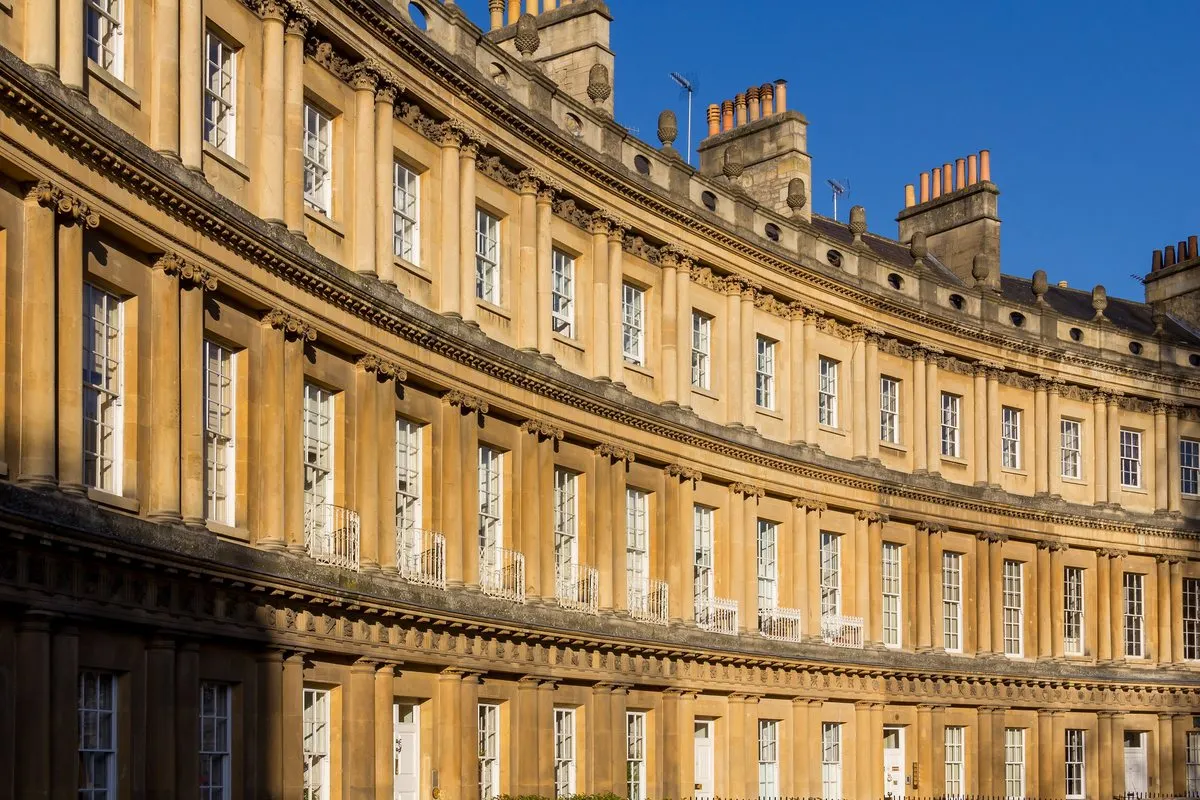
John Wood the Elder laid out many of Bath's streets and squares. He laid the foundation stone of the Circus on 18 May 1754 and died five days later; his son, John Wood the Younger, continued his work. Brock Street leads from the Circus to the Younger's masterpiece, the Royal Crescent, built between 1767 and 1774: 30 terraced houses in a 150-metre crescent with 114 Ionic columns on the first floor, looking over a lawn and a ha-ha towards Royal Victoria Park. The Crescent is Grade I listed. No. 1 is a museum run by the Bath Preservation Trust, and Nos. 15 and 16 are The Royal Crescent Hotel. William Wilberforce stayed at No. 2 in 1798.
Pulteney Bridge and Thermae Bath Spa
Pulteney Bridge, designed by Robert Adam around 1770, is one of the few bridges in Europe lined with shops. To bathe in the springs today, visitors go to Thermae Bath Spa, which opened on 7 August 2006.
How to spend a day in Bath
Start at the Roman Baths and the Abbey, cross Pulteney Bridge, then walk up to the Circus and along Brock Street to the Royal Crescent and No. 1. End the day at Thermae Bath Spa. Bath is an easy day trip from London; start there with VERA PI's London guide, read Metro Mode's London guide (in Swedish), and find more city guides among metromode.co's destinations.
Roman Baths
The Roman spa of Aquae Sulis
Roman bathing complex and temple beside Bath Abbey.
Abbey Churchyard, Bath BA1
Royal Crescent
John Wood the Younger's crescent
30 houses and 114 Ionic columns; No. 1 is a museum.
- Built
- 1767–1774
- Listed
- Grade I
Royal Crescent, Bath BA1