In this story · 7 sections
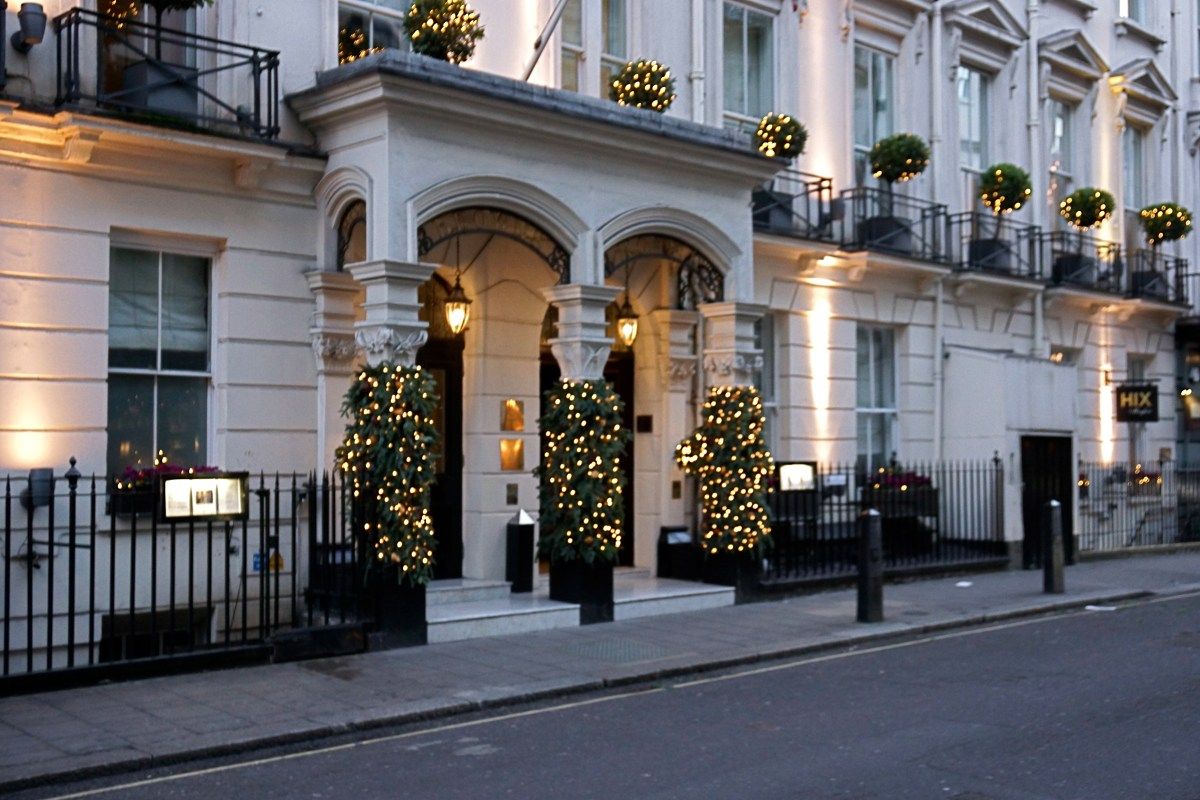
At 33 Albemarle Street, behind an unassuming Mayfair façade, stands the hotel generally credited with having opened London's hotel trade. Brown's Hotel is London's first hotel, opening its doors on Albemarle Street in 1837, founded by James Brown, once valet to Lord Byron, and his wife Sarah Willis, who had served Lady Byron as her maid. Over nearly two centuries, eleven Georgian townhouses have been folded into one address without the hotel ever changing its name, being rebuilt or moving, a claim few London hotels can match. Rocco Forte Hotels has owned Brown's since it joined the group on 3 July 2003. There are 117 rooms and suites, two restaurants, a cocktail bar named after a photographer of Swinging London, and a spa tucked below street level. The MICHELIN Guide recognises the hotel with Two MICHELIN Keys, its mark for exceptional character and service.
Brown's Hotel, a Rocco Forte Hotel
Hotel · Mayfair
© OpenStreetMap contributors · OpenFreeMap
- Address
- 33 Albemarle Street, Mayfair, London W1S 4BP
- Opened
- 1837
- Rooms
- 117
- Restaurants
- Charlie's, The Drawing Room
- Spa
- The Spa at Brown's
- Telephone
- +44 20 7493 6020
- Website
- roccofortehotels.com
- MICHELIN Guide
- Two MICHELIN Keys
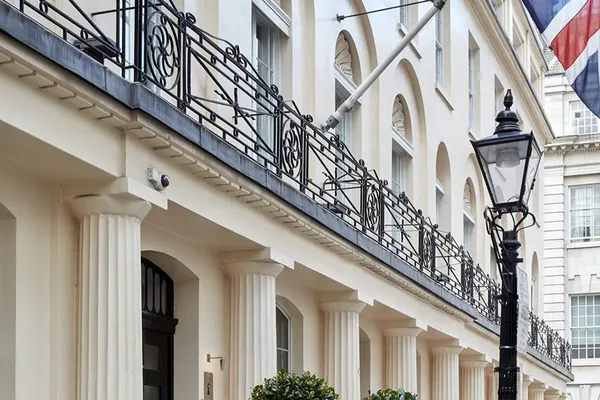
Brown's Hotel occupies eleven interlinked Georgian townhouses on Albemarle Street, Mayfair, and has operated continuously since 1837 under one name.
01The house
James Brown's ambition in 1837 was, on paper, modest: a genteel inn for discerning travellers, built from a leased townhouse on Dover Street. With help from Lady Byron, Brown and Sarah Willis went on to acquire further Dover Street houses to grow the business into something larger than either had first planned.
The hotel changed hands in 1859, sold to James John Ford, who already owned Ford's Hotel in Manchester Square. Three decades later, in 1889, the Ford family bought the neighbouring St George's Hotel and joined the two buildings together, adding a fifth floor to both; two mosaic panels in blue and gold, bearing the names of Brown's and St George's, were set into the new Albemarle Street front and remain there today. A further expansion in 1905 brought three more Albemarle Street houses into the fold, making room for new public rooms and a proper dining room. Eleven Georgian townhouses now make up the hotel, merged into one without ever straightening the façade. When Rocco Forte Hotels took over in 2003, the refurbishment that followed carried the signature of designer Olga Polizzi, who kept the materials rich and gave each room its own character rather than a house template.
The best-known guest story belongs to Rudyard Kipling, who married in January 1892 and spent his honeymoon in a first-floor suite overlooking Albemarle Street with his wife Caroline. He returned to Brown's for the rest of his life, describing it in a 1907 letter as his 'faithful, beloved, warm, affectionate' hotel. That suite is now folded into what the hotel calls the Kipling Suite.
02Rooms and suites
Rooms are organised in ascending tiers. Executive Rooms run to 30 square metres over the inner courtyard, Superior Rooms to 35 square metres, and Deluxe Rooms to 45 square metres with views over Albemarle or Dover Street. Families are offered an 80-square-metre Interconnecting Family Room or a 105-square-metre Two-Bedroom Family Suite, while Junior and Studio Suites run from 50 to 52 square metres, decorated in slate and grey with bursts of burgundy, ochre, moss green and azure.
Insider tipCharlie's, the Donovan Bar and The Spa at Brown's all keep published hours; smart-casual dress is recommended throughout the hotel.
At the top sit six Forte Suites, each built around its own story. The Dover Suite has floor-to-ceiling windows onto its namesake street; the Clara Dow Suite honours the English soprano photographed on Dover Street in 1906; the Nightingale Suite takes its mood from the 1939 ballad 'A Nightingale Sang in Berkeley Square'; the three-bedroom Grand Suite carries interiors by Sir Paul Smith; and the two-bedroom Clementi Suite is named for the pianist Muzio Clementi. The largest and most storied is the 155-square-metre Kipling Suite, built around the room where Rudyard Kipling once stayed.
03Where to eat
Charlie's, named after Lord Charles Forte, is the hotel's main dining room: a warm space of velvet banquettes serving modern British cooking from a menu overseen by Adam Byatt, a Michelin-starred chef whose own grandfather once worked at Brown's. Expect venison en croûte and a roast beef trolley carved tableside, alongside seasonal plates such as Cornish crab salad, with Sunday service turned over to jazz.
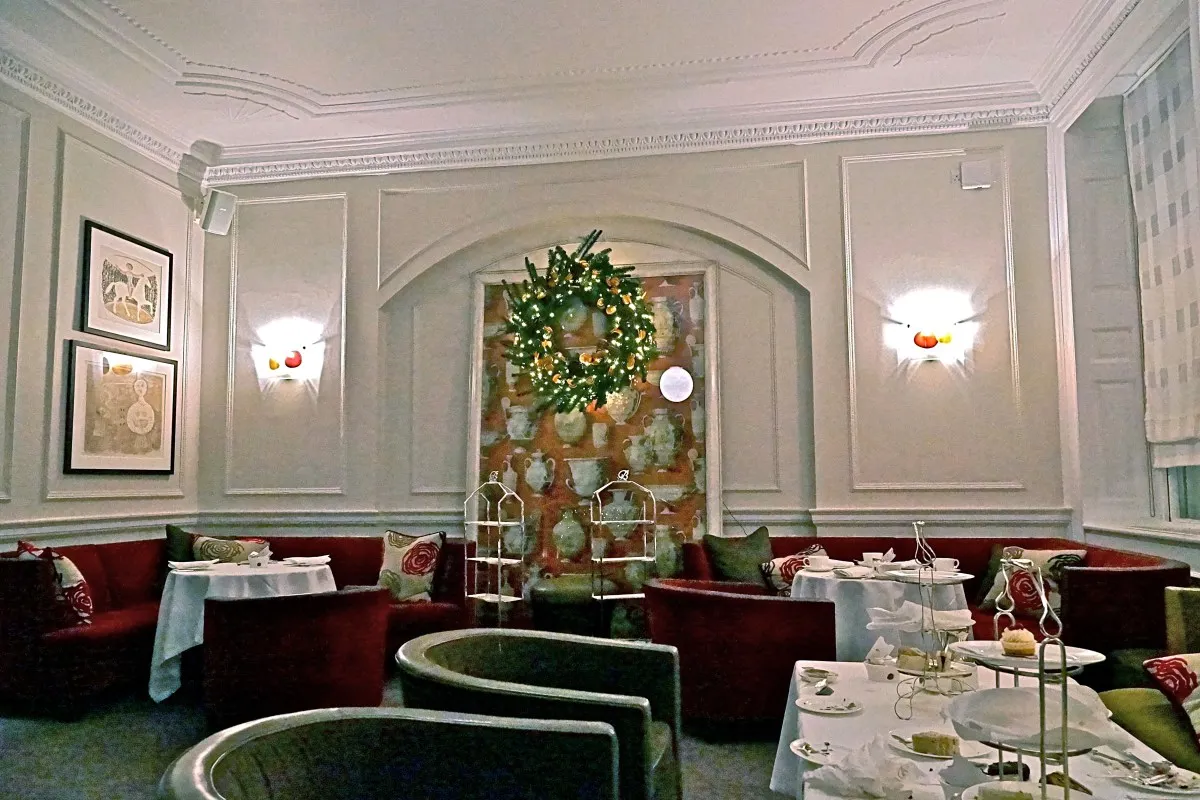
The Drawing Room carries the hotel's best-known ritual: afternoon tea in a room where, by the hotel's own account, Queen Victoria liked to take hers. Midweek, the same room becomes an intimate venue for live jazz after dark.
04The bar
Downstairs, the Donovan Bar is named for Terence Donovan, the fashion photographer whose portraits of 1960s London still define its character. The cocktail list is overseen by Maestro Salvatore Calabrese together with Director of Mixology Federico Pavan, built around revived classics and signature drinks such as the Pecan Old Fashioned and the Pear Gibson, best enjoyed from the bar's self-styled Naughty Corner. Food comes as seasonal small plates and tapas from Fernando Montejo Moraga and Adam Byatt, and the bar hosts rotating chef residencies that have included Andrew Wong of the two-Michelin-starred A.Wong, Tom Kitchin and seafood specialist Mitch Tonks.
05Spa and wellbeing
The Spa at Brown's keeps a low profile: three treatment rooms and a reception area, built around facials, massages, body treatments and rituals using Irene Forte Skincare, the organic line developed from ingredients grown at Rocco Forte's Verdura Resort farm in Sicily. A Technogym-equipped gym stays open around the clock, useful for guests running on international time, while the spa itself keeps more sociable hours — Monday to Friday 10am to 8pm and weekends 10am to 6pm, as published in October 2026.
06The neighbourhood
Brown's sits inside Mayfair's quietest grid, moments from the Bond Street boutiques, Dover Street Market, the Royal Academy of Arts and a run of independent galleries. Albemarle Street itself carries literary weight: it was home to John Murray's publishing house, frequented by Byron and Walter Scott, and to the Albemarle Club, where an incident that led to Oscar Wilde's libel suit and eventual imprisonment took place. A short walk away, the Royal Institution still keeps Michael Faraday's legacy alive, and the gates of Green Park are a few minutes further on.
07Making the most of a stay
Guests with half an eye on history should ask about the Kipling connection, or look for the blue-and-gold Victorian mosaic panels still set into the Albemarle Street front since 1889. Charlie's caviar and Champagne menu and its Sunday roast are worth timing a visit around, as are the Donovan Bar's seasonal chef residencies and its Jazz Sundays. Each autumn and winter, Brown's also tracks what it calls the Season, its own name for the capital's run of cultural and sporting fixtures, with a dedicated calendar of events for guests.
Don't miss
Don't miss
- 01
Afternoon tea in The Drawing Room, where Queen Victoria is said to have taken hers
- 02
Dinner at Charlie's, Adam Byatt's modern British menu with tableside carving
- 03
A cocktail in the Donovan Bar's Naughty Corner
- 04
The Kipling Suite, built around the room where Rudyard Kipling once stayed
- 05
A treatment at The Spa at Brown's using Irene Forte Skincare