 The Metro Mode 55
In this story · 6 sections
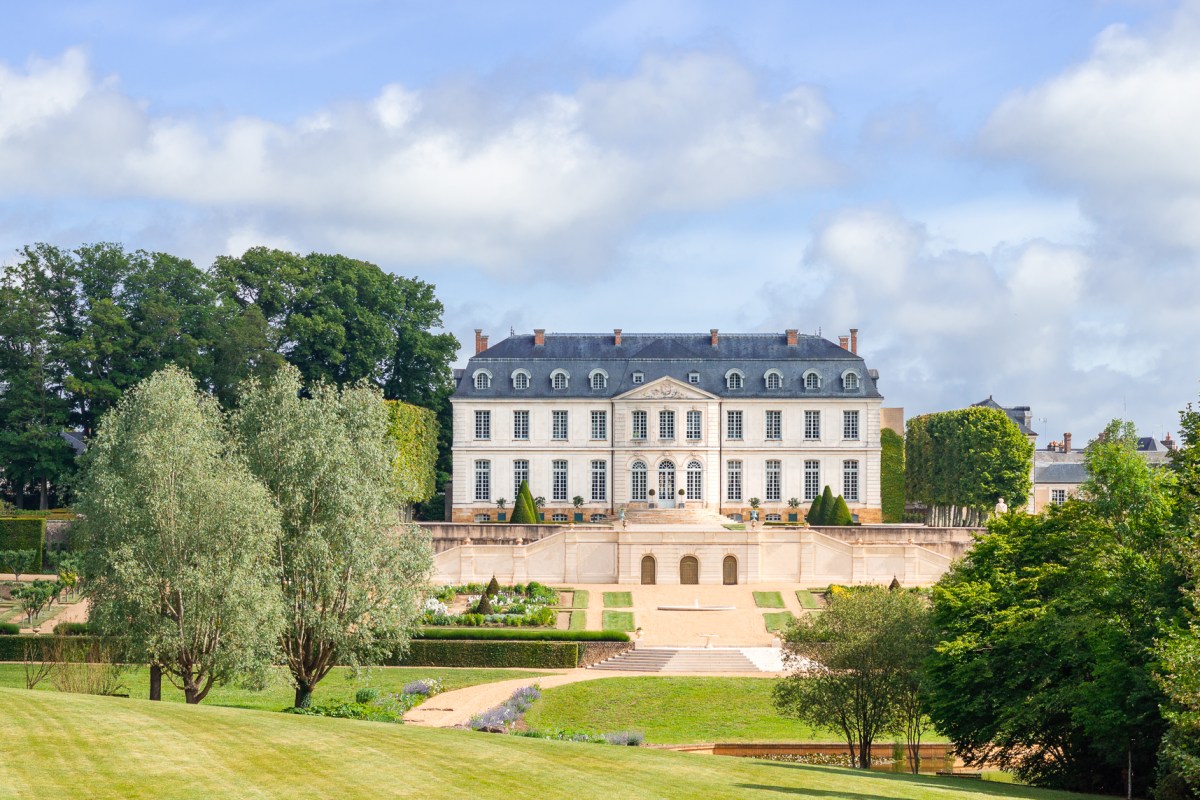
In the northern Loire Valley, in a village of the Sarthe that most travellers drive past, a pale limestone palace stands at the end of its own cour d'honneur. Château du Grand-Lucé was built between 1760 and 1764 as the summer house of Baron Jacques Pineau de Viennay, a confidant of Louis XV, and the French state still counts it among the finest neoclassical buildings in the country. Today it is a hotel of only 19 rooms and suites, inside 45,000 square feet of creamy tuffeau stone and 80 acres enclosed by the original medieval wall. Formal gardens laid out on a north-south axis, an orangerie, a potager, a lake and an old white-oak forest all belong to the house. Paris is a 55-minute train ride away. The MICHELIN Guide awards Château du Grand-Lucé two Keys, for an exceptional stay, and singles out the rare wall paintings by Jean-Baptiste Pillement that survive in the Baron's drawing room.
This is a house to visit for its architecture as much as its comfort – and to stay in long enough to walk all of it.
Château du Grand-Lucé
Hotel · Sarthe, Loire Valley
© OpenStreetMap contributors · OpenFreeMap
- Address
- 7 place du Château, 72150 Le Grand-Lucé, France
- Opened
- As a hotel in 2019 (château built 1760–1764)
- Rooms
- 19 rooms and suites
- Restaurants
- Le Lucé; bar Jack Pine's
- Spa
- Spa and fitness centre; heated outdoor pool (seasonal)
- Telephone
- +33 2 55 48 40 40
- Website
- chateaugrandluce.com
- MICHELIN Guide
- Two Keys
The Baron de Lucé's summer palace, now a hotel: Pillement's chinoiserie in the Salon Chinois, Le Lucé and its potager, Jack Pine's bar in the old chapel, a heated pool and 80 walled acres.
01The house
The estate came into the Pineau de Viennay family in 1718, when the second baron bought Lucé with his wife's fortune: an old walled castle, ponds, farms and mills. His son, the third baron, rose to administer the whole of eastern France and had no use for a fortress. He engaged Mathieu de Bayeux – the engineer behind the Pont Wilson, the oldest bridge in Tours – to design a modern palace in the spirit of the Enlightenment. Work began in 1760 and the château and its outbuildings were finished by 1764. According to the hotel, Louis XV sent statues for the grounds as a housewarming gift.
The Baron's daughter, Louise, inherited the house and kept a salon for the writers and artists of the age; the hotel names Diderot, Voltaire and Rousseau among her guests. During the First World War the château served as a hospital for wounded British officers, and in the Second it sheltered paintings from the Louvre in a secret cache beneath the stage of the theatre built in the old stables. The French state later restored the gardens and used the buildings as tourism offices before selling the château in 2003 to the American interior designer Timothy Corrigan, who restored it as his private home. New owners took over in 2017, and the house reopened as a hotel in 2019.
02Rooms and suites
The 19 rooms and suites are cut from the original state rooms rather than added on, so no two are the same. Floors are limestone or original French oak laid in point de Hongrie, walls keep their boiseries, and the fabrics run from Pierre Frey archive prints and Zuber damask to Christian Lacroix and Jean-Paul Gaultier. Art spans three centuries, from eighteenth-century romantic canvases to French abstract oils. Bathrooms are marble, several with clawfoot tubs, and stocked with Diptyque.
Insider tipBook the Baron's Suite for the Salon Chinois – its Pillement walls have a counterpart only at the Petit Trianon.
Room choice here is mostly a choice of view. Rooms on the central north-south axis look down over the cour d'honneur to the entrance gates; others face the formal gardens, with casement windows almost as tall as the 15-foot ceilings. One garden-view room is hung with a Pierre Frey pattern recalling the Montgolfier brothers' balloon flights of 1783; a top-floor room is dressed in Jean-Baptiste Huet's toile of Diana the Huntress. The Baron's Suite has ceilings of 17 feet, Versailles-pattern oak floors, its own library and a door onto the West Garden – and it opens into the Salon Chinois. For families or longer stays, two apartments come with private kitchens and living rooms.
03The Salon Chinois
The Baron's private drawing room is the one room not to miss. Its canvas-covered walls were painted with chinoiserie scenes of an imagined Asia by Jean-Baptiste Pillement (1728–1808). The hotel notes that Pillement wall paintings of this kind survive in only two places: here, and at the Petit Trianon, Marie Antoinette's retreat at Versailles. Smaller works by him hang in the Louvre and the National Gallery of Art in Washington. Sitting among them with a morning coffee is not something a museum allows.
04Where to eat: Le Lucé and Jack Pine's
Le Lucé, the hotel restaurant, sits in a salon beside the garden, reached through the Galerie de Chasse, and its prix-fixe menu can also be served in the château's original formal dining room. The cooking is modern and French and follows the seasons of the house's own organic potager, where haricots verts, artichokes, many kinds of tomato, herbs, stone fruit, apples and pears are grown for the kitchen. The MICHELIN Guide names Maxime Thomas as chef. Wines come from the château's own collection.
Next door, the bar occupies the Baron's former private chapel. It is called Jack Pine's – the Baron's name in English, a nod to the French-American partnership behind the hotel – and pours house cocktails infused with herbs from the potager. Its bistro menu travels anywhere in the house: to a window seat in the Tea Salon, the Grand Salon overlooking the formal gardens, or a lounger by the pool. In-room dining runs 24 hours, and picnics, box lunches and dinners in the forest can be arranged.
05Gardens, pool and spa
The gardens step down from the château in the manner of Versailles: clipped boxwood, topiary and a central allée nearest the house, growing looser towards the woods. On a lower level, sheltered by walls and catching the most sun, the Jardin Exotique holds the swimming pool – heated, outdoor and seasonal – alongside working greenhouses and the orangerie, where citrus trees spend the winter. Beyond the potager and orchards lie meadows, a lake and the white-oak forest with the circular clearing drawn in 1760, where a statue of Proserpine stands. The former laundry house is now the spa and fitness centre, with garden views and its own courtyard; the old stables are a ballroom with 12-foot windows.
06Making the most of a stay
Take the train from Paris and give the house at least two nights: one to see it, one to use it. Borrow a bicycle for the forest, ask for a picnic of local cheese and pastries from the village, and book a massage in the spa. If the Salon Chinois is the reason you came, book the Baron's Suite, which opens into it; eat at least once in the old dining room, and finish with a cognac in the formal garden after dark, when there are no city lights to compete with the stars. Check-in is from 15.00 and check-out by 11.00.
Don't miss
Don't miss
- 01
The Baron's Suite and Pillement's chinoiserie in the Salon Chinois
- 02
Dinner at Le Lucé, with vegetables from the château's potager
- 03
A herb-infused cocktail in Jack Pine's, the Baron's former chapel
- 04
A walk to the statue of Proserpine in the white-oak forest
- 05
A swim in the heated pool of the Jardin Exotique in summer