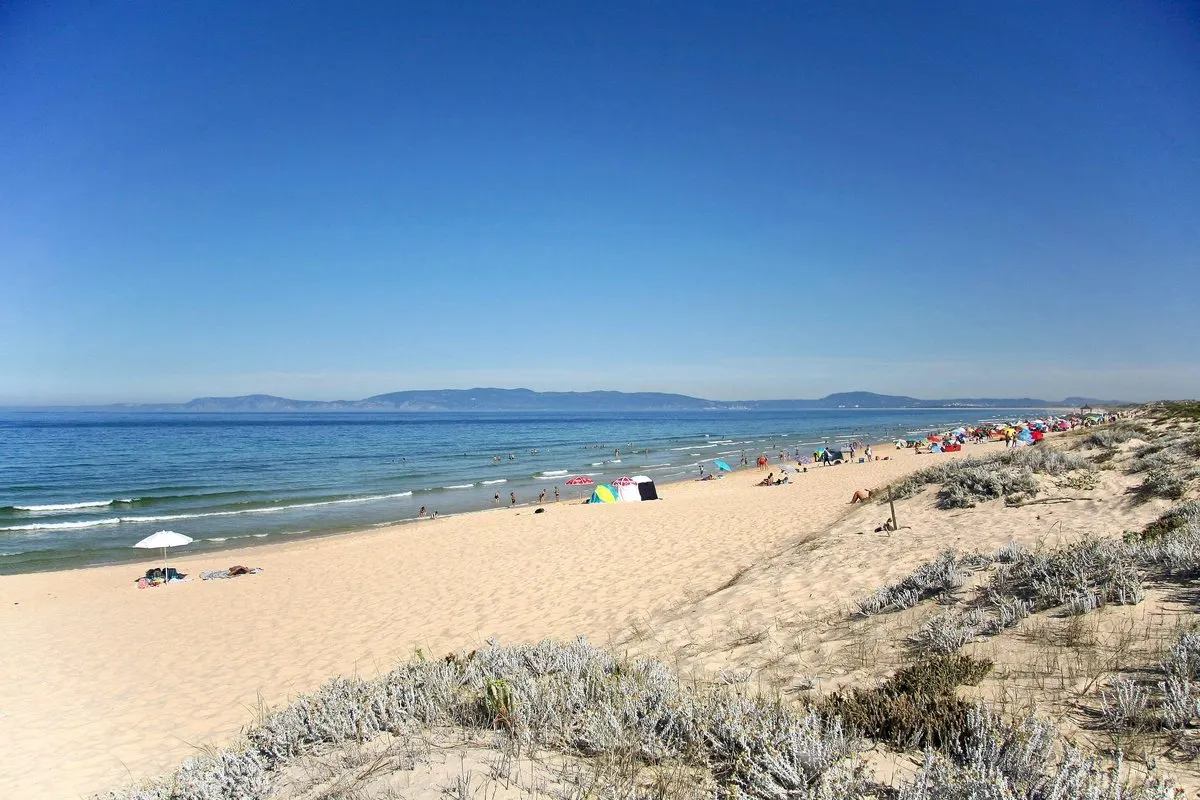
An hour or so south of Lisbon, the Alentejo coast unrolls in pine forest, rice paddies and dunes. Comporta has drawn designers and quiet money for decades without losing its barefoot simplicity. How to enjoy it, from the beaches to the stilt pier of Carrasqueira.
In this story · 5 sections
Comporta is less a place than a mood. The name belongs to a small village on Portugal's Alentejo coast, but it has come to describe a whole stretch of shoreline in the municipalities of Alcácer do Sal and Grândola: dozens of kilometres of pale sand and dunes, backed by umbrella pines, rice paddies and salt marsh, with a handful of whitewashed villages in between. It has been called the Hamptons of Europe, which captures the money but not the manner. Here the luxury is space, silence and a barefoot simplicity that its regulars guard closely.
Cais Palafita da Carrasqueira
Landmark · Carrasqueira
- Address
- Carrasqueira, 7580 Comporta, Alcácer do Sal
- Region
- Alentejo coast; Alcácer do Sal and Grândola
- From Lisbon
- About an hour by car
- Beaches
- Comporta, Carvalhal, Pego
- Don't miss
- Carrasqueira stilt pier at sunset
- Best months
- June and September
A maze of wooden walkways on stilts over the mudflats, built by fishermen to reach their boats at any tide.
01From rice estate to refuge
Comporta's character comes from its history as a single agricultural estate. The Herdade da Comporta, formally constituted in 1836 with roots going back to the twelfth century, once owned most of the land and villages of the area, which lived from salt works, fishing and above all rice. In 1991 the estate began to develop part of its land for a discreet kind of tourism, centred on design and sustainability, while continuing to farm and to look after large areas of protected nature. That stewardship is why the coast still looks the way it does.
Over the years the area has attracted a community of designers and artists, among them Christian Louboutin and the interior designer Pierre Yovanovitch, and given its name to the Comporta style: traditional Alentejo architecture, thatch and timber, natural materials and a relaxed, bohemian sensibility.
02The beaches
The Atlantic coast here is one long beach, interrupted only by the paths that cross the dunes. Praia da Comporta, closest to the village, has wooden boardwalks and a couple of beach restaurants serving grilled fish and cold vinho verde. Further south, Praia do Carvalhal and Praia do Pego are just as beautiful, and between and beyond them you can walk for an hour and see almost no one. The water is fresher than the Mediterranean and the surf can be strong; swim where there are lifeguards.
Insider tipBest at sunset; the planks are uneven, so watch your step.
03Rice fields, storks and Carrasqueira
Inland, the landscape is as memorable as the coast. Rice is still grown in the flat paddies beside the road, and white storks nest on poles and chimneys across the area. On the edge of the Sado estuary, the fishing village of Carrasqueira has one of the most photographed sights in Portugal: a palafitic pier, a maze of wooden walkways on stilts built over the mudflats by fishermen to reach their boats at any tide. Go at sunset, when the light turns the water pink.
04The Sado estuary and Tróia
To the north, the Sado estuary is a nature reserve and home to a resident population of bottlenose dolphins; boat trips leave from Setúbal on the opposite shore. The Tróia peninsula, between the ocean and the river, holds the remains of a Roman fish-salting town. A car ferry links Tróia with Setúbal, a scenic alternative to the motorway when driving from Lisbon.
05Where to stay and eat
Accommodation in Comporta is mostly in small design hotels and private villas set in the pines and rice fields; book early for summer. The villages of Comporta, Carvalhal and Brejos have simple restaurants serving the region's specialities, above all arroz de marisco, a soupy rice with seafood, and grilled fish. The village of Grândola, inland, gave its name to the song that served as a signal for the Carnation Revolution of 25 April 1974.
Combine Comporta with a few days in the capital: read our Lisbon guide (in Swedish), find our Lisbon neighbourhood guides among the Metro Mode destinations, and browse our travel section in English.