In this story · 5 sections
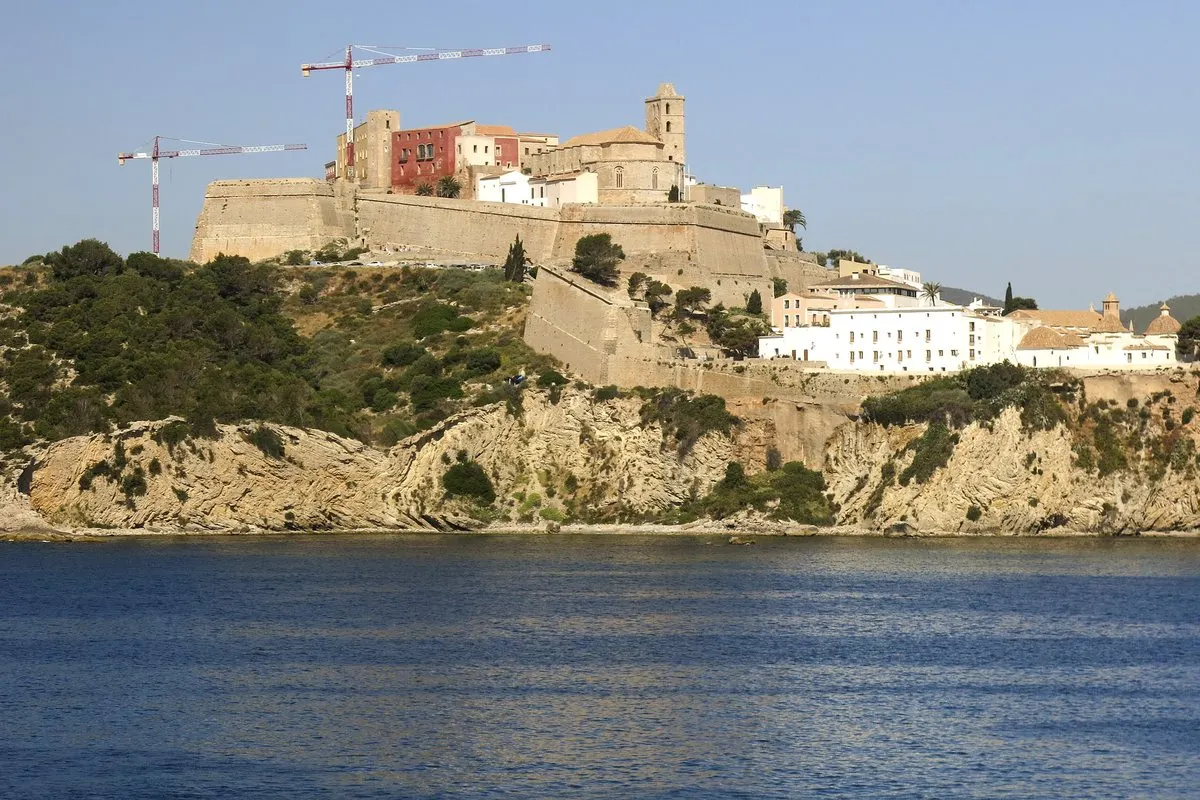
Arrive in Ibiza by sea and the first thing you see is not a club or a beach but a fortress: a hill wrapped in massive stone walls, crowned by a cathedral tower, with white houses tumbling down towards the harbour. This is Dalt Vila, the Upper Town of Ibiza's capital, known locally as Eivissa or simply Vila. It is one of the best-preserved fortified towns in the Mediterranean, and on a quiet morning it feels a world away from the island's reputation.
Portal de ses Taules
Historic gate · Dalt Vila
© OpenStreetMap contributors · OpenFreeMap
- Address
- Portal de ses Taules, 07800 Eivissa
- Founded
- Phoenician settlement, traditionally 654 BC
- Walls
- Renaissance fortifications, 16th century
- UNESCO
- World Heritage site since 1999
- Highlights
- Portal de ses Taules, cathedral, bastions, Puig des Molins
- Best time
- Early morning and sunset
The ceremonial entrance to the walled upper town, reached by a ramp from the harbour district of La Marina.
01Twenty-seven centuries of history
The Phoenicians founded a settlement here, traditionally dated to 654 BC, and by the fifth century BC the city had several thousand inhabitants. It later passed to Rome, to the Vandals and Byzantines, and in the tenth century to al-Andalus, before forces of the Crown of Aragon conquered the island in August 1235. Each left traces, but the most visible legacy is military: the great circuit of Renaissance walls built in the sixteenth century to defend the town against attack from the sea.
UNESCO inscribed Ibiza as a World Heritage site in December 1999, recognising both its biodiversity and its culture. The listing covers the fortified upper town, the Phoenician-Punic necropolis of Puig des Molins and the meadows of Posidonia seagrass that keep the waters around the island so clear.
02Through the Portal de ses Taules
Enter as visitors always have, by the main gate, the Portal de ses Taules, reached by a ramp and a former drawbridge from the harbour district of La Marina. Inside, a covered passage opens onto a parade ground, and from there cobbled streets wind upwards between whitewashed houses, small palaces and convents. The climb is steep but short, and every turn brings a new view over the rooftops to the sea.
Insider tipThe old town is steep and cobbled; wear flat shoes.
Walk along the bastions themselves for the finest panoramas. On one side lies the harbour and the yachts; on the other, the coast stretching towards the island of Formentera on a clear day. The walls are at their most beautiful at sunset, when the stone turns gold.
03The cathedral and the summit
At the top of Dalt Vila stands the cathedral of Santa Maria d'Eivissa, Gothic in origin and remodelled in later centuries, with a sober bell tower that serves as a landmark for sailors. The square in front of it is the highest point of the old town, with views in every direction. Nearby, the old castle and the governor's residence complete the summit.
On the way down, look out for the contemporary art museum housed in the old fortifications, which shows work by the many artists drawn to Ibiza in the twentieth century.
04Puig des Molins: the city of the dead
Just outside the walls, on a hillside of olive trees, the necropolis of Puig des Molins is one of the most important Phoenician and Punic burial sites anywhere. Thousands of tombs were cut into the rock, and the museum on the site displays finds from them, including terracotta figures and jewellery. It is quiet, shaded and rarely crowded, and it gives depth to everything you have seen above.
05Sa Penya, La Marina and dinner
Below the walls, the old fishermen's quarter of Sa Penya clings to the rocks, and the streets of La Marina around the harbour fill with boutiques and terraces in the evening. Dalt Vila itself has several restaurants with tables in its squares, the most atmospheric place on the island for a late dinner under the walls.
For the quieter neighbouring island, read our Formentera guide among the Metro Mode destinations, and browse our travel section in English. If Spain tempts you for longer, see why Swedes are buying everyday homes in Spain (in Swedish).