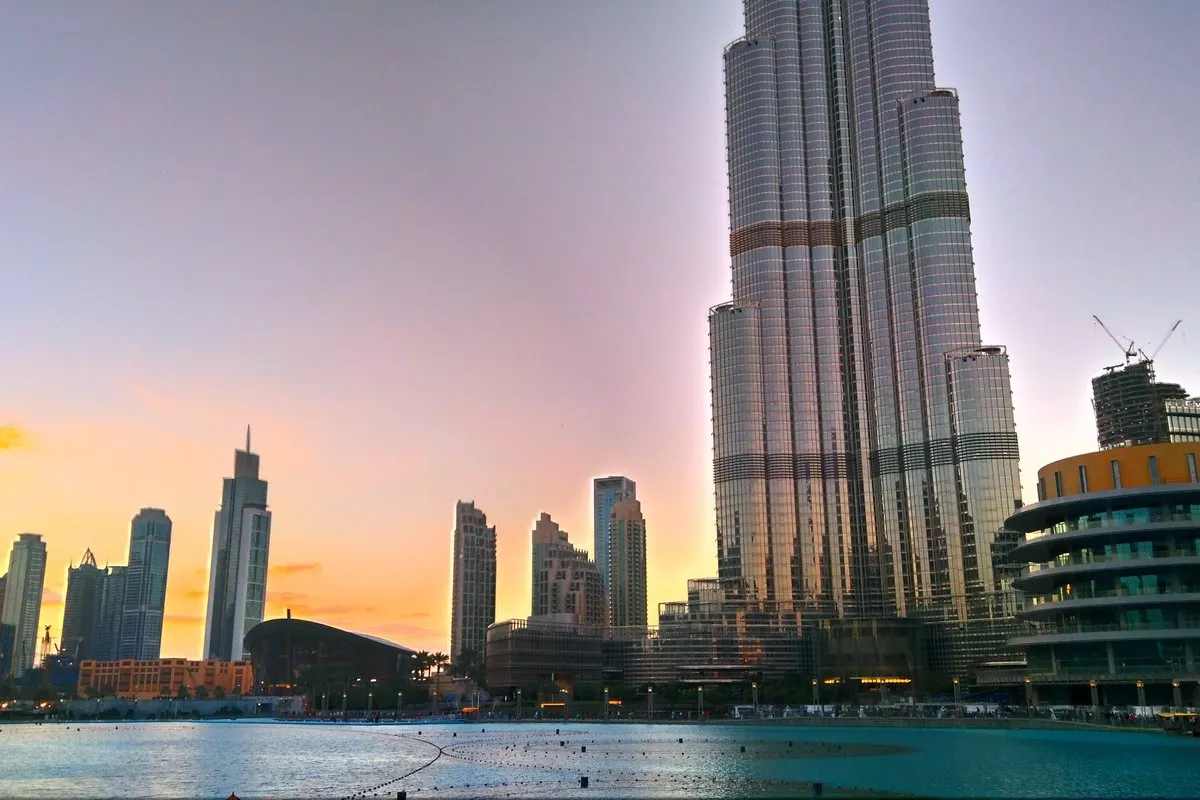
Twenty-five years ago this stretch of Sheikh Zayed Road was called Umm Al Tarif. Today it holds the tallest structure ever built, the world's largest choreographed fountain and a 2,000-seat opera house. A day and a night in Downtown Dubai.
In this story · 5 sections
Downtown Dubai is a large mixed-use district developed by Emaar along Sheikh Zayed Road, between Business Bay and the financial centre. Before 2000 the area was called Umm Al Tarif; today it holds some of the city's best-known landmarks: the Burj Khalifa, the Dubai Mall and the Dubai Fountain. Low-rise Arabic vernacular architecture shapes the so-called Old Town, while contemporary towers dominate the rest. It is the obvious place to begin a first visit to Dubai – and best experienced from late afternoon into the night.
01The Burj Khalifa
The centrepiece is the Burj Khalifa, designed by Skidmore, Owings & Merrill of Chicago – the firm behind the Sears Tower – with Adrian Smith as chief architect. At 829.8 metres it is the tallest structure ever built and has been the world's tallest building since its inauguration, overtaking Taipei 101. Construction began in 2004, the exterior was completed in October 2009 and the tower opened on 4 January 2010. Its Y-shaped floor plan draws on the region's Islamic architecture, and some of its steel was salvaged from the demolished Palace of the Republic in East Berlin.
Originally called Burj Dubai, it was renamed at its inauguration after Sheikh Khalifa bin Zayed Al Nahyan, the UAE president who arranged federal support when the developer struggled in the financial crisis. Its construction was also criticised over the treatment of the South Asian migrant workers who built it. The tower holds several other world records, including the elevator with the longest travel distance, and houses the Armani Hotel Dubai across 30 floors. Book observation-deck tickets in advance, ideally for sunset.
02The Dubai Mall and Souk Al Bahar
At the foot of the tower, the Dubai Mall, opened in 2008, is the second-largest shopping mall in the world by total area, with some 1,300 shops, an Olympic-size ice rink and an aquarium, and around 100 million visits a year. Its Fashion Avenue, opened in 2018, gathers more than 150 luxury brands. Across the lake, Souk Al Bahar is an Arabian-style market with more than 100 shops and over 20 restaurants, cafes and lounges facing the fountain.
03The Dubai Fountain
As the light fades, the Dubai Fountain takes over Burj Khalifa Lake. Designed by WET Design, the company behind the fountains at the Bellagio in Las Vegas, it is the world's largest choreographed fountain, illuminated by 6,600 lights and 25 coloured projectors, with jets that fire water into the air to music ranging from classical to Arabic and world music. It opened on 8 May 2009 and reopened in October 2025 after a renovation, with a second phase of works planned for 2026. Evening shows run every half hour; check the current schedule before you go. The best views are from the lake promenade and the terraces of Souk Al Bahar.
04A night at Dubai Opera
End the evening in the Opera District at Dubai Opera, a 2,000-seat performing arts centre designed by Janus Rostock of Atkins. Announced in 2012, it opened on 31 August 2016 with Plácido Domingo, and hydraulic lifts and seating wagons allow it to transform from theatre to concert hall to banquet hall. Its programme mixes opera, ballet, musicals and concerts; in 2017 it hosted the first BBC Proms Dubai, and the 2023–24 season drew a record 250,000 people.
05Planning
Visit between autumn and spring, when evenings outdoors are pleasant; walk Sheikh Mohammed bin Rashid Boulevard, a 3.5-kilometre strip of restaurants and cafes, between the sights. For more, see our destinations, the Metro Mode home page and our list of hotels worth a single night.