In 1766 a 26-year-old architect won a competition to design a new Edinburgh on the fields north of the polluted Nor Loch. The result, built between 1767 and around 1850, is the New Town: a Georgian grid of squares and broad streets named for king, queen and union. Here is its story.
In this story · 5 sections
The New Town is the Georgian heart of Edinburgh, built in stages between 1767 and around 1850 on the ridge north of the Old Town. Its best-known street, Princes Street, faces Edinburgh Castle across the valley of the former Nor Loch, now Princes Street Gardens. Behind it runs a grid of broad streets and squares lined with neo-classical houses. With the Old Town and the West End, the New Town has been a UNESCO World Heritage Site since 1995.
2 places
The New Town in dates- 1766
- James Craig wins the competition
- 1767
- Thistle Court, the first building
- 1772
- North Bridge built
- 1774
- Dundas House completed
- c. 1820
- Charlotte Square completed
- 1995
- UNESCO World Heritage Site
Why Edinburgh built a New Town
By the mid-18th century overcrowding inside the walls of the Old Town had reached breaking point, and the city feared losing its wealthy citizens to London. The Enlightenment had reached Edinburgh, and its professional and merchant classes wanted a modern city. Lord Provost George Drummond extended the burgh boundary to take in the fields north of the Nor Loch, a heavily polluted loch whose draining was not complete until 1817. The North Bridge was built in 1772, and the Mound grew from earth dug out for the new houses, reaching its present size in the 1830s.
James Craig's plan and the union of names
A design competition in January 1766 was won by 26-year-old James Craig. Following the contours of the land, he proposed a simple grid: a main street along the ridge linking two garden squares, with streets downhill to the north and south, minor streets between and mews for stables. The names celebrated the Hanoverian union. George Street was named after George III, Queen Street after his wife, and the squares St Andrew and St George after the patron saints of Scotland and England; Thistle Street and Rose Street stood for their national flowers. The king rejected St Giles Street for the southern street, since St Giles was the patron saint of lepers and the name of a London slum, so it became Princes Street, after his sons. St George's Square became Charlotte Square, after the queen.
St Andrew Square and Dundas House
At first the exposed site was unpopular, and a £20 premium was offered to the first builder. It went to John Young, whose Thistle Court of 1767 is the oldest surviving building in the New Town. Craig intended churches to close the view at each end of George Street, but on St Andrew Square Sir Lawrence Dundas built a town mansion on the church site instead. Designed by Sir William Chambers and completed in 1774, Dundas House was acquired by the Royal Bank of Scotland in 1825 and is still its registered office. In 1823 William Burn's monument to Henry Dundas was added to close the vista.
Charlotte Square – Robert Adam's masterpiece
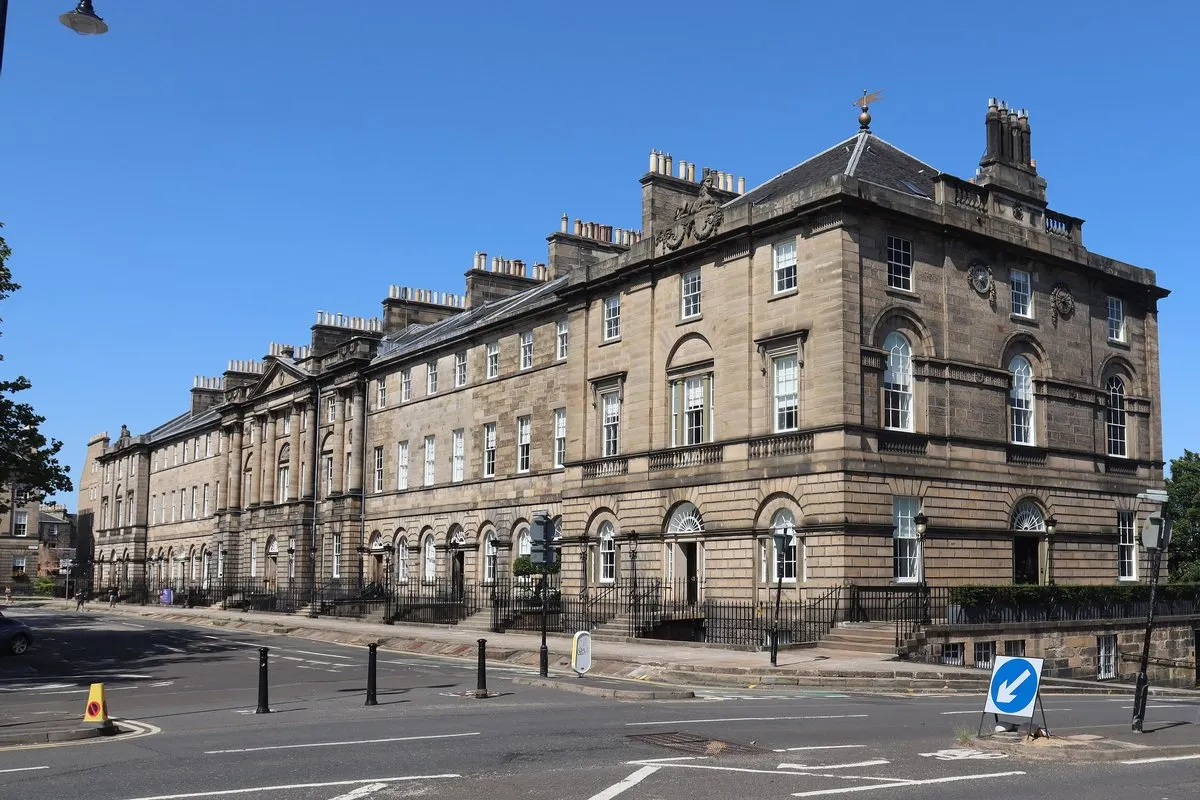
The first New Town was largely complete by 1820, when Charlotte Square was finished to a design by Robert Adam – the only architecturally unified part of the New Town. Robert Reid's church on the square, St George's, is now West Register House and holds part of the National Archives of Scotland. On the north side, Bute House is the official residence of the First Minister of Scotland. The Scottish National Portrait Gallery was built in 1885 on an unbuilt plot of Queen Street.
How to walk the New Town
Start at St Andrew Square and Dundas House, walk the length of George Street to Charlotte Square, then return along Princes Street for the view of the castle across the gardens. Rose Street, between George Street and Princes Street, is lined with pubs and shops. See the city in VERA PI's City of Edinburgh pages and VERA PI Scotland, and find more city guides among metromode.co's destinations.
Charlotte Square
Robert Adam's square
Completed around 1820, with Bute House on the north side.
Charlotte Square, Edinburgh EH2
Dundas House
Sir William Chambers' Palladian mansion
Completed 1774; Royal Bank of Scotland since 1825.
St Andrew Square, Edinburgh EH2