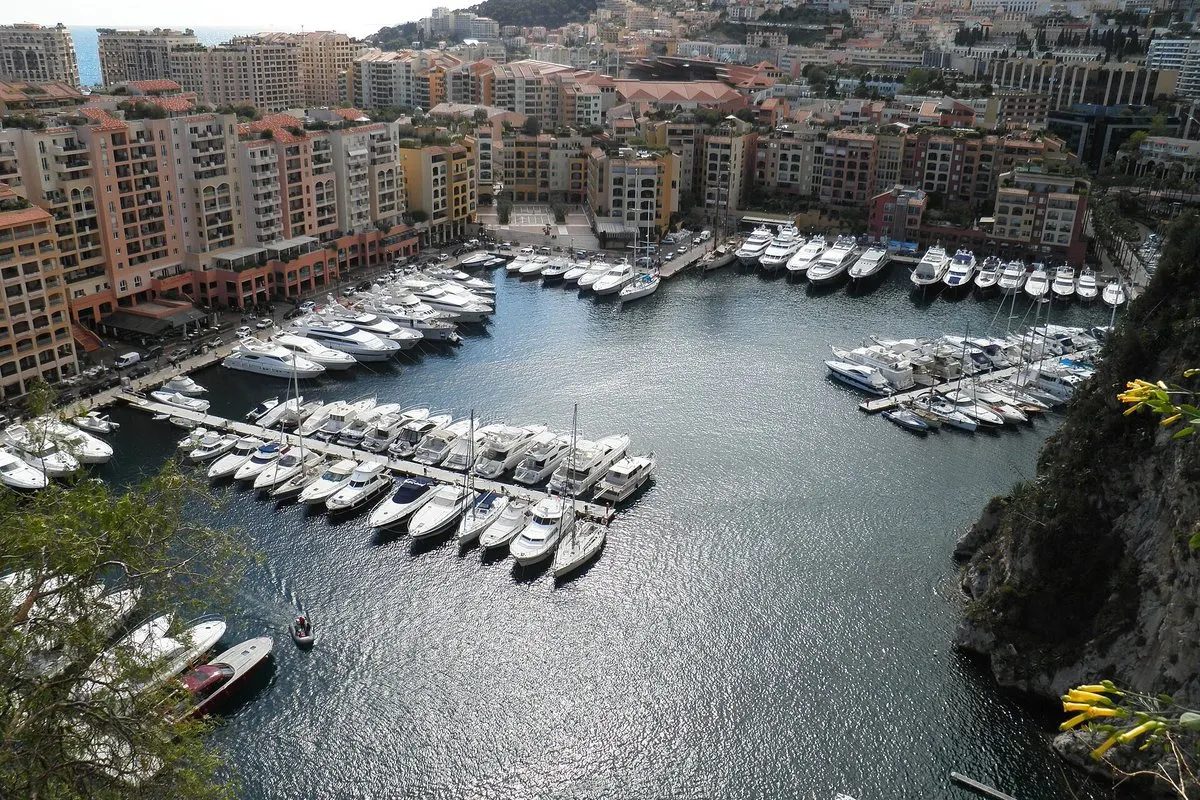
Beneath Monaco's cliff lies a district that didn't exist sixty years ago. Fontvieille was reclaimed from the Mediterranean from 1966 onwards, and gained its own harbour, a rose garden in memory of Grace Kelly, and a stadium with nine arches. Here, the principality is at its calmest.
In this story · 7 sections
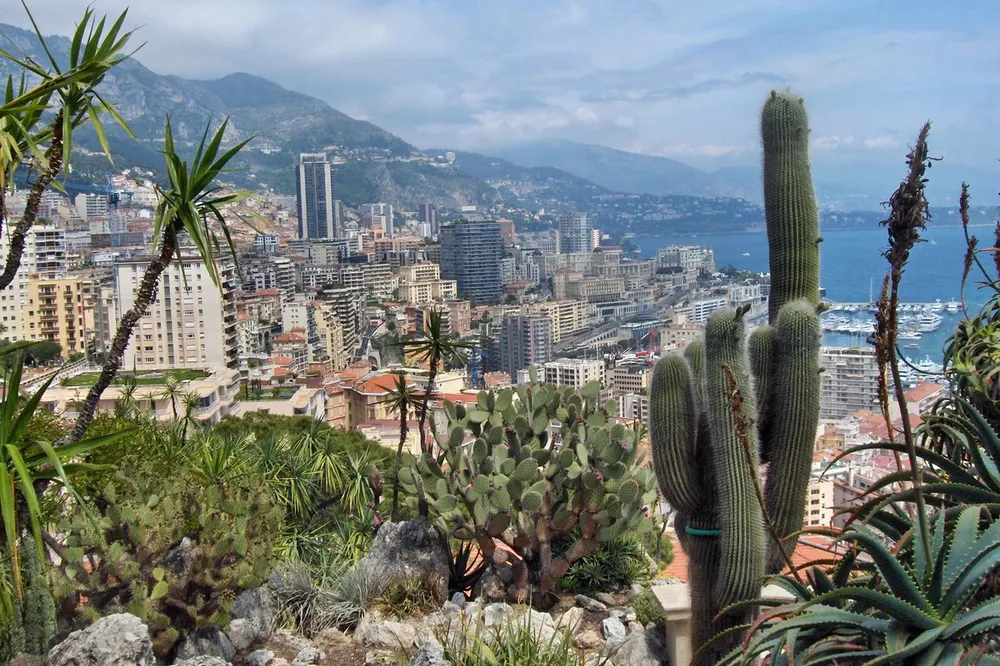
Anyone standing up on the cliff by the Prince's Palace and looking westward sees straight down into an almost enclosed harbour basin, lined with salmon-pink and ochre-yellow residential buildings. It looks as though Fontvieille has always been there. But the southernmost district of Monaco is also the principality's youngest: almost everything you walk on here is land reclaimed from the Mediterranean.
That makes Fontvieille something unusual in Monaco. There's no casino and no Grand Prix circuit here, but there is a harbour that's calmer than its neighbour's, a rose garden in memory of Grace Kelly, and an arena with nine arches. It's the principality on a weekday, and that's precisely why it's worth an afternoon.
01A district that was built out of the sea
Monaco has always been short of space. Under Prince Rainier III, who was nicknamed the builder prince, it was decided to create new land on the south-western side of the rock. Work began in 1966 based on drawings by the architect Manfredi Nicoletti, and the Italian engineer Gianfranco Gilardini led the construction. The first landfill, of around 17 hectares, was completed in 1973, built using approximately 7.5 million cubic metres of fill material. In 1981, the then hereditary prince Albert laid the foundation stone for the new district, and over the years it has grown to around 33 hectares.
Today, around 4,400 people live in Fontvieille, roughly an eighth of the principality's population. To the west, the border runs towards the French commune of Cap-d'Ail, and a small part of the reclaimed land actually belongs to France. The mix here is different from the rest of Monaco: luxury flats along the quay, but also many state-owned blocks of flats built so that Monegasques can afford to remain living in their own country. There are also offices, light industry, a fire station, a shopping centre and a heliport.
02The harbour beneath the cliff
Port de Fontvieille was built in 1973, at the same time as the district. It is the second largest of Monaco's three harbours, after Port Hercule in La Condamine, with around 275 berths on approximately eight hectares. The harbour lies at the foot of the rock, with the Prince's Palace and the Musée océanographique high above.
The harbour basin is best seen from above. Go up onto the rock and stand by the wall on its western side, and you'll get the whole harbour, the house façades and the boats in a single view. Then go back down again and follow the quai Jean-Charles-Rey along the water. It's one of the few places in Monaco where the pace feels like that of an ordinary Mediterranean town.
03Roses in memory of Grace Kelly
Around four hectares of Fontvieille is parkland. Princess Grace's rose garden, Roseraie Princesse Grace, was created in 1984 in memory of Grace Kelly, wife of Prince Rainier III. Amid the flower beds stands a statue of the princess, made by the Dutch sculptor Kees Verkade, surrounded by thousands of roses. The garden was reopened in 2014, and since 2015 it has had its own friends' association, Les amis de la Roseraie Princesse Grace de Monaco.
The Rose Garden connects with Parc de Fontvieille, which has a sculpture trail through the greenery. Two of the most famous works are Arman's Cavalleria Eroica and a clenched fist by the French sculptor César. The park was extended by 1.5 hectares when it turned thirty. Both parks are open every day from dawn to dusk, making them a good destination early in the morning before the day visitors come up onto the rock.
04The arena with the nine arches
Stade Louis II is Monaco's only football and athletics arena and home ground for AS Monaco. The original arena opened in 1939, but in 1979 Rainier III decided that Fontvieille should have a new sports area. Construction began in May 1981, on land reclaimed from the sea, and required 120,000 cubic metres of concrete. The arena was inaugurated on 25 January 1985.
It holds 16,360 spectators, almost half the country's population, and is most easily recognised by the nine arches behind one of the short ends. Most of the facility is hidden underground: the indoor arena Salle Gaston Médecin, where AS Monaco play basketball, the swimming pool Centre aquatique Prince Albert II and a large garage directly beneath the pitch. The athletics gala Herculis, a leg of the Diamond League, is also held here, and the International University of Monaco has its premises within the complex.
05Stamps, coins and a church in Ligurian colours
At Terrasses de Fontvieille, by the harbour, lies the Musée des timbres et des monnaies. The collection began when Prince Albert I bought a large collection of Monegasque stamps, and it was later expanded by Louis II and Rainier III. Rainier opened a first museum in the palace in 1950, and the current museum was inaugurated in 1996. Here Monaco's first coins are displayed, minted in 1640 under Honoré II, along with the entire stamp production from the first stamp in 1885 onwards, with sketches, colour proofs and the machines used to produce stamps and coins.
In the middle of the district stands Église Saint-Nicolas, completed in 1989. It is built in a Ligurian idiom, with a square and a fountain in front, as in a village centre, and the bell tower's dome is clad with glazed tiles in several colours. Inside there is a font from the old cathedral on the rock, which was demolished in 1873, and stained-glass windows by Italian glassmakers.
The church is also connected to one of the principality's major winter events. The Festival international du cirque de Monte-Carlo started in 1974 and has its tent, chapiteau de Fontvieille, within the parish. Since 2002, an ecumenical service with the festival's artists has been held there every year.
06The car collection has moved
Many older guides send visitors to the prince's car collection at Terrasses de Fontvieille. It has moved: since 2022, Rainier III's collection has been displayed in a new building at Port Hercule, right in the middle of the Grand Prix track. So plan it in for La Condamine instead. The world of motoring still has a foothold here, though, as the electric car manufacturer Venturi has its headquarters on the northern side of the district.
07How to get to Fontvieille
Fontvieille is located below the western side of the rock and is most easily reached on foot, either from La Condamine around the base of the rock or down from the rock after a visit to the palace. Monaco's heliport is located in the district and has frequent connections to the airport in Nice, making Fontvieille the first district many visitors see.
If you want to see the rest of the principality, all the districts are in our Monaco guide, and our plan for 48 hours in Monaco ties together the Rock, the harbours and Monte-Carlo. You'll find more cities among our destinations.