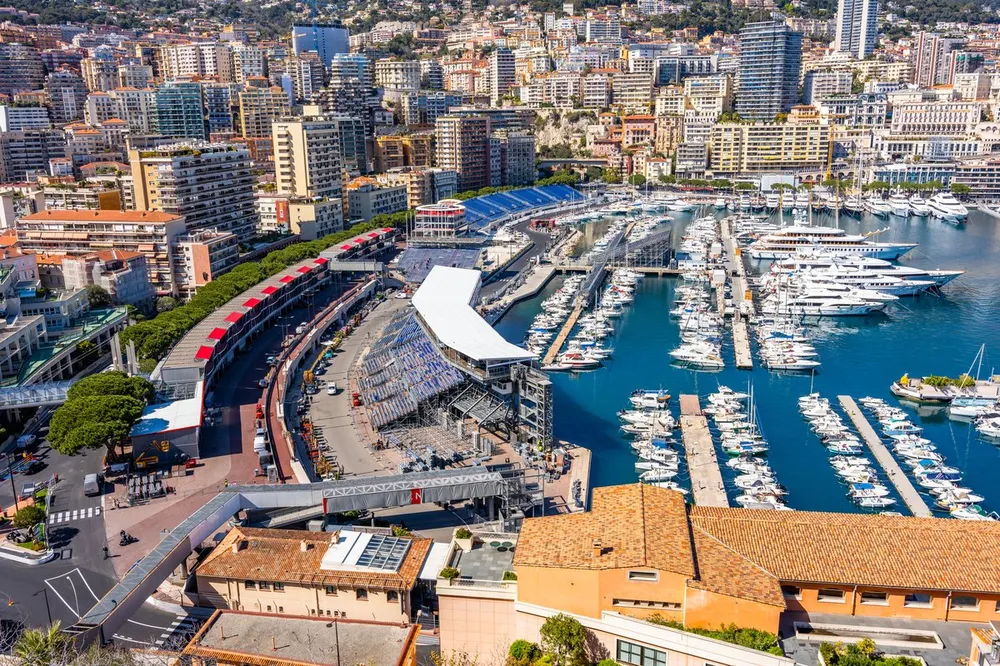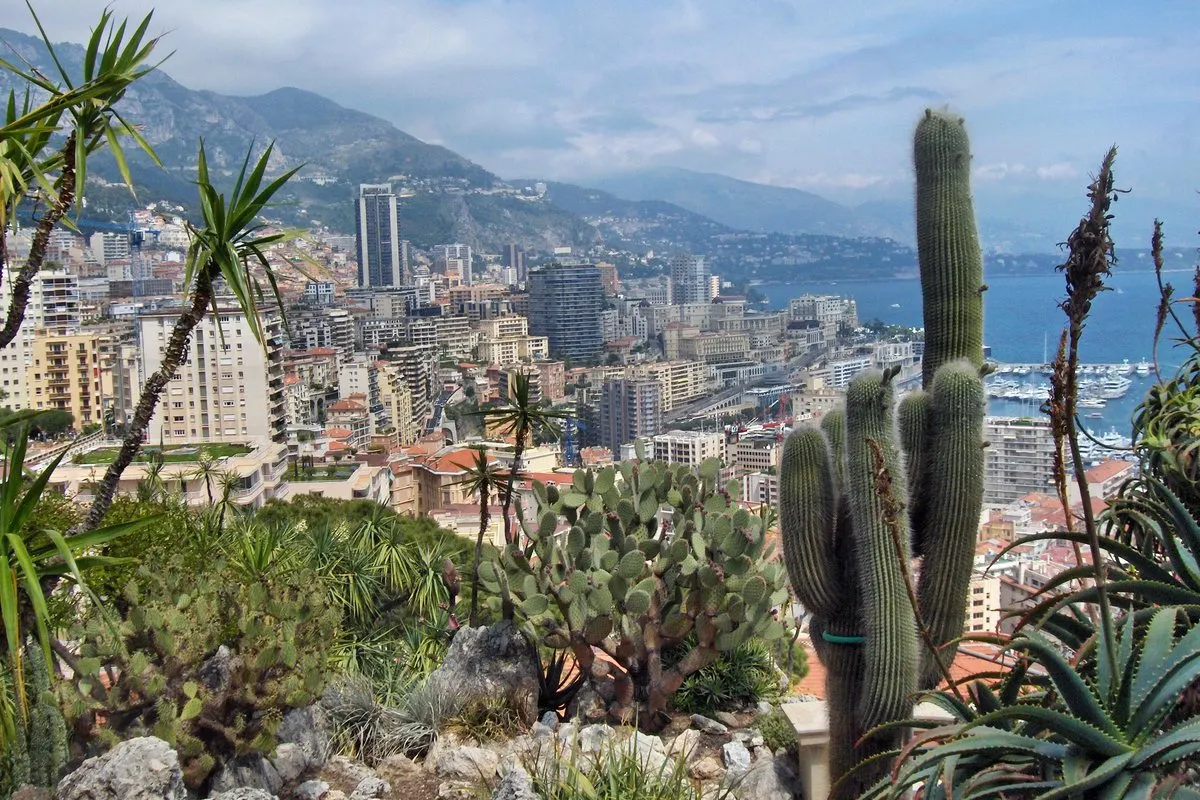
Moneghetti is the Monaco that visitors rarely see: a steep residential slope above La Condamine, where the Alps descend into the Mediterranean and staircases and lifts link the streets together. Here lies the principality's railway station, a Jesuit church from the 1920s, and the road up to the exotic garden.
In this story · 5 sections
Les Moneghetti – Munéghëti in Monegasque – is the north-central district of Monaco, where the Alps run straight down into the Mediterranean. It is a steep residential slope above La Condamine, to which it long belonged, and the upper edge is the border with France. The streets are terraces and hairpins: Boulevard de Belgique, Boulevard Rainier III and Boulevard du Jardin Exotique carry traffic across the slope, while Rue Bosio, Rue Louis-Aureglia and Rue Malbousquet run between them. Stairways and public lifts link the levels. According to VERA PI's mapping, the district has 22 streets, stairways and passages.
It's not a neighbourhood you tick off – it's a neighbourhood you walk through, upwards, for the view and to see how Monaco lives. The walk below starts at the bottom of the ravine and ends at the very top.
01Sainte-Dévote and the ravine
Start down in the ravine by the chapel of Sainte-Dévote, dedicated to Monaco's patron saint and mentioned in documents as early as 1070. Here, Pont Sainte-Dévote, Parvis Sainte-Dévote and Escalier Sainte-Dévote form the district's lower gate, and the chapel has given its name to the first corner of the Grand Prix circuit. From the ravine, staircases lead upwards – Escalier Malbousquet, Escalier de la Costa and Escalier du Castelleretto are some of the names – through residential buildings from various decades.
02Sacré-Cœur – the Jesuit church
The landmark of the district is the Église du Sacré-Cœur, built in 1926–1929 as a Jesuit church to designs by Fulbert Aureglia and Louis Notari – the same Notari who was Monaco's chief engineer and built the exotic garden further up. Since 1965 it has been the district's parish church, and it is also the headquarters of Monaco's scout organisation. The church crowns the slope and is visible from the harbour.
03Square Lamarck, Villa Ispahan and Théâtre des Muses
Square Lamarck, with its garden and the Joyeux fountain, is the district's little centre. Along the boulevard stands the 1910 Villa Ispahan, whose actual name is Villa Danichgah, after the Persian word for place of knowledge, and the Théâtre des Muses, a small theatre that was a bakery before it was rebuilt in 2012. The International University of Monaco and the barracks of the Compagnie des Carabiniers du Prince, the principality's small garrison, are also here.
04The station in the mountain
Monaco's only railway station, Monaco-Monte-Carlo, is in Moneghetti. It is served by the French state railway SNCF on the Marseille–Ventimiglia line, and the trains now run through a tunnel – the old railway viaduct below, over the valley in La Condamine, has become a road. For those arriving by train from Nice, Moneghetti is thus the first encounter with Monaco.
05Upwards: the Jardin Exotique
At the very top of the cliff, along Boulevard du Jardin Exotique, lies the Jardin Exotique de Monaco. In 1912, Prince Albert I purchased the observatory headland in Moneghetti and had Louis Notari create a garden for succulents, with natural-looking rock formations and small bridges along narrow paths. Construction began in 1913, in 1916 a grotto was found containing remains of animals and early humans, and the garden opened in 1931 and was formally inaugurated by Prince Louis II on 7 February 1933. The collection comprises over 1,000 species and 6,000 varieties of succulents from all over the world. Since 1959, the Musée d'anthropologie préhistorique has also been here.
The garden closed for renovation in 2020 and reopened on 30 March 2026, after six years. The view from the boulevard over the principality, the harbour and the cliff with the palace is free to enjoy either way.
Streets, houses and places can be found in VERA PI's guide to Moneghetti, Jardin Exotique and the neighbouring district La Condamine. Plan the rest of your stay with 48 hours in Monaco and Metro Mode's Monaco guide.