In this story · 6 sections
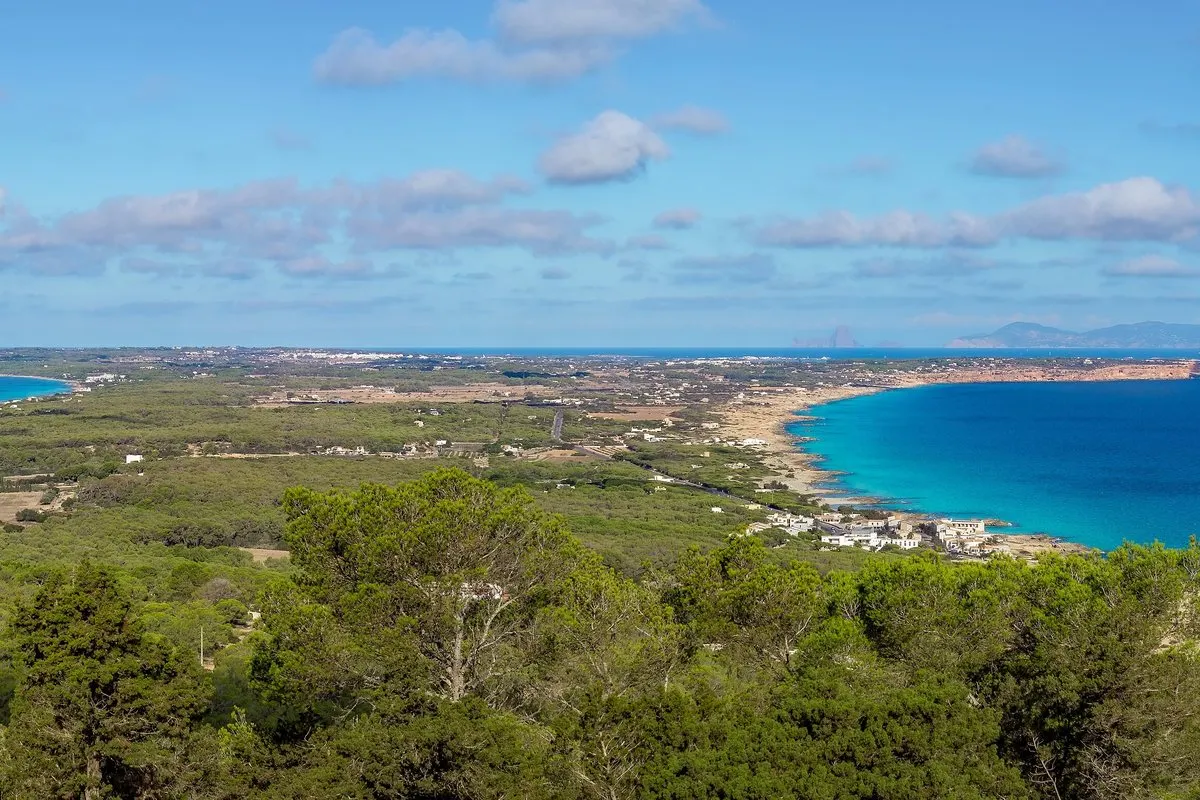
There is no airport on Formentera, and that has shaped everything. The smallest and most southerly of the Pityusic Islands, which it shares with Ibiza, covers just over 83 square kilometres and has a population of around 11,000. It is low and dry, scattered with fig trees, salt flats and juniper, and fringed by beaches whose water is so clear that boats seem to float in mid-air. Many visitors come for the day from Ibiza; the wiser ones stay for several.
Ses Illetes
Beach · Northern Formentera
© OpenStreetMap contributors · OpenFreeMap
- Address
- Platja de ses Illetes, Formentera
- Area
- About 83 km²
- Population
- About 11,400 (2023)
- Arrival
- By boat from Ibiza to La Savina
- Beaches
- Ses Illetes, Migjorn, Cala Saona
- Getting around
- Bicycle, scooter or small car
A narrow strip of white sand between two seas, inside the natural park of the salt flats, with turquoise water over Posidonia meadows.
01The granary island
The name is said to derive from the Latin frumentarium, a granary. Formentera has been inhabited since prehistoric times, with sites such as Ca na Costa surviving from the second millennium BC, and passed through Carthaginian, Roman, Byzantine and Arab hands before the Crown of Aragon took it in the thirteenth century. From 1403 until the early eighteenth century the threat of pirate raids left it virtually uninhabited, and the watchtowers along its coast date from that long, uneasy period.
02Ses Illetes and the northern tip
The most famous beach lies on the narrow sandy spit that runs north from La Savina towards Ibiza, within a natural park that also protects the salt flats. Ses Illetes is a ribbon of white sand between two seas, with water of a startling turquoise. Its clarity owes much to the meadows of Posidonia seagrass on the seabed, which UNESCO protects as part of its World Heritage listing for Ibiza. Arrive early, as the beach is popular with boats and day visitors in high summer.
Insider tipArrive early in high summer; a fee may apply for vehicles entering the natural park.
03Migjorn and Cala Saona
The long southern beach of Migjorn curves for several kilometres between the island's two highlands, backed by dunes and simple beach restaurants. It is the place to walk for an hour along the shoreline and stop for grilled fish at a chiringuito. On the west coast, Cala Saona is a small bay of pale sand framed by reddish cliffs, and the best spot on the island to watch the sun set into the sea.
04Two lighthouses
Formentera's ends are marked by lighthouses. At the eastern tip, on the high plateau of La Mola, the Far de la Mola stands above sheer cliffs; the road there passes the village of El Pilar de la Mola, known for its craft market, and the viewpoint near the top looks back over the whole island. To the south, the Far des Cap de Barbaria stands alone on a stony plateau at the end of a long straight road. It was a key setting in Julio Medem's film Lucía y el sexo, and at dusk, with nothing but sea beyond, it has an end-of-the-world stillness.
05Villages: Sant Francesc and Sant Ferran
The small capital, Sant Francesc Xavier, centres on a fortified whitewashed church and a square with cafés and boutiques. Sant Ferran de ses Roques, a few kilometres away, has a bohemian past, and Es Pujols on the north coast is the island's liveliest resort. None is large, and all are easily reached by bicycle.
06How to get around
The island is mostly flat and laced with signposted green routes for walkers and cyclists, so bicycles and electric bikes are the most pleasant way to explore. Scooters and small cars can be hired at La Savina, and in high season a bus network links the port with the villages and the main beaches. The island limits the number of vehicles in summer, which is part of its charm.
Starting from Ibiza? Read our guide to Dalt Vila among the Metro Mode destinations, and browse our travel section in English. For life beyond the holiday, see why Swedes are buying everyday homes in Spain (in Swedish).