 The Metro Mode 55
In this story · 4 sections
Glass in Venice has long been treated as a craft for the table and the chandelier. The autumn exhibition at the Peggy Guggenheim Collection, open since 14 November 2026 and running until 29 March 2027, follows the small enterprise that set out to change that. In 1955 Egidio Costantini, born in Brindisi and brought up in Venice, opened a gallery for artistic glass in Campo Santi Filippo e Giacomo. Jean Cocteau gave it its name, Fucina degli Angeli, the Foundry of the Angels. Costantini's method was to take a drawing or an idea from a painter or sculptor and see it through every stage, to the furnaces of Murano and the hands of the glass masters who could make it stand. Peggy Guggenheim, whose palazzo on the Grand Canal is now her museum, was one of his most useful allies: she bought pieces for her own collection, opened her address book to him and pushed him to plan his exhibitions with an international audience in mind. The curator, Cristina Beltrami, has gathered more than a hundred works to tell the story in order, from the early experiments to the workshop's final years.
Peggy Guggenheim Collection
Museum · Dorsoduro
© OpenStreetMap contributors · OpenFreeMap
- Until
- 29 March 2027
- Dates
- 14 November 2026 – 29 March 2027
- Venue
- Peggy Guggenheim Collection, Palazzo Venier dei Leoni
- Open
- 10 am–6 pm, closed Tuesdays and 25 December (Nov 2026)
- Tickets
- €17 adults, €14 over 70, €9 students under 26, under 10 free (Nov 2026)
- Curator
- Cristina Beltrami
- Works
- More than one hundred
- Address
- Palazzo Venier dei Leoni, Dorsoduro 701, 30123 Venice
- Telephone
- +39 041 2405 411
- Website
- guggenheim-venice.it
Fucina degli Angeli, the story of Egidio Costantini's glass workshop and the artists who worked with it, runs here until 29 March 2027.
01The story
The Fucina grew out of an earlier venture, the Centro Studio Pittori nell'Arte del Vetro, and the show begins there. The first pieces took their cue from the ceramics that Georges Braque and Pablo Picasso were making at the time, translated into a far less forgiving material. From there the list of collaborators widens quickly: Arman, Jean (Hans) Arp, Jean Cocteau, Max Ernst, Lucio Fontana, Paul Jenkins, Oskar Kokoschka, Matta and Mark Tobey all appear. The point the museum makes is that the Fucina helped lift glass out of the decorative arts and into the same conversation as painting and sculpture.
Archive photographs give the human side. One shows Peggy Guggenheim beside Arp's Forms at the ninth international exhibition of art glass at Ca' Giustinian in June 1964; another places her in her garden at Palazzo Venier dei Leoni, around 1965, with Arp's Bride and Groom.
02What you see
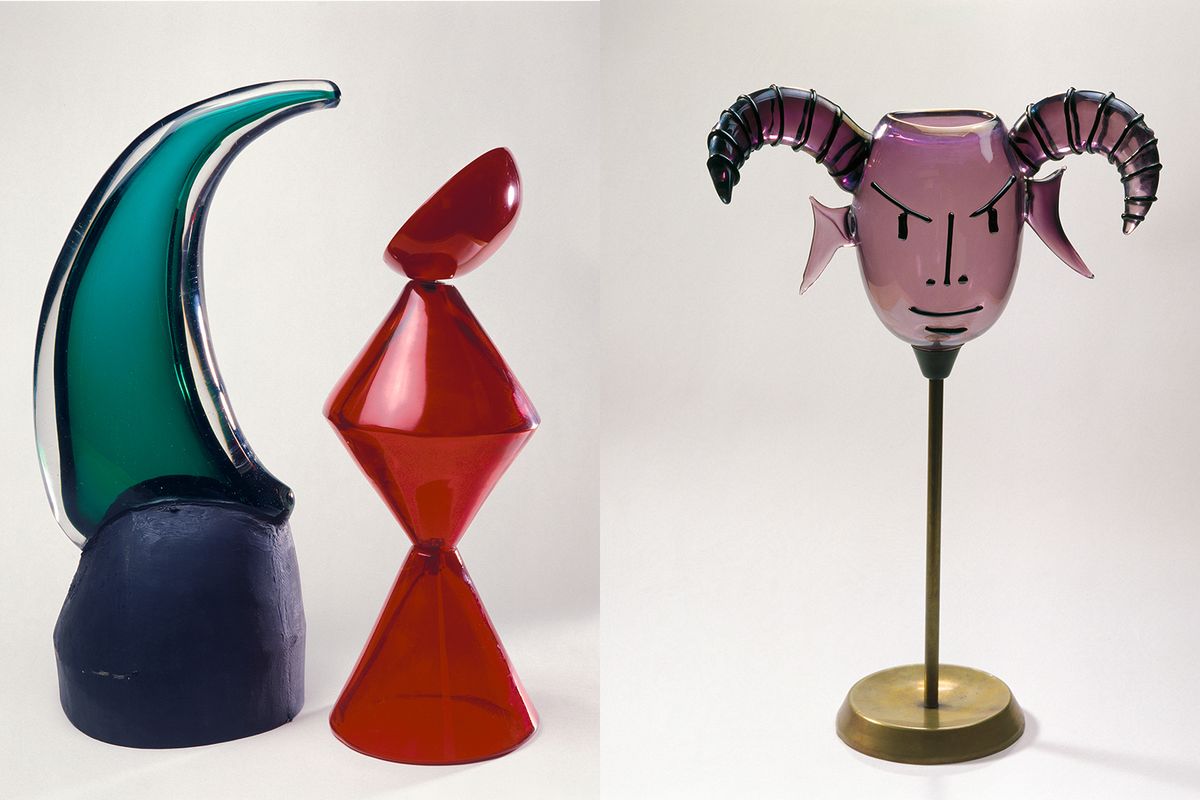
Glass shares the rooms with drawings, paintings, sculpture and documents, so that each piece can be read against the idea it started from. Max Ernst's King and Queen of 1964, hot-modelled in cristallo with a green sommerso layer, and his Poet of 1963, in amber and amethyst glass made by Ermanno Nason, show how far a painter could push the furnace. Cocteau's Billy Goat, or Lucifer, from 1962 is a horned amethyst head on a metal stand. Arp is present with a Doll of 1963–64 and a moulded Column of 1964, and Arman with Procession, a large moulded panel from 1966. Several of these loans come from the collection of the City of Lausanne at Mudac.
Insider tipClosed on Tuesdays. Last entry 5 pm.
One section looks east. In the 1960s and 1970s a group of Japanese artists worked with Venice, among them Miki Tomio, Katsuhiko Narita, Omura Mikuni and Yokoo Tadanori, and the show gives them a section of their own. The last gallery is given to the Fucina's late experiments, and the rooms also hold Luigi Veronesi's Relative of 1969, a canvas set with coloured glass and iron, on loan from the Kunstmuseum Walter in Augsburg.
03The museum
Palazzo Venier dei Leoni is itself part of the visit: a palace begun in 1748 to designs by Lorenzo Boschetti and never finished. It was Peggy Guggenheim's home, and today it shows her own collection, works from the Hannelore B. and Rudolph B. Schulhof collection and a sculpture garden, alongside the temporary exhibitions. The museum belongs to the Solomon R. Guggenheim Foundation, with New York and Bilbao. Marsilio Arte publishes the illustrated catalogue, edited by Beltrami with essays by Marianna Rossi and Stefano Turina.
04How to visit
The museum stands on the Grand Canal between the Accademia Bridge and the church of Santa Maria della Salute. From the railway station or Piazzale Roma, take vaporetto line 1 to Accademia or Salute, or line 2 to Accademia. It opens every day except Tuesday from 10 am to 6 pm, with last entry at 5 pm, and it is closed on 25 December. Tickets cost €17 for adults, €14 for visitors over 70 and €9 for students under 26; children under ten go free (Nov 2026). Booking a timed slot online is advised. Short 15-minute talks on the exhibition are free with admission, and members can join the curator for after-hours tours on 22 January and 26 February at 6.30 pm.
Don't miss
Don't miss
- 01
Max Ernst's King and Queen in cristallo and green sommerso glass, 1964
- 02
Jean Cocteau's horned Billy Goat in amethyst glass, 1962
- 03
Arman's Procession, a moulded glass panel more than a metre wide, 1966
- 04
The section on Japanese artists in Venice in the 1960s and 1970s
- 05
Photographs of Peggy Guggenheim with Arp's work at Ca' Giustinian, 1964