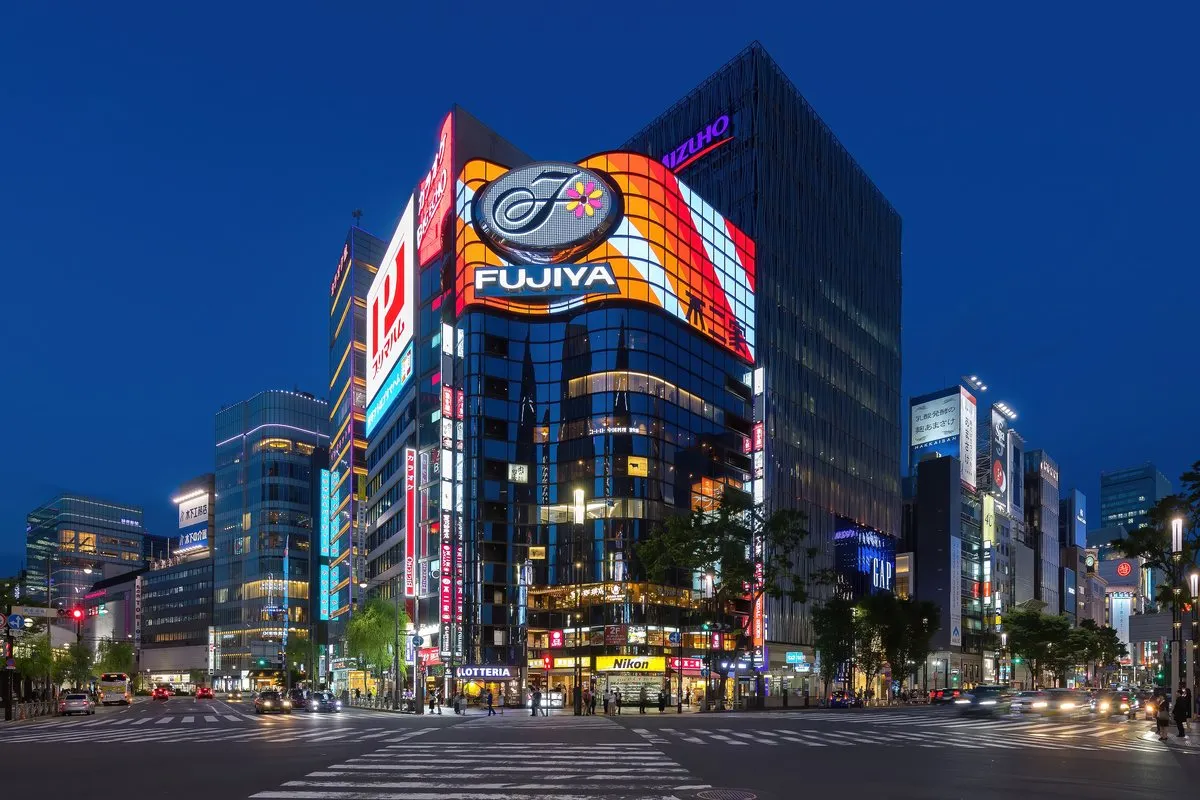
Tokyo's most elegant district was a swamp, then a mint, then Japan's showcase of Western modernity. A day in Ginza, from the clock tower of the man who founded Seiko to an evening at the Kabuki-za.
In this story · 6 sections
Ginza, in Tokyo's Chūō ward, lies between Kyōbashi to the north, Shinbashi to the south, Tsukiji to the east and Yūrakuchō to the west. It is the city's classic upscale shopping district, with internationally known department stores, boutiques, restaurants and coffee houses – and the highest concentration of Western luxury flagships in Tokyo. It is also a district with a surprising history, much of it still legible in its streets.
01From swamp to silver mint
Ginza was built on a swamp filled in during the sixteenth century, and it got its name – silver seat – from the silver-coin mint established here in 1612, in the Edo period. With Nihonbashi and Kanda, the old Kyōbashi ward formed the heart of Shitamachi, the original downtown of Edo.
02The Meiji bricktown
In 1872 a fire destroyed most of the district, and the Meiji government decided to rebuild it as a model of modernisation: fireproof brick buildings and wide streets linking Shimbashi Station with the foreign settlement at Tsukiji. The Irish-born engineer Thomas Waters designed it, and within a year a Western-style promenade of two- and three-storey Georgian brick buildings ran from the Shinbashi bridge to the Kyōbashi bridge.
Not everyone was impressed. The buildings suited neither the climate nor Japanese taste, rents were too high, and foreign visitors looking for old Edo were disappointed: the traveller Isabella Bird thought it looked less like an Oriental city than the outskirts of Chicago or Melbourne. Yet newspapers and magazines settled here, shop windows introduced modern marketing, and between the wars killing time in Ginza became a Tokyo pastime.
03The Wako clock tower
Most of the brick buildings have gone, but a few older landmarks remain, the most famous being the Wakō building at the main crossing, crowned by the Hattori Clock Tower. Both were built by Kintarō Hattori, the founder of Seiko, and the clock is the emblem of Ginza. Start your walk beneath it.
04Department stores and flagships
Across the crossing stands Ginza Mitsukoshi, a branch of a department store that traces its origins to 1673, when the kimono shop Echigoya opened. A decade later Echigoya pioneered selling in a shop, on the spot, for cash, instead of door to door – the root of today's Mitsui group. From here the avenues are lined with flagships of the great fashion houses; researchers have counted Ginza among the two best locations in Tokyo for a luxury store.
Come at the weekend, when Chuo-dori, the main north–south artery, has been closed to traffic since the 1960s, an initiative of Governor Ryōkichi Minobe. The street becomes a promenade, and the whole district slows down.
05An evening at the Kabuki-za
End the day at the Kabuki-za, Tokyo's principal theatre for kabuki. It was founded in 1889 by the Meiji journalist Fukuchi Gen'ichirō and has been run by Shochiku since 1914. It has been rebuilt again and again – after a fire in 1921, the Great Kantō earthquake of 1923 and wartime bombing – and the present complex opened on 28 March 2013, keeping the baroque Japanese revival style of 1924, which evokes castles and pre-Edo temples. Programmes change monthly, with separate afternoon and evening shows, and tickets are sold for single acts as well as whole plays – an easy first taste of kabuki.
06Planning
Ginza is walkable and well served by the metro; save the weekend for the pedestrian street. For more, see our destinations, our story on why Japan is drawing ever more travellers and the Metro Mode camera.