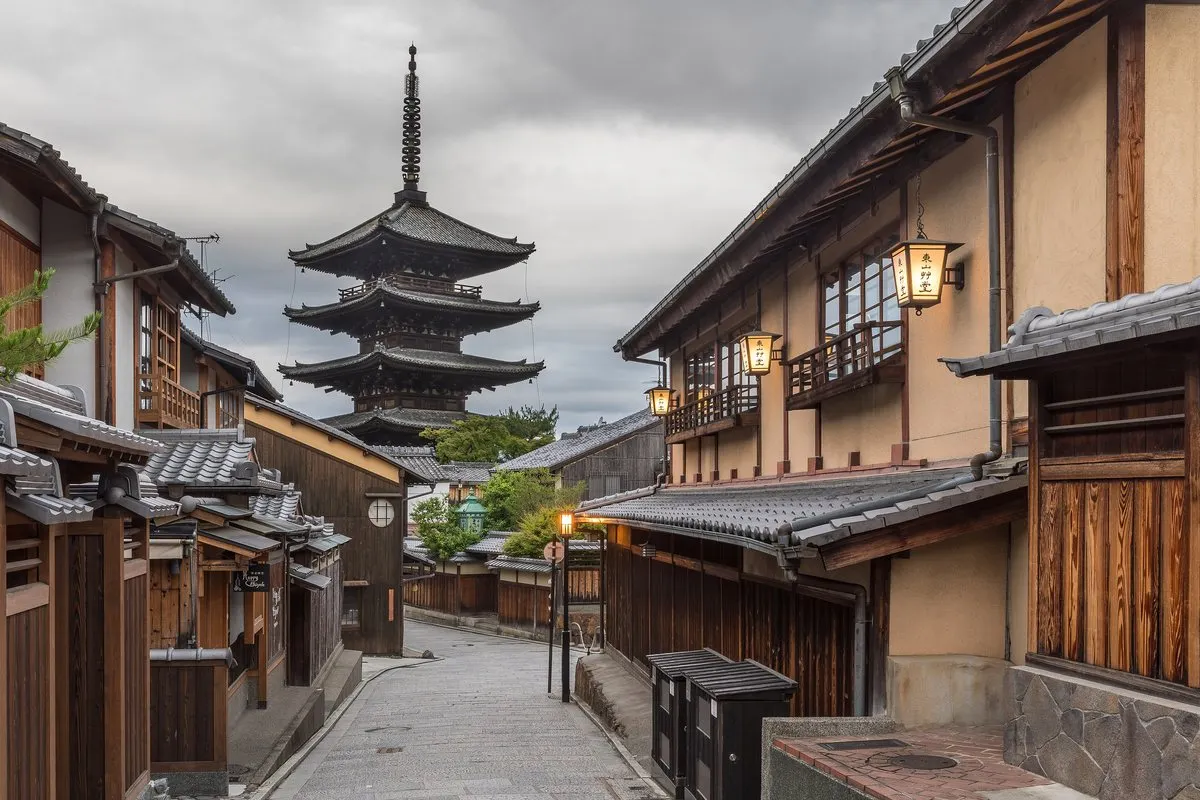
Between the Kamo River and the Eastern Mountains lies the Kyoto of the imagination: a hillside temple older than the city itself, stone-paved lanes of wooden shops and the teahouses of Gion. A walk through Higashiyama, downhill all the way.
In this story · 5 sections
Higashiyama-ku, the Eastern Mountain District, is the Kyoto ward between the Kamo River and the forested Higashiyama hills, roughly from Sanjō Street in the north to Jūjō Street in the south. Historically it lay outside the city's official boundaries; today strict limits on development mean it has the smallest population of any Kyoto ward – and a remarkable concentration of the city's most famous sights. Many of the places central to Higashiyama culture, the fifteenth-century flowering of Japanese arts, are here.
The best way to see it is to start at the top and walk down. Arrive early: by mid-morning the lanes are crowded.
01Kiyomizu-dera: the temple of pure water
Begin high on Mount Otowa at Kiyomizu-dera, one of the few temples in Kyoto older than the capital of Heian-kyō itself, and part of the Historic Monuments of Ancient Kyoto World Heritage Site. Its founding is wrapped in legend: in 778 the monk Kenshin followed a dream to the mountain, found a golden stream and a 200-year-old ascetic praying beneath a waterfall, and carved a statue of Kannon from the tree he left behind. Two years later the warrior Sakanoue no Tamuramaro, hunting deer, met the monk, converted and gave his own house as the main hall. The waterfall became Otowa Falls, still in the temple grounds; Kiyomizu means pure water.
Kiyomizu-dera is one of Japan's leading temples of Kannon and the sixteenth stop on the Saigoku pilgrimage, and every 12 December since 1995 it has announced the Kanji of the Year. Its principal image is a hidden statue of the eleven-headed Kannon.
02Sannenzaka and Ninenzaka
From the temple, walk down the stone-paved lanes of Sannenzaka and then Ninenzaka, a 150-metre pedestrian street lined with traditional buildings and shops. Both enjoy protected status to preserve their architecture, and since 1986 the city has buried the electricity cables along several of the most popular streets in the area, so the views are as clean as they look in pictures. Take your time over the ceramics, sweets and teas.
03Kōdai-ji and Nene no Michi
Continue north to Kōdai-ji, one of the ward's important temples, and along Nene no Michi, a lane cleared of overhead cables in the same programme. On the way you pass the five-storey pagoda that rises above the rooftops of the neighbourhood – the image on many a Kyoto postcard.
04Gion: the geiko district
The walk ends in Gion, which grew up in the Sengoku period as an entertainment district for visitors to Yasaka Shrine, the centre of the Gion faith, and became one of the most exclusive and famous geisha districts in Japan. In Kyoto the geisha call themselves geiko. Gion has two districts: the larger Gion Kōbu, which includes Hanamikōji street, and the smaller Gion Higashi; they split in 1881. Old townhouses still serve as teahouses where geiko entertain guests with song, dance and conversation.
Walk Hanamikōji south from Shijō Street, past the famous Ichiriki Tei, towards the great Zen temple of Kennin-ji, and finish beside the Shirakawa, whose south bank is lined with traditional establishments facing the water. Treat the district with respect: these are working streets, and geiko and maiko are on their way to engagements, not posing for photographs. To see them perform, look for the annual Miyako Odori or the shows at Gion Corner.
05More in Higashiyama
With more time, the ward also holds Tōfuku-ji, Sanjūsangen-dō and the Kyoto National Museum. For more, see our destinations, our story on why Japan is drawing ever more travellers and the Metro Mode home page.