Fifty-five miles of valley floor between two mountain ranges, a western town that elected an all-woman council in 1920 and a national park saved by a Rockefeller. Jackson Hole in winter and summer, and how to plan it.
In this story · 6 sections
Jackson Hole is a valley in north-western Wyoming, near the Idaho border, lying between the Gros Ventre Range and the Teton Range. Early trappers used the word hole for a large mountain valley, and this one is 55 miles long and 6 to 13 miles wide, with an average elevation of about 6,800 feet. The only incorporated town is Jackson, at the southern end – often itself called Jackson Hole – with 10,760 residents at the 2020 census. It is the gateway to Grand Teton and Yellowstone national parks and to three ski areas.
01Trappers, ranchers and a town named by post
Native American tribes, among them the Shoshone, Crow, Blackfeet, Bannock and Gros Ventre, used the valley for hunting and ceremony, though it had no known year-round settlement before the 1870s. John Colter, a veteran of the Lewis and Clark Expedition, became the first European-American to see it, in the winter of 1807–08. In the late 1820s the trapper David Edward Jackson worked the valley for beaver and was one of the first European-Americans to spend a whole winter here; his name stuck.
The town got its name in a practical way: in 1893 Margaret Simpson, who received the area's mail at her home, called it Jackson so that easterners could forward letters west. It was incorporated in 1914, and in 1920 elected an all-woman town government, from mayor and council to marshal, clerk and treasurer. Poor soil made the valley cattle country, and tourism arrived early with the dude ranches.
02Town Square
Start in Jackson itself. Some of the early buildings survive around Town Square, the centre of a compact grid of galleries, outfitters and restaurants. Snow King Resort rises right behind town; established in 1930, it is one of the oldest ski areas in the region.
03Grand Teton National Park
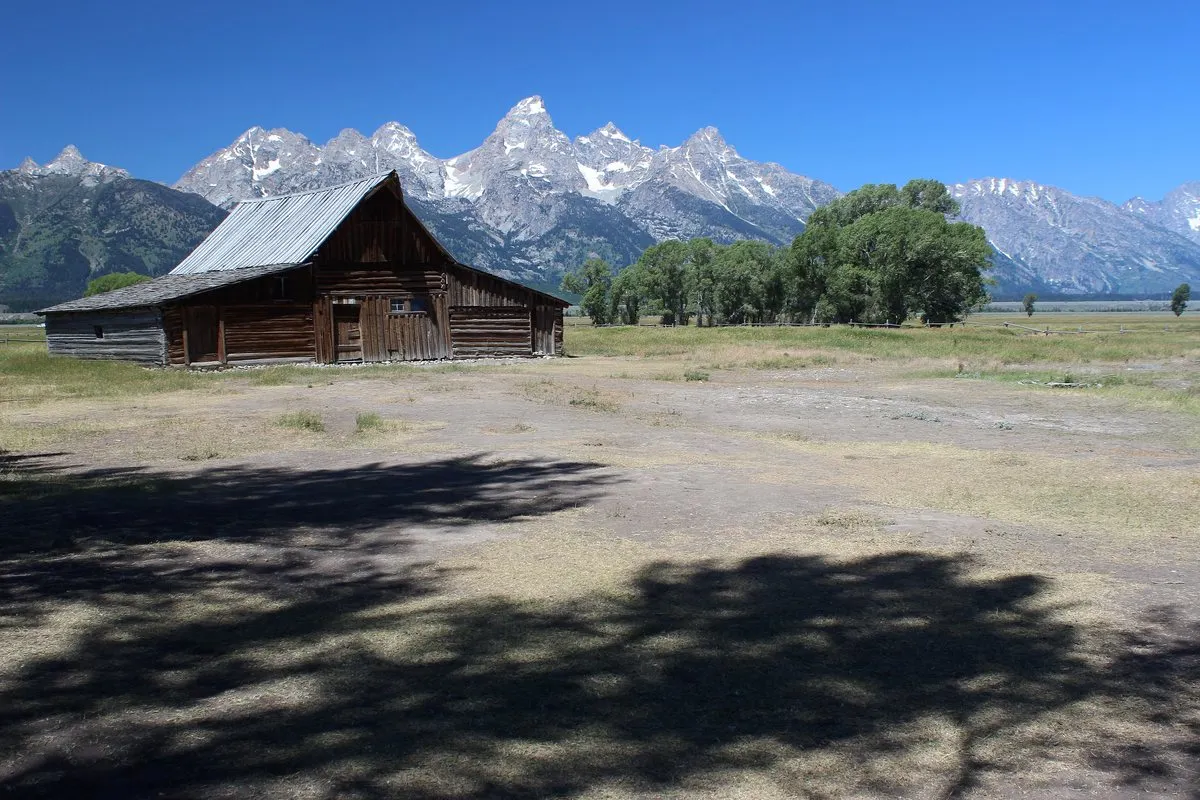
North of town lies Grand Teton National Park, which protects the main peaks of the Teton Range and most of the northern part of the valley, including Jackson Lake and the upper Snake River. Its history is a story of persistence. The park was created in 1929 to protect the peaks alone. In the 1930s conservationists led by John D. Rockefeller Jr. began buying land in the valley; in 1943, against local opposition and repeated attempts in Congress to undo it, much of Jackson Hole became a national monument, and in 1950 most of that land was added to the park.
Grand Teton, the tallest peak, gives the park its name. A dozen small glaciers survive near the summits, and some of the park's rocks, dated at nearly 2.7 billion years, are among the oldest in any American national park. More than 1,000 species of plants and some 300 species of birds live here. The Hayden Expedition's photographer, William Henry Jackson, took the first photographs of the Teton Range in 1871–72 – pictures that helped persuade Congress to create Yellowstone, the first national park, just to the north.
04Winter: elk and powder
In winter large numbers of elk come down to graze on the valley floor, and sleigh rides take visitors out among them. Skiers have three choices: Jackson Hole Mountain Resort at Teton Village, reached along the Moose–Wilson Road; Snow King on the edge of town; and Grand Targhee on the western slope of the Tetons, reached over Teton Pass. The first ski rope tow in the area was built on Teton Pass in 1937.
05Summer: over the pass to Pierre's Hole
In summer, drive the park's roads for views of the range, or cross Teton Pass to the Idaho side, the valley once known as Pierre's Hole, which hosted the Rocky Mountain Rendezvous of fur trappers in 1832.
06Planning
Ski season runs through the winter; summer is best for the national parks. More trips are on our destinations page, the Metro Mode home page and our list of hotels worth a single night.