In this story · 5 sections
L'Abysse Paris occupies a single, pared-back room inside the Pavillon Ledoyen, Yannick Alléno's cluster of restaurants at the foot of the Champs-Élysées, and gives itself over entirely to the choreography of sushi. The restaurant is built around an intimate pale wood counter with just twelve seats, placing every guest at the heart of the action as nigiri are shaped to order. It opened in 2018 as part of Alléno's rebuilding of the Pavillon Ledoyen, earned its first MICHELIN star within a year and rose to two stars by 2020. Here, French and Japanese craft are deliberately made to answer one another: ikejime fish brought in from the Atlantic, rice held at ambient temperature, extractions and consommés that owe as much to Alléno's sauce-driven French cooking as to Edo-period sushi tradition. It holds Two MICHELIN Stars, a rare distinction for a restaurant with so few covers, and one that places L'Abysse among the most exacting Japanese tables in Paris.
L'Abysse Paris
Restaurant · Champs-Élysées, 8th arrondissement
© OpenStreetMap contributors · OpenFreeMap
- Address
- Pavillon Ledoyen, 8 avenue Dutuit, 75008 Paris
- Cooking
- Japanese, Creative
- Chef
- Yannick Alléno & Katsutoshi Tomizawa (Sushi Master)
- Run by
- Groupe Yannick Alléno
- MICHELIN Guide
- Two MICHELIN Stars
- Open
- Lunch & dinner, Monday–Friday
- Covers
- 12-seat counter
- Setting
- Pale wood counter, Kawamata & Coggin installations
- Nearest station
- Champs-Élysées – Clemenceau
- Telephone
- +33 1 53 05 10 30
- Website
- yannick-alleno.com
Yannick Alléno and sushi master Katsutoshi Tomizawa set French and Japanese craft side by side at a pale wood counter for twelve.
01The room and the setting
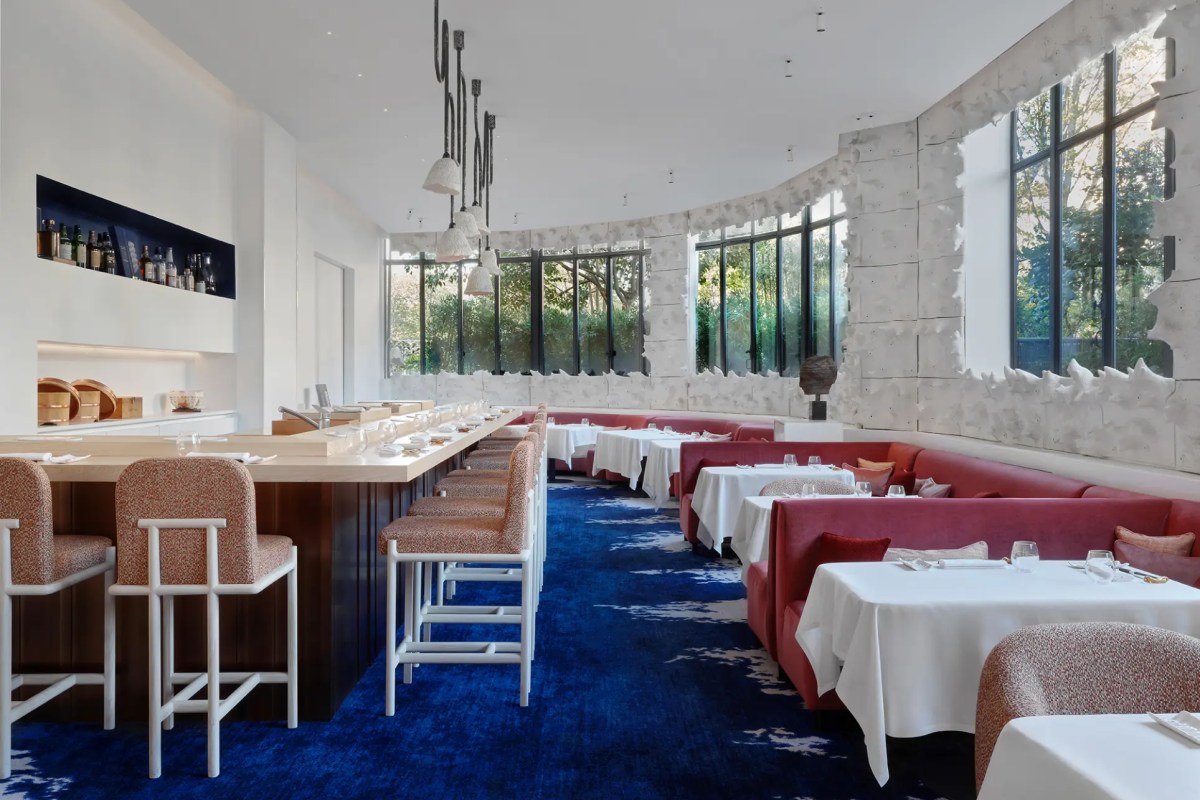
The dining room is deliberately spare, built to let the counter and the gestures of the sushi master carry the room. Around the twelve seats, the setting is designed as what the house calls a modern and intimate encounter, sensitive and outside of time, where diners watch the master's hand shape each piece of nigiri on rice served at ambient temperature, passing, as Alléno's own team puts it, a shared energy from the chef's hand to the guest's.
The décor is the work of Laurence Bonnel-Alléno, who brought together international contemporary artists for the space, chief among them Japanese sculptor Tadashi Kawamata and American artist William Coggin. Kawamata's installation, made of thousands of wooden chopsticks suspended above the counter, is set against ceramic walls by Coggin, producing a room the house describes as balancing strength and softness in a distinctly Japanese idiom of restraint.
L'Abysse keeps traditional house rules: smart dress is required, in keeping with a room where nothing is left to chance, from the lacquered counter to the temperature of the rice.
02The chef and the sushi master
Yannick Alléno built L'Abysse as the Japanese counterpart to his three-starred Alléno Paris elsewhere in the Pavillon Ledoyen, pairing his own French technique with a succession of Japanese sushi masters. The counter was first entrusted to Yasunari Okazaki, under whom the restaurant earned its first star within a year of opening and its second by 2020.
Insider tipOpen lunch and dinner, Monday to Friday; smart dress required; book well ahead for the twelve-seat counter.
The sushi counter is now led by Katsutoshi Tomizawa, who started cooking at sixteen and devoted himself to mastering kaiseki cuisine, exploring its many regional styles across more than a decade of Japanese kitchens. Like his predecessor Okazaki, Tomizawa is a disciple of the master Jun Goto; the two sushi chefs first met at the Hotel Manhattan where Goto worked, before crossing paths again years later in Paris to continue the line of transmission at L'Abysse.
Pastry at L'Abysse is signed by Valentin Mille, whose desserts extend the same French–Japanese conversation into the sweet course, playing salty, sweet, bitter and sharp flavours against one another for what the house calls a modern vision of pâtisserie.
03The cooking
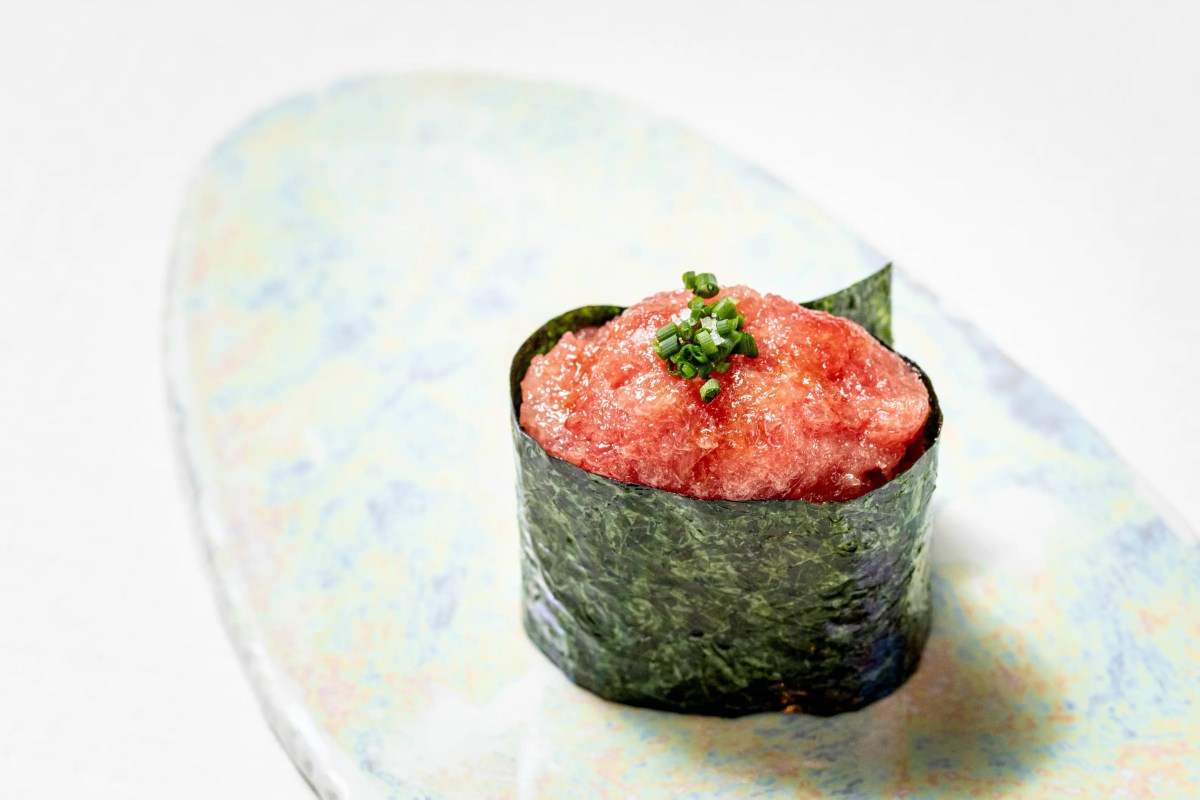
The kitchen's signature is Atlantic ikejime fish, killed and bled using the Japanese technique to preserve texture and flavour, cut to order at the counter rather than prepared in advance. Nigiri are formed one by one on rice kept at ambient temperature, a technical choice the house treats as central to the experience rather than a flourish.
The lunch menu has at times paired French and Japanese technique on a single plate: a triptych of tuna cuts seasoned differently for each texture, a soy gel brightening the leaner akami, the mid-fatty chutoro smoked over binchotan charcoal and finished with a sobacha praline, and the rich otoro cut with vinegared shallot. Meals open with what Alléno calls "emotions" – small, extraction-based savoury bites that function as a prelude before the sashimi and nigiri courses proper.
The wine and drinks list leans heavily on sake, reflecting a kitchen that treats Japanese pairing as seriously as French; MICHELIN has previously highlighted the restaurant's sought-after sake selection alongside its wine list.
04What to order
L'Abysse structures its repertoire around a short set of named menus rather than free ordering. At lunch, the entry point is the Saiho Ji menu; a longer, more elaborate lunch option runs alongside it for guests who want the fuller experience without committing to a full evening omakase.
In the evening, the Keitaku-en menu and the Collection menu – the latter built entirely around fourteen pieces of nigiri shaped in front of guests by the sushi master – sit below the restaurant's signature Koishikawa Koraku-en omakase, the most complete expression of the kitchen's range, according to Gault&Millau's 2026 review read in October 2026.
Desserts close the meal on the same register as the savoury courses: sweet, bitter, salted and sharp notes are kept in conversation rather than resolved into straightforward sweetness, in line with the pastry philosophy set out by Valentin Mille.
Don't miss
Don't miss
- 01
The Koishikawa Koraku-en omakase, the house's fullest expression of the sushi repertoire
- 02
The Collection menu's fourteen pieces of nigiri, shaped one by one at the counter
- 03
Tadashi Kawamata's suspended installation of thousands of wooden chopsticks above the room
- 04
William Coggin's ceramic walls, set against the room's pale wood counter
- 05
Valentin Mille's desserts, closing the meal on salt, sweetness, bitterness and acidity
05The neighbourhood
L'Abysse sits inside the Pavillon Ledoyen, a nineteenth-century pavilion tucked into the tree-lined Carré of the Champs-Élysées, a few minutes' walk from the Place de la Concorde and the Grand Palais. Alléno took over the building in 2014 and turned it into what his own group calls the most Michelin-starred independent establishment in the world, a single address holding three separate restaurants – Alléno Paris, L'Abysse and Pavyllon Paris – across close to 1,600 square metres.
The setting trades the bustle of the avenue for the relative calm of its garden square, making L'Abysse's twelve-seat counter feel more like a private Tokyo sushi-ya than a restaurant on one of the world's best-known boulevards.