 The Metro Mode 55
In this story · 4 sections
Maria Lassnig lived from 1919 to 2014, Edvard Munch from 1863 to 1944. More than half a century lies between them, and until now no exhibition had set their work side by side. Maria Lassnig and Edvard Munch. Flow of Paint = Flow of Life opened at the Kunsthaus Zürich on 2 October 2026 and runs until 21 February 2027, with some 150 works, 78 of them paintings. The title is taken from a painting Lassnig made in 1996, and it names what the museum sees as common ground between the Austrian and the Norwegian: painting as the expression of lived experience and a means of looking at oneself. The exhibition was made with the Hamburger Kunsthalle and draws on loans from the Munchmuseet in Oslo and the Maria Lassnig Foundation in Vienna. It is shown on the first floor of the Moser Building, the older of the museum's two houses on Heimplatz.
Kunsthaus Zürich
Museum · Altstadt
© OpenStreetMap contributors · OpenFreeMap
- Until
- 21 February 2027
- Dates
- 2 October 2026 – 21 February 2027
- Venue
- Kunsthaus Zürich, Moser Building, 1st floor
- Open
- Tue–Wed and Fri–Sun 10 am–6 pm; Thu 10 am–8 pm; closed Mon (Nov 2026)
- Tickets
- Adults CHF 31, reduced CHF 22, including the collection (Nov 2026)
- Curator
- Sandra Gianfreda, with Brigitte Kölle and Hans Dieter Huber
- Works
- Some 150, including 78 paintings
- Address
- Heimplatz 1, 8001 Zurich
- Telephone
- +41 44 253 84 84
- Website
- kunsthaus.ch
Maria Lassnig and Edvard Munch. Flow of Paint = Flow of Life brings some 150 works to the Moser Building of the Kunsthaus Zürich, from 2 October 2026 to 21 February 2027.
01The exhibition
Both painters kept returning to the same subjects: the body, emotion, illness and death, and the ties between people, animals and nature. The difference lies in where they looked. Munch followed the cycle of life, death and renewal. Lassnig turned her gaze inwards, and what she called her body awareness pictures were painted from the direct sensation of her own body. She studied the history of art closely, and Munch was one of her most important points of reference; the museum traces his influence in her handling of colour, her free brushwork and her appetite for experiment.
The idea for the pairing came from Hans Dieter Huber, a scholar and curator based in Berlin. It was carried out by Sandra Gianfreda, curator at the Kunsthaus, and Brigitte Kölle, curator and head of collection at the Hamburger Kunsthalle, within a four-year collaboration between the two museums begun by their directors, Ann Demeester and Alexander Klar.
Don't miss
Don't miss
- 01
Chain of Tradition (1983), Lassnig with Velázquez, Munch and Van Gogh behind her
- 02
Munch's Madonna (1895), from the Munchmuseet in Oslo
- 03
Flow of Paint = Flow of Life (1996), the Lassnig painting that gives the exhibition its title
- 04
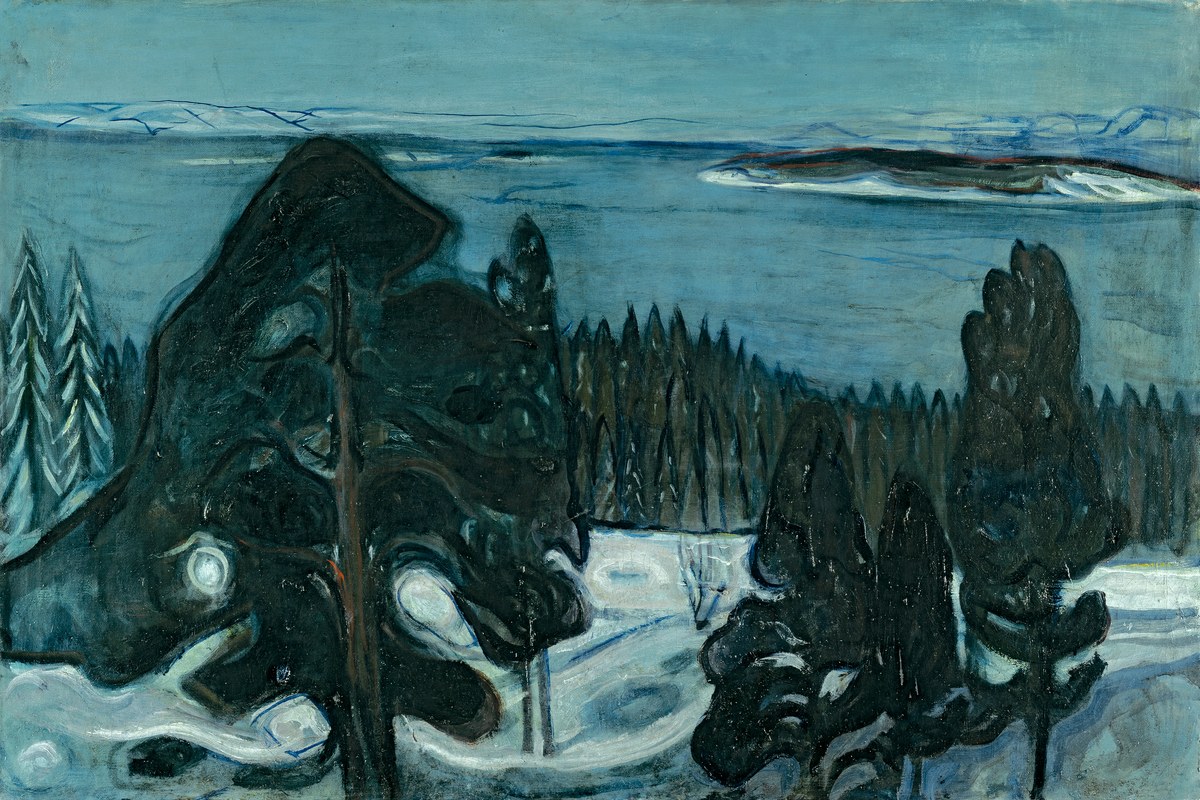
Munch's Winter Night (c. 1900), from the Kunsthaus's own collection
- 05
Self-Portrait with the Spanish Flu (1919), from the National Museum in Oslo
02What you see
The works are hung in pairs and groups of shared motif and theme. Munch's use of line and colour and the way he composed a picture are seen against Lassnig's canvases, so that familiar works of his appear in a new context and her debt to him becomes plain. The Munchs include Madonna, of 1895, and Two Human Beings. The Lonely Ones, of about 1935, both from the Munchmuseet; Girls on the Pier, of 1901, from the Hamburger Kunsthalle; and Self-Portrait with the Spanish Flu, of 1919, from the National Museum in Oslo. Lassnig's paintings include Sleeping with a Tiger (1975), The Great Wave (1995), Married Couple (2001) and Three Graces (2011).
Insider tipClosed on Mondays. Open until 8 pm on Thursdays.
One painting is back before the public after a long absence. In Chain of Tradition, of 1983, Lassnig painted herself with Diego Velázquez, Munch and Vincent van Gogh behind her, a family tree of painters in which she takes her own place. The museum says the work was located for this exhibition. Two of the pictures belong to the Kunsthaus itself: Munch's Winter Night, of about 1900, in the collection since 1931, and Lassnig's Balled-Up Violence, painted in 1988 and acquired in 2004.
03The museum
The exhibition is also a reminder of what the Kunsthaus owns. The museum describes its holdings as the largest collection of Munch paintings outside Norway, and the connection goes back to 1922, when its director Wilhelm Wartmann gave Munch a survey of more than 70 paintings and over 430 works on paper. Munch later counted it among his best solo exhibitions, and the first of his works entered the collection that same year. Lassnig's ties are more recent. In 2002 she received the Roswitha Haftmann Prize, which is presented each year at the Kunsthaus, and a solo exhibition followed the year after.
The Kunsthaus stands on Heimplatz in Zurich's old town, close to the main railway station and the lake, and is divided between the Moser Building and the newer Chipperfield Building. A ticket to the exhibition covers the collection in both. For a pause there are the Kunsthaus Bar and the restaurant Bei Moudi am Kunsthaus, both closed on Mondays.
04How to visit
The museum is open from 10 am to 6 pm on Tuesday, Wednesday, Friday, Saturday and Sunday and until 8 pm on Thursday. It is closed on Mondays, on 25 December 2026 and on 1 January 2027 (Nov 2026). The galleries close about ten minutes before the museum does. Admission to the exhibition, with the collection and the smaller exhibitions, is CHF 31 for adults and CHF 22 at the reduced rate, and children and teenagers under 14 enter free (Nov 2026). An audio guide to the exhibition in German, English, French and Italian costs CHF 7 at the ticket desk. Tickets are sold at the desk or in advance online.
Trams 3, 5 and 9 and bus 31 stop at Kunsthaus. Public guided tours are mostly in German: on Thursdays at 6.30 pm and Sundays at 11 am in November, January and February, and on Fridays at 3 pm and Sundays at 11 am in December, though not on 25 December. The next tour in English is on Saturday 2 January at 11 am. Coats, umbrellas and bags larger than a small handbag go into the lockers, which are found in both buildings. The catalogue, which includes an interview with the writer Siri Hustvedt, costs CHF 54.