On a peninsula where the Nam Khan meets the Mekong, a former royal capital keeps more than thirty Buddhist temples, a palace turned museum and a ritual that begins before dawn every day. Two days in Luang Prabang.
In this story · 5 sections
Luang Prabang, historically Xieng Thong, is the capital of Luang Prabang Province in north-central Laos, set on a peninsula between the Mekong and Nam Khan rivers. Its name means Royal Buddha Image, after the Phra Bang, a statue that symbolises Lao sovereignty. Since 1995 the town has been a World Heritage Site, valued for its blend of Lao architecture, French colonial buildings and more than 30 Buddhist temples; the protected area covers 33 of its 58 villages, where daily rituals continue.
01A royal capital
In 1353 the town became the capital of Lan Xang, the Land of a Million Elephants, and in 1359 the Khmer king gave the Phra Bang to his son-in-law Fa Ngum, the first Lan Xang monarch, to lend Buddhist legitimacy to his rule. King Setthathirath later moved the capital to Vientiane, but Luang Prabang remained a royal city: under French rule it was recognised as the royal residence of Laos, and its king, Sisavang Vong, became head of state of the Kingdom of Laos at independence. The monarchy ended in 1975, when the Lao People's Democratic Republic was established.
02Dawn: the alms round
Rise before dawn for the morning alms-giving, one of the daily rituals that still shape life in the protected villages, as monks walk the streets to receive offerings of food. It is a religious ceremony, not a performance: watch quietly from a distance, keep below the monks' eye level, never use flash and do not block their path. Take part only if you do so sincerely and in the proper way.
03Wat Xieng Thong
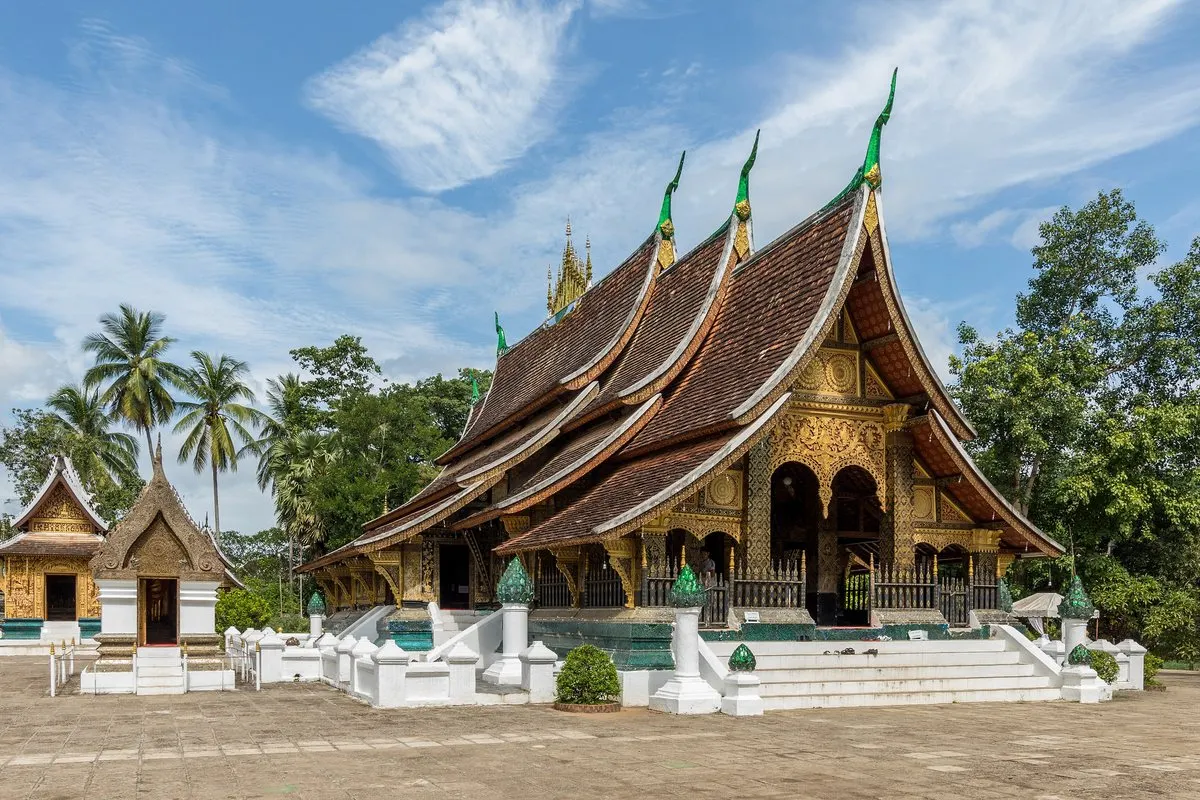
Then walk to the northern tip of the peninsula and Wat Xieng Thong, the Temple of the Golden City, built in 1559–60 by King Setthathirath. It was a royal temple where kings were crowned, as well as a place of worship, a library of ancient scripts and a showcase of traditional craft. UNESCO counts it among the most sophisticated Buddhist temples in Southeast Asia.
Its sim, or ordination hall, has nine cascading roofs sweeping almost to the ground, crowned by gilded miniature pagodas. Inside, red and black walls are covered in gold stencilling of mythological scenes, and the rear gable carries a glass mosaic of the tree of life. Look too for the rare reclining Buddha, as old as the temple, which was shown at the Paris Exhibition of 1931 and only returned to Luang Prabang in 1964, and for the royal funerary carriage house by the eastern gate.
04The Royal Palace and the Phra Bang
Walk back along the river to the Royal Palace, Haw Kham, built in 1904 in the French era for King Sisavang Vong, on a site chosen so that visitors arriving by river could step ashore right below it. After 1975 the royal family were sent to re-education camps and the palace became a national museum. Its architecture mixes Lao motifs with French Beaux-Arts; inside are murals of Lao life painted in 1930 by Alix de Fauntereau, each wall meant to be seen at a different time of day, and diplomatic gifts from around the world, among them a piece of Moon rock from the United States.
The most precious object is the Phra Bang itself, 83 centimetres tall and cast in an alloy of gold, silver and bronze. Legend says it was made in Sri Lanka; the Siamese carried it off twice, in 1779 and 1827, before King Mongkut returned it in 1867. A dedicated temple, Haw Phra Bang, stands in the palace grounds.
05Planning
Dress modestly for temples, with shoulders and knees covered, and remove your shoes before entering a sim. For more, see our destinations, the Metro Mode home page and our list of hotels worth a single night.