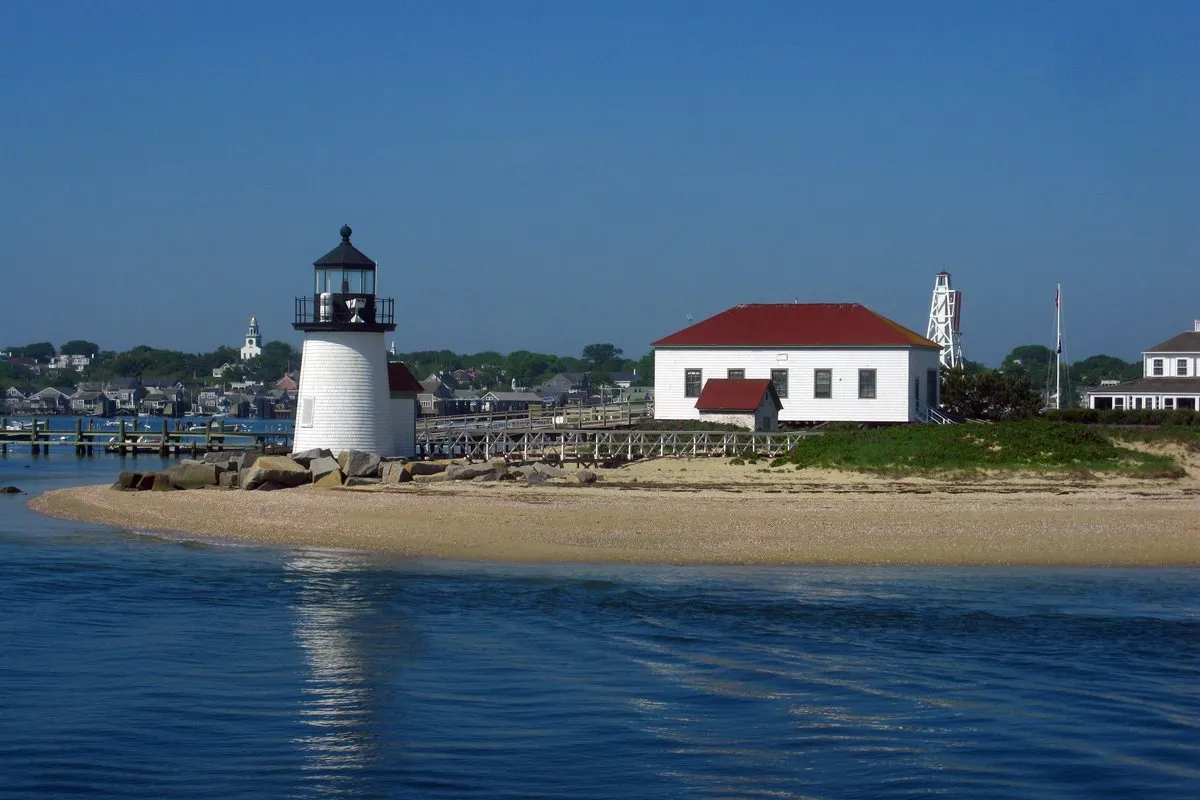
In summer some 80,000 people crowd onto an island south of Cape Cod. In autumn the fog rolls back in, the town of whaling captains empties and Nantucket becomes what the National Park Service calls the finest surviving New England seaport of its age.
In this story · 6 sections
Nantucket is an island south of Cape Cod in Massachusetts, which together with the islets of Tuckernuck and Muskeget forms a single town and county – the south-easternmost in the state. Its name probably comes from a Wampanoag word whose meaning is uncertain; it may have meant "far away island". Seen from the sea in fog, it earned the nickname the Little Grey Lady of the Sea.
In summer the population swells to around 80,000. Out of season the island returns to its year-round residents and its architecture comes into focus. When the National Park Service designated Nantucket a National Historic Landmark District in 1966, it called it the finest surviving architectural and environmental example of a late eighteenth- and early nineteenth-century New England seaport town.
01Settlers, sea captains and whalers
The Wampanoag lived here long before the English. Thomas Mayhew secured Nantucket, Martha's Vineyard and neighbouring islands as a proprietary colony in 1641, and in 1659 sold most of his interest to investors led by Tristram Coffin; settlement began in earnest. Native tribes came seasonally to fish and to harvest whales that washed ashore – the first step towards the industry that would make Nantucket's name known around the world in the eighteenth and nineteenth centuries.
02The Whaling Museum
Start at the Nantucket Whaling Museum on Broad Street, the flagship of the Nantucket Historical Association. Its core is the Greek Revival oil and candle factory built in 1847 by Richard Mitchell & Sons, a year after the Great Fire swept through the area, and bought in 1848 by William Hadwen and Nathaniel Barney. The factory refined oil and made spermaceti candles, supplying street lamps in London and Paris and lighthouses along the American coast. The last whaling ship sailed from Nantucket in 1869; the building became a warehouse, then an antiques shop, and opened as the Whaling Museum in 1930.
Restored and expanded in 2005, the museum now links the old factory, with its massive lever press, to the 1971 Peter Foulger Museum. In Gosnell Hall a 46-foot sperm whale skeleton hangs from the ceiling, and eleven galleries cover Nantucket's life, art and ideas. Allow a morning.
03The town on foot
From the museum, the old town spreads up from the wharves. Steamboat Wharf, once New North Wharf, is where the ferries come in; Straight Wharf has the Thomas Macy Warehouse, a Greek Revival industrial building of the same family as the candle factory. Walk inland through the streets of the old seaport; the Historical Association's house museums show how islanders lived through successive eras.
04Brant Point Light
At the entrance to the harbour stands Brant Point Light, the first thing ferry passengers see. The island's sea captains asked for a lighthouse at a town meeting in January 1746, and the town has rarely stopped rebuilding it since: the first wooden tower burned in 1758, the second blew down in a violent gust in March 1774, the third burned in 1783, and the fourth was little more than a lantern hoisted between two spars. The present wooden tower of 1901 is the tenth light on the point. It was automated in 1965, is still in operation and has been on the National Register of Historic Places since 1987.
05Sconset: the place of great bones
Drive or cycle to the eastern end of the island and Siasconset, known to everyone as Sconset – a Wampanoag name for "place of great bones". It was settled as a fishing village in the seventeenth century; the core of one fishing shack, Auld Lang Syne, is believed to date from the 1670s, which may make it one of the oldest houses on Nantucket. Cottages were expanded haphazardly over the centuries, which gives the village its unique look. In 1877 Edward Underhill built new cottages in the style of the old shacks and let them to summer visitors, and in the early twentieth century Sconset was the summer retreat of a colony of Broadway actors.
Today Sconset has around 500 residents and three of the island's four golf courses. Its bluffs face the open Atlantic and have suffered serious erosion in recent years – a reminder of how exposed this island is.
06When to go
Late September and October bring quieter streets and easier bookings; winter is for those who like their islands grey and wild. Our partner data site has a page for Nantucket on VERA PI, and there are more guides on our destinations page and the Metro Mode home page.