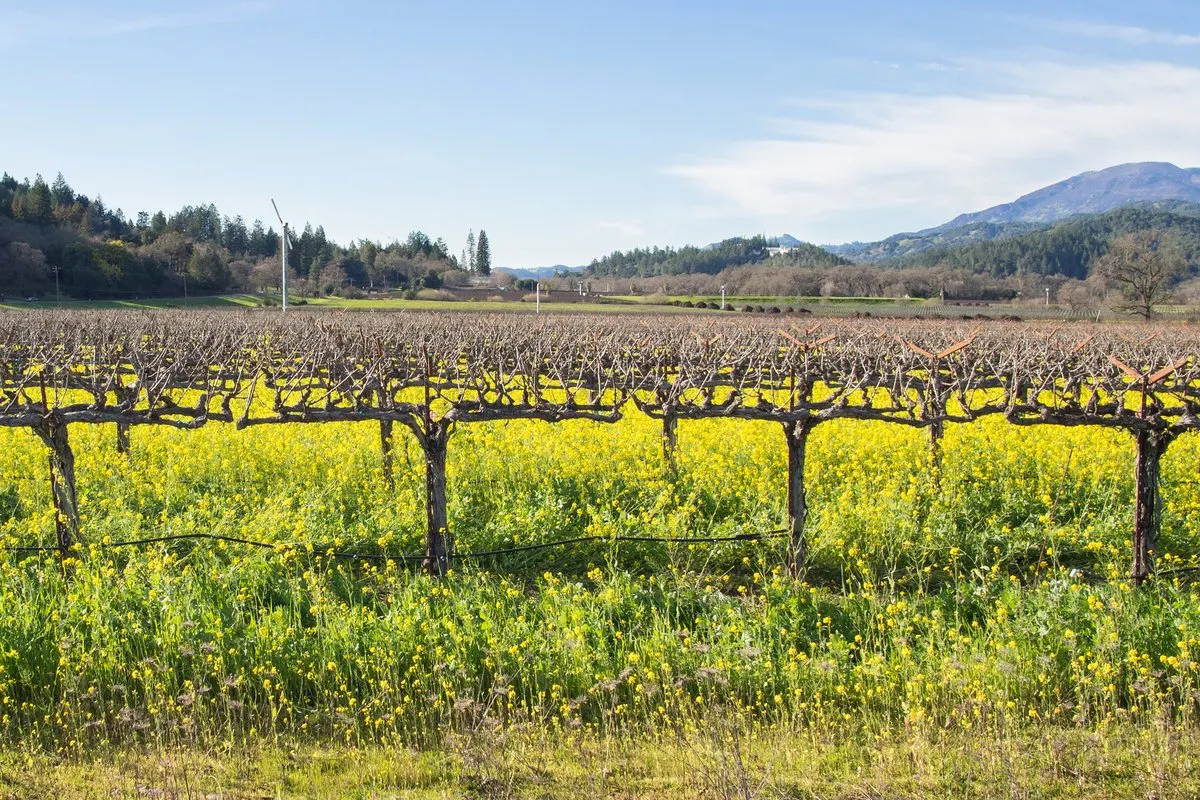
Two parallel roads, hundreds of wineries and a small town with more Michelin stars per head than anywhere in North America. How to drive Napa Valley, from the first vines of 1838 to the Judgment of Paris.
In this story · 5 sections
Napa Valley, in Napa County north of San Francisco, is one of the world's best-known wine regions and, since 1981, an American Viticultural Area – the second in the country and the first in California. A Mediterranean climate, a long growing season of 215 to 260 days and soils that range from gravelly loam to clay suit Cabernet Sauvignon above all, but also Merlot, Cabernet Franc, Chardonnay, Sauvignon Blanc and Zinfandel. Within the valley lie sixteen smaller appellations, from Los Carneros in the cool south to Calistoga at the top.
The valley is long and narrow, and it is served by two roads: California State Route 29 on the west and the Silverado Trail on the east. The simplest way to see Napa is to drive up one and down the other.
01A short history in vines
George C. Yount is credited with planting the first vines in the valley in 1838. John Patchett began selling wine commercially in 1858, at two dollars a gallon, and in 1861 Charles Krug opened the winery in St. Helena that is often cited as Napa's first. By 1880 the valley had 443 vineyards of a thousand vines or more. Then came phylloxera, Prohibition and the Great Depression, and Napa's modern premium wine industry did not re-emerge until the 1960s.
The turning point came in 1976. At a blind tasting in Paris, later known as the Judgment of Paris, Californian wines were set against the best of France – and Stag's Leap Wine Cellars, on the Silverado Trail, came out on top. Napa has been a destination ever since.
02Morning: up Highway 29
Start in the south and head north on Route 29, through the village names that have become appellations in their own right: Yountville, Oakville, Rutherford. Rutherford takes its name from Thomas Rutherford, who married one of Yount's granddaughters in 1864 and received land from him that he planted with vines. Nearby, Captain Gustave Niebaum founded Inglenook Winery in 1879.
Stop in St. Helena, a town of 5,430 people at the 2020 census and the centre of its own appellation, with more than 400 vineyards. Its Main Street is lined with shops and restaurants, and two of its estates – Beringer Vineyards and the Charles Krug Winery – are California Historical Landmarks. On the edge of town, the Culinary Institute of America has a campus at Greystone. St. Helena had an earlier life as a resort, too: White Sulphur Springs opened in 1852 and is remembered as California's oldest resort.
03Afternoon: down the Silverado Trail
Cross the valley and turn south on the Silverado Trail. It began as a track in 1852, when floods made the main road impassable, and later carried wagons from the cinnabar mines on Mount St. Helena to San Pablo Bay; it was the first permanent road from Napa to Calistoga. In the 1880s the stagecoach robber Black Bart worked this road. Today it is the quieter of the two routes, running 29 miles along the foot of the eastern hills, with at least 40 of the valley's wineries along it or close by.
This is the road of the Stags Leap District, where the 1976 winner was made. Every March the Silverado Trail also hosts the Napa Valley Marathon.
04Evening: Yountville
End the day in Yountville, a town of 3,436 people at the 2020 census. It was founded as Sebastopol in 1855 and renamed in 1867 in honour of George Yount. Its fame is culinary. The French Laundry, founded by Sally Schmitt in 1978 and now owned by Thomas Keller, holds three Michelin stars and has twice been named the best restaurant in the world by The World's 50 Best Restaurants. Keller's Bouchon, a short walk away, holds one star. With more than one Michelin star per thousand residents, Yountville claims the highest density of stars in North America. Domaine Chandon sits just outside the town limits.
05Planning your tastings
Many wineries receive guests by appointment, so book ahead, keep to three or four visits a day and arrange a driver if you plan to taste properly. The valley is at its liveliest during the harvest in late summer and autumn; winter is quieter and easier to book. For more inspiration, browse our destinations, the Metro Mode home page and our pick of hotels worth a single night.