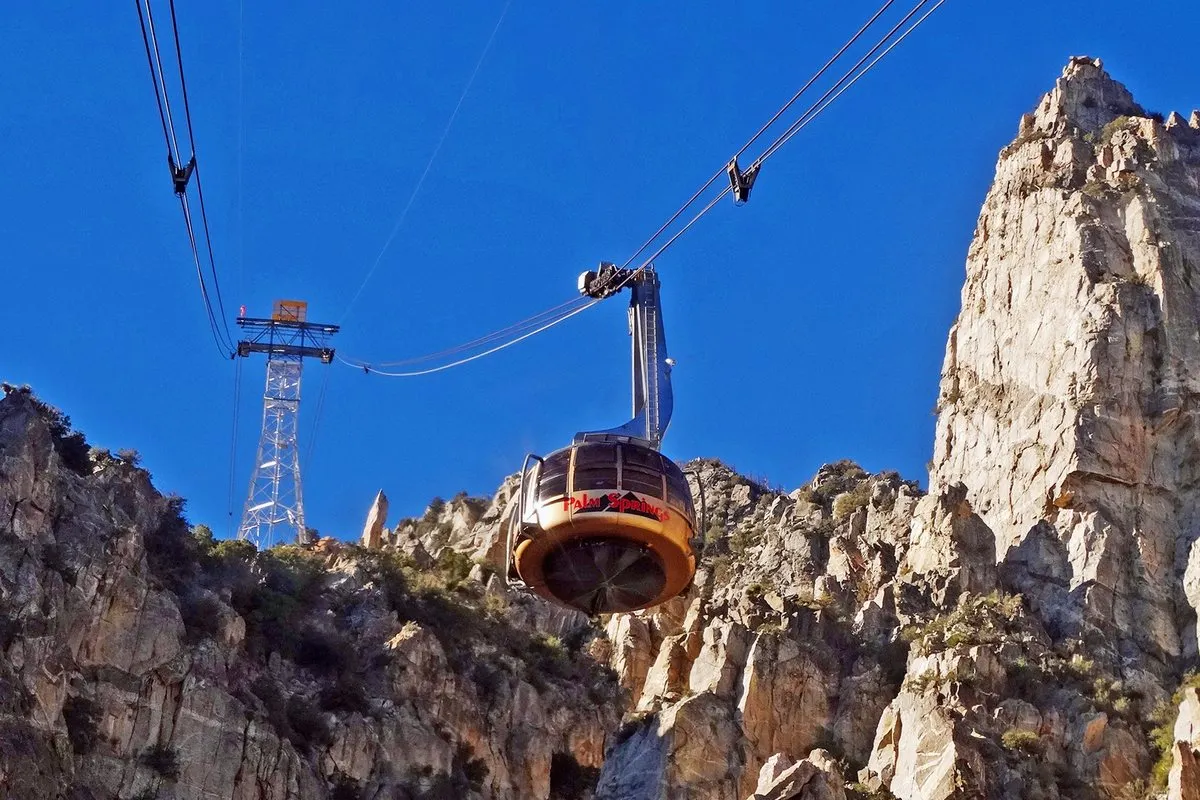
A desert resort that triples in size every winter, with clean-lined mid-century buildings, a cable car that climbs from cactus to pine forest in ten minutes and canyons that belonged to the Cahuilla for two thousand years. Palm Springs in three acts.
In this story · 5 sections
Palm Springs lies in the Coachella Valley in Riverside County, California, at the foot of the San Jacinto Mountains. It is a small city of 44,575 people at the 2020 census, but between November and March, when winter visitors arrive – most of them Canadians – its population triples. It is known above all for its mid-century modern architecture, its arts scene and its desert landscapes.
This guide is built in three acts: the architecture in town, the mountain above it and the canyons that were here long before either.
01The first people of the springs
The Cahuilla arrived some 2,000 years ago and called the place Se-Khi, boiling water, after its hot springs. They wintered in the canyons, where water and shade were plentiful, and moved to cooler Chino Canyon in summer. In 1876 the federal government established the Agua Caliente Reservation in a checkerboard of alternating square-mile sections, with the sections in between granted to the Southern Pacific Railroad. As a result, more than ten per cent of today's city is reservation land, and the Agua Caliente Band of Cahuilla Indians is the administrative heart of the most populous reservation in California.
02Act one: desert modernism
Mid-century modern design – clean, simple lines, honest materials and little ornament – flourished in North America from roughly 1945 to 1970. Its houses were wide and low, with flat roofs, walls of glass and post-and-beam structures that brought the outdoors in. In the desert light of Palm Springs the style found one of its purest expressions, and since the late 1990s it has enjoyed a major revival.
The most rewarding examples to visit are public buildings. Start at the foot of Tramway Road with the Tramway Gas Station, designed by Albert Frey and Robson Chambers in 1965, its wing-like roof cantilevered towards the mountains. Since 2003 it has been the Palm Springs Visitor Center, so you can step inside. Then head downtown to the Palm Springs Art Museum, founded in 1938 as the Palm Springs Desert Museum and focused on design and contemporary art since 2004. Its Modernist building by E. Stewart Williams was listed on the National Register of Historic Places in 2016, and the museum also runs an Architecture and Design Center in town.
Many of the city's most famous modernist houses are private homes. Admire them from the street, respect the residents, and save the interiors for the museum's exhibitions.
03Act two: the tramway to the pines
The electrical engineer Francis Crocker dreamt up a cable car up the face of Chino Canyon in 1935 – a newspaper called it Crocker's Folly. Two wars delayed the project, construction began in 1960, and helicopters were used to build four of its five towers, an engineering first. The Palm Springs Aerial Tramway opened in September 1963. In 2000 new cars were installed whose floors rotate twice during the ride, making it the largest rotating aerial tramway in the world.
The ride takes about ten minutes and passes through five life zones, from the Colorado Desert to the alpine wilderness of Long Valley and Mount San Jacinto State Park. At the top the air can be as much as 22°C cooler than on the valley floor. On a clear day the view reaches north to Mount Charleston near Las Vegas, and the Salton Sea is plainly visible to the south-east. Even today, supplies and water reach the mountain station only by the tram itself.
04Act three: the canyons
South of town, the Indian Canyons belong to the Agua Caliente. Here you can see Cahuilla petroglyphs in Tahquitz, Chino and the Indian Canyons, the remains of irrigation ditches, dams and house pits, and in Andreas Canyon ancient pictographs and mortar holes where acorns were ground into meal. Walk early in the day and carry water: this is the desert, even in winter.
05When to go
The season runs from November to March, when the days are warm and the snowbirds are in town; summer is fiercely hot. For more trips, see our destinations, the Metro Mode camera for reading buildings as you walk, and our pick of hotels worth a single night.