In this story · 5 sections
The Rallye Automobile Monte-Carlo is organised every year by the Automobile Club de Monaco, which also runs the Grand Prix. Monaco is its start and finish, but most of the action takes place in the mountains behind the Riviera and across south-eastern France, on roads that in winter can switch from dry tarmac to ice and snow within a single stage. In 2026, for the first time since 2008, the rally also returned to the principality itself for a super special stage.
It was conceived to show off the latest progress in motoring and to promote Monaco as a winter resort. It has done both for more than a century.
2 places
© OpenStreetMap contributors · OpenFreeMap
Rallye Monte-Carlo- 1911
- First rally; Henri Rougier wins
- 1966
- Minis disqualified over headlamps
- 1973–2008
- Opening round of the World Rally Championship
- 1997
- End of the concentration format
- 2012
- Returns to the World Rally Championship
- 2026
- Super special stage back in Monaco; Oliver Solberg wins
1911: all roads lead to Monaco
Planning began in 1909 at the request of Prince Albert I, and the first rally was created by two young Monegasques, Gabriel Vialon and Antony Noghès, who would later found the Monaco Grand Prix. In January 1911, 23 cars set out from 11 starting points across Europe; Henri Rougier, one of nine starters from Paris, drove 1,020 kilometres and won in a Turcat-Méry. The result depended on driving but also, rather arbitrarily, on the elegance of the cars and the comfort of their passengers.
For most of its history it remained a concentration rally, with crews driving from distant cities across winter Europe to converge on Monaco before the special stages. As late as 1991 competitors could still choose between roughly five starting points. The format changed in 1997.
1966: the light-bulb scandal
The most controversial edition came in 1966. The first four finishers, Timo Mäkinen, Rauno Aaltonen and Paddy Hopkirk in Mini Coopers and Roger Clark in a Ford Cortina, were all disqualified for using non-dipping quartz-iodine headlamp bulbs instead of the standard production bulbs. Victory passed to Pauli Toivonen in a Citroën, who was said to be deeply embarrassed by the result.
The Col de Turini
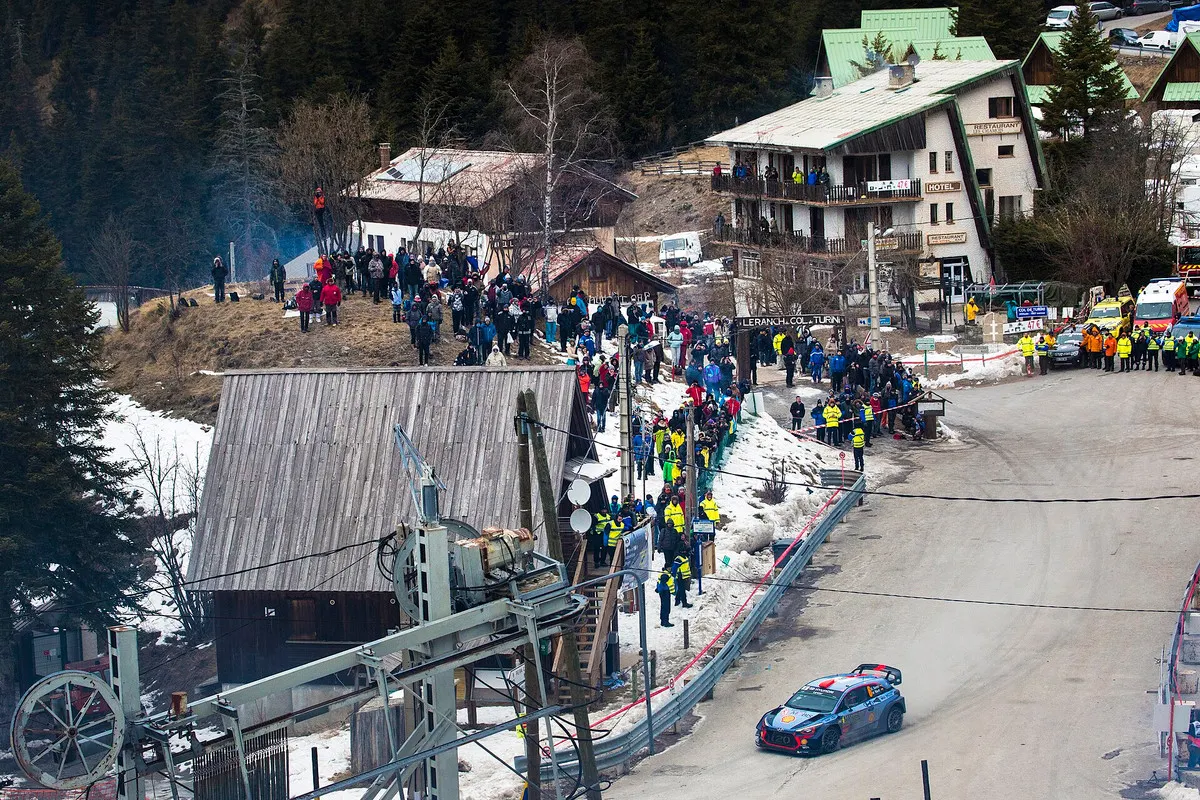
The rally's most famous stage runs between La Bollène-Vésubie and Sospel over the Col de Turini: 31 kilometres of steep, narrow road and hairpins, often with ice and snow at that time of year. Sospel lies at 479 metres and the road peaks at 1,603. Run at night, it becomes the "Night of the Turini", watched by thousands of fans as headlights cut through the dark. Spectators have been known to throw snow onto the road; in 2005 both Marcus Grönholm and Petter Solberg crashed after skidding on it.
Champions and records
From 1973 to 2008 the rally opened the World Rally Championship each January. It spent 2009 to 2011 in the Intercontinental Rally Challenge before returning to the world championship in 2012. Two Frenchmen have dominated the modern era: Sébastien Loeb with eight wins and Sébastien Ogier with a record ten. The 2026 edition was won by Oliver Solberg and Elliott Edmondson for Toyota.
The historic rally
For those who prefer the romance of the old format, the Rallye Monte-Carlo Historique has run every year since 1998, about a week after the modern event. Open to models from the 1960s to the early 1980s that took part in the original rally, it is still a concentration rally, with starts across Europe converging on Monaco.
Col de Turini
The rally's legendary mountain pass
The heart of the 31 km stage between La Bollène-Vésubie and Sospel.
Col de Turini, 06440 Moulinet
Insider tipDress for snow and arrive early; crowds are large on rally night.
Automobile Club de Monaco
The rally's organiser
The club behind both the Rallye Monte-Carlo and the Grand Prix.
23 boulevard Albert-Ier, 98000 Monaco
Insider tipCheck the official programme for start and finish venues.
Monaco's districts are on VERA PI Monaco, and more motorsport and Monaco stories are on metromode.co and metromode.se.