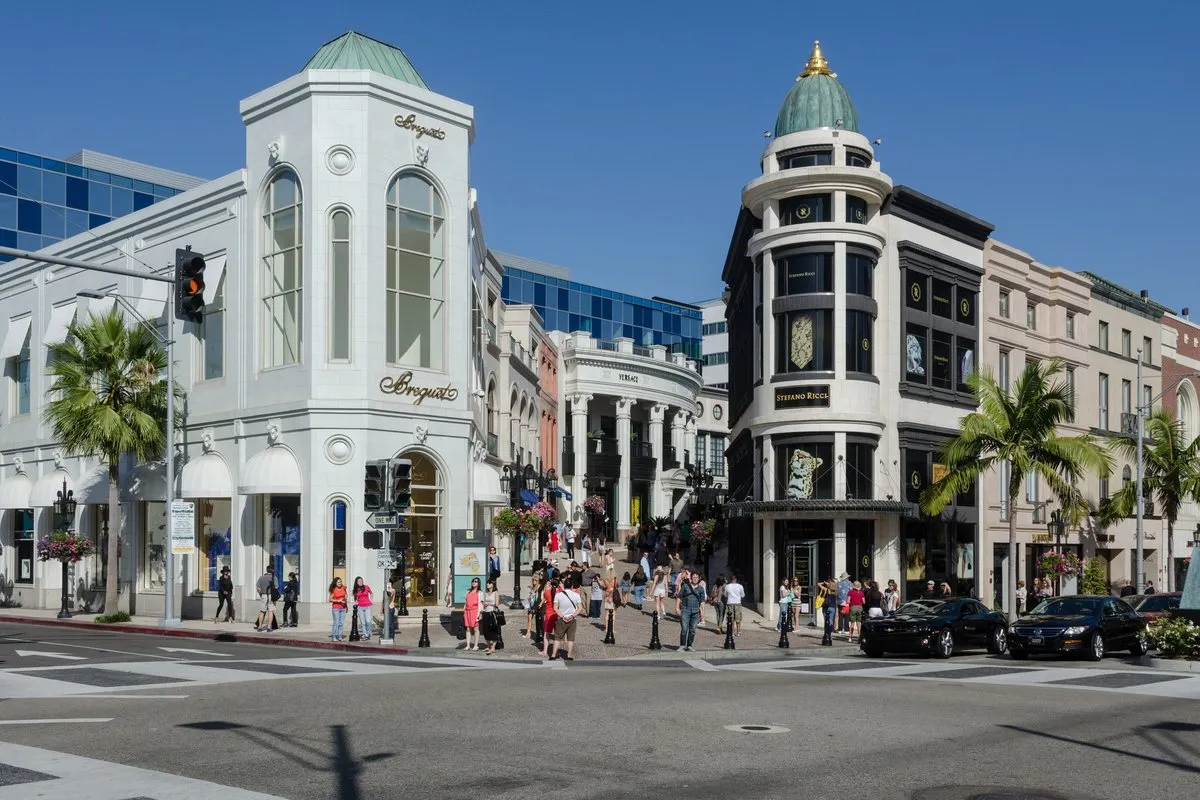
Three short blocks between Wilshire and Little Santa Monica made Beverly Hills a byword for luxury. The story of Rodeo Drive, the grand hotel at its foot and the pink palace on Sunset Boulevard – and how to spend a day there.
In this story · 6 sections
Rodeo Drive runs north from Beverwil Drive to Sunset Boulevard, mostly within Beverly Hills, a city of 32,701 people entirely surrounded, together with West Hollywood, by the City of Los Angeles. When people say Rodeo Drive, though, they mean three blocks: the stretch between Wilshire Boulevard and Little Santa Monica Boulevard, counted among the most expensive streets in the world. It is pronounced the Spanish way, ro-DAY-o.
It took barely a century for this corner of Los Angeles County to go from ranch land to global shorthand for luxury. Here is how it happened, and how to see it in a day.
01A rancho, a bean field and a failed oil hunt
The land was home to the Tongva people before the Spanish arrived; Gaspar de Portolá passed through in 1769 along native trails that roughly follow today's Wilshire Boulevard. In 1828 María Rita Quinteros de Valdez and her husband settled the Rancho Rodeo de las Aguas – the ranch of the gathering of the waters – which gave the street its name. Later owners farmed lima beans here.
In 1900 a group of investors led by Burton E. Green bought the ranch to look for oil. They found too little to exploit and, in 1906, reorganised as the Rodeo Land and Water Company, renamed the property Beverly Hills after Beverly Farms in Massachusetts, and began selling lots. Rodeo Drive was platted that year; parcels sold for $1,100 in 1907. The city was incorporated in 1914.
02How Rodeo became Rodeo
For decades the central part of Rodeo was an ordinary business street, with hardware stores, petrol stations and bookshops. The menswear store Carroll & Company arrived in 1950, and in 1952 Frank Lloyd Wright designed the Anderton Court Shops at 332 North Rodeo – still worth seeking out for its angular ramp. The transformation began in 1961, when Fred Hayman, later called the father of Rodeo Drive, opened Giorgio Beverly Hills, the street's first high-end boutique. Gucci followed in 1968, Van Cleef & Arpels in 1969 and, in 1971, the first freestanding Polo store.
That same year the Beverly Wilshire opened a new wing, which the Rodeo Drive Committee later credited with sparking the street's international turn. In 1977 the committee launched a campaign to make the world think of Rodeo Drive as the shopping street of the rich and famous. It worked.
03The Beverly Wilshire at the foot of the street
Start where Rodeo meets Wilshire. The Beverly Wilshire opened on 1 January 1928 as an apartment hotel, built by Walter G. McCarty on the site of the former Beverly Hills Speedway, in Tuscan stone and Carrara marble in the Italian Renaissance style. The architect Paul Revere Williams remodelled it between 1946 and 1957, and Hernando Courtright added the tower wing in 1971 on the site of the old pool, doubling its size. It has appeared in many films and television series.
04Walking the three blocks
Walk north on Rodeo from Wilshire to Little Santa Monica. Most of the great fashion and jewellery houses have flagships here, and the pavements are made for slow window-shopping rather than speed. Detour to Wright's Anderton Court, then continue north across Little Santa Monica and Santa Monica Boulevard, where Rodeo turns residential and climbs towards Sunset under its palms.
05Lunch at the pink palace on Sunset
At the top of the street, on Sunset Boulevard, stands the Beverly Hills Hotel. It opened in May 1912, before the city existed, commissioned by the widow Margaret J. Anderson and her son Stanley; Burton Green wanted it to draw buyers to his new subdivision, billing it as halfway between Los Angeles and the sea. The Mediterranean Revival building by Elmer Grey was first painted its famous pink in 1948, and Paul Williams added the Crescent Wing a year later.
In 1941 Hernando Courtright bought the hotel with friends including Irene Dunne, Loretta Young and Harry Warner and opened the Polo Lounge, where the Rat Pack, Humphrey Bogart and Marlene Dietrich were regulars. The hotel has 210 rooms and suites and 23 bungalows, has been part of the Dorchester Collection since 1996 and, in 2012, became the first historic landmark in Beverly Hills. Its photograph is on the cover of the Eagles' album Hotel California.
06Planning your day
The three blocks are compact: allow a morning for the shops, lunch on Sunset and an afternoon for the residential streets. More city guides are on our destinations page and the Metro Mode home page, and the Metro Mode camera reads the buildings around you as you walk.