 The Metro Mode 55
In this story · 5 sections
At the top of Pointe Saint-Hospice in Saint-Jean-Cap-Ferrat stand a small chapel, a bronze Virgin 11.4 metres high and two cemeteries that look out over the Mediterranean. The chapel was built in the eleventh century on the ruins of an earlier sanctuary, according to the village tourist office, and the French state has protected it as a Monument Historique since 13 May 1929; the headland around it became a classified site in 1932. The visit itself is short – the Nice Côte d'Azur tourist office allows about a quarter of an hour inside – but the chapel is also the natural pause on the signposted loop that circles the point, and it takes in almost everything that gives this end of the Cap its character: a hermit's legend, a Savoy duke's restoration, a merchant's vow cast in bronze and the graves of soldiers from a war fought far away. It is open every day of the year, from 10 am to 6 pm, and it costs nothing to go in.
Chapelle Saint-Hospice
Sight · Pointe Saint-Hospice
© OpenStreetMap contributors · OpenFreeMap
- Address
- 12 chemin de Saint-Hospice, 06230 Saint-Jean-Cap-Ferrat
- Open
- Daily, all year, 10 am–6 pm, public holidays included (Nov 2026)
- Tickets
- Free
- Time needed
- About 15 minutes for the chapel; 40 minutes for the 1.8 km loop
- Best time
- Any season – the loop is walkable all year
- Getting there
- About 2 km from the village; parking nearby
- Listed
- Monument historique since 13 May 1929
- Website
- saintjeancapferrat-tourisme.fr
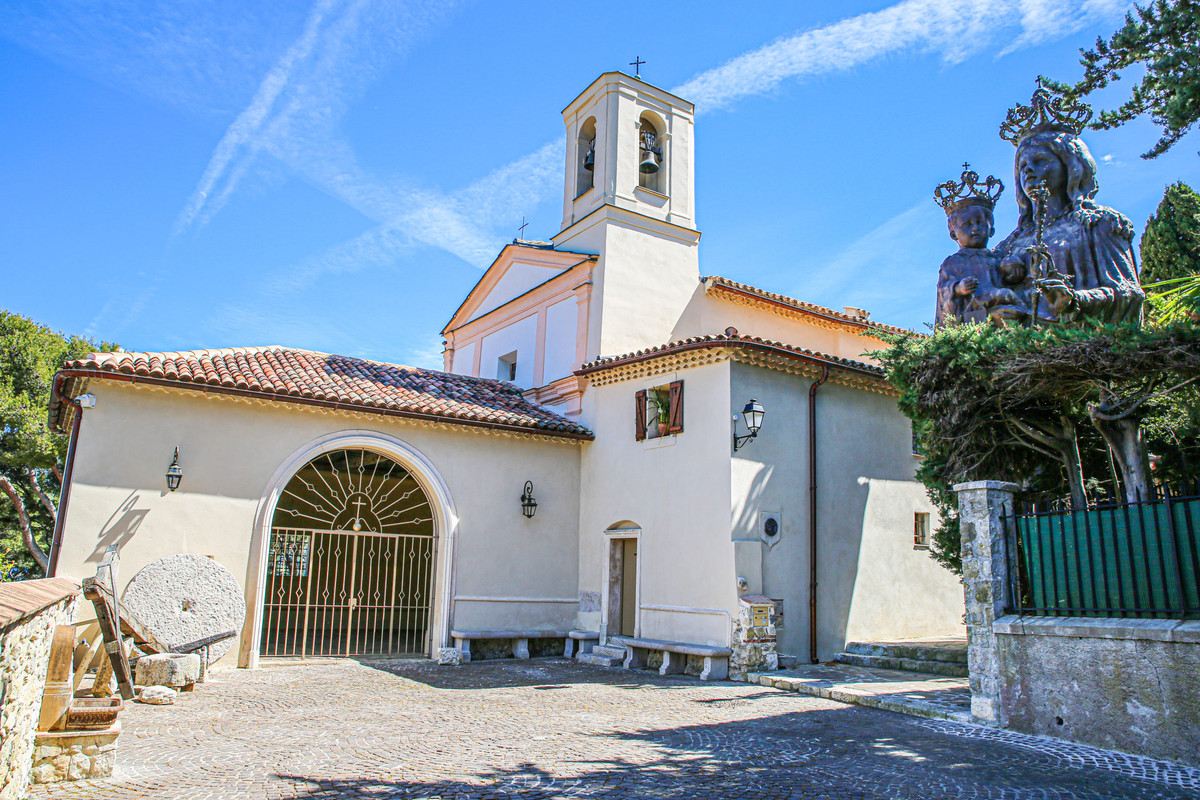
The Saint-Hospice chapel, with its bronze Virgin of 1903 and the cemetery by the sea, at the top of Pointe Saint-Hospice in Saint-Jean-Cap-Ferrat.
01The story
The chapel takes its name from Hospitius, a Benedictine monk who, the tourist office records, lived in one of the towers here around 575 AD in complete poverty, imposing hard penances on himself to earn his place in heaven. The legend told of him is that when the Lombards came down the coast, as he had foretold, one of them raised his sword against the hermit and found his arm suddenly paralysed; the soldier was later baptised and went off to preach. The healing of a deaf and mute man, a blind man and a woman possessed by demons is also credited to him.
The building you see owes its form to later centuries. Charles Emmanuel II, Duke of Savoy, had it fully restored in the seventeenth century – the national heritage register dates the main building campaign to 1655 – and it was extended and given an altar in the eighteenth. The porch was added in 1826. The commune owns the chapel, and it was last renovated between 2020 and 2022.
02What you see
For centuries this was a place of pilgrimage, and at one time it held as many as 140 ex-votos left by the faithful. Inside, the paintings to look for are those by Louis Marchand des Raux, which tell the life of Saint Hospice and the miracles attributed to him.
Insider tipOpen daily 10 am–6 pm, free. The 1.8 km loop round the point takes about 40 minutes.
Beside the chapel rises the bronze statue of the Virgin. A wealthy merchant from Nice commissioned it in 1903 after a vow of his was fulfilled, and it was sculpted by Tranquillo Galbusieri. It stands 11.4 metres high, and together with the bell tower it is what you see first as you come up the path.
Don't miss
Don't miss
- 01
The paintings by Louis Marchand des Raux on the life and miracles of Saint Hospice
- 02
The bronze Virgin of 1903, 11.4 metres high, by Tranquillo Galbusieri
- 03
The cemetery by the sea, laid out in 1905 at the foot of the chapel
- 04
The view from the tip of the peninsula towards Cap Martin, Monaco and Italy
03The two cemeteries
At the foot of the chapel and the Virgin lies the village cemetery, created in 1905 on land given by Auguste Gal, another wealthy merchant from Nice. The tourist office likens it to the end of the world, and it is easy to see why: it sits on the summit of the point and overlooks the open Mediterranean, a place for silence rather than sightseeing.
Just below the chapel is a smaller military cemetery with a story of its own. It holds Belgian soldiers of the First World War who died at Villa Les Cèdres, the Cap Ferrat estate of King Leopold II of Belgium, which his nephew Albert I had turned into a military hospital.
04The walk round the point
The best way to arrive is on foot. The Pointe Saint-Hospice interpretation trail is a signposted loop of 1.8 km with six observation points and only about 15 metres of climbing; the tourist office allows 40 minutes. It runs through maritime pines to the Pointe du Colombier, where the limestone has been worn by spray and salt. A little further on, the Edmund Davis path branches off to the top of the point and the chapel – about 20 minutes there and back. From the tip of the peninsula the view runs to Cap Martin, the Principality of Monaco and as far as Italy. The loop then reaches the cove of the Anse de la Scaletta, climbs a flight of steps back to the Saint-Hospice road and ends at the Jardin de la Paix, with its Coexist fountain.
05How to visit
The chapel is open daily throughout the year, public holidays included, from 10 am to 6 pm, and entry is free. It lies about two kilometres from the village centre, with parking nearby, and it is accessible to wheelchair users with assistance. The walking loop is a different matter: the ground is rock and grit in places, and the tourist office marks it as unsuitable for pushchairs. Allow an hour for the loop and the chapel together, and wear proper shoes.