Georgia's oldest city still follows the grid its founder drew in 1733: a chequerboard of 22 leafy squares between the river and a great park. A slow day in Savannah, from the bluff where the colonists landed to the cemetery that made a bestseller.
In this story · 6 sections
Savannah, on the Savannah River near the Atlantic coast, is the oldest city in Georgia. It was the capital of the colonial Province of Georgia and the state's first capital, a strategic port in both the Revolution and the Civil War, and is still an important seaport, with 147,780 people at the 2020 census. Millions of visitors come each year for its cobbled streets, its parks and its historic buildings.
Above all they come for the town plan. Downtown Savannah, with its Historic District and Victorian District, became one of the largest National Historic Landmark Districts in the United States in 1966, and it still follows the grid laid out by its founder.
01Morning: the bluff where Georgia began
Begin by the river at Yamacraw Bluff. On 12 February 1733 General James Oglethorpe and the settlers of the ship Anne landed here and were greeted by Tomochichi, leader of the Yamacraw, and by the traders John and Mary Musgrove; Mary often served as interpreter. City and colony were founded that day. Savannah became the capital of a royal colony in 1751, was taken by the British in 1778, withstood a failed siege by American and French troops, including Haitian soldiers, in 1779, and was not evacuated by the British until July 1782.
02The Oglethorpe Plan and its squares
Oglethorpe's design, known as the Oglethorpe Plan, organised the town in wards around open squares. Today 22 park-like squares remain, shaded by trees and threaded through the grid, so that every few blocks the street opens onto a garden. The best way to see them is simply to walk south from the river, square by square.
Along the way you pass some of the city's notable buildings: the birthplace of Juliette Gordon Low, founder of the Girl Scouts of the USA; the Telfair Academy, one of the South's first public museums; the First African Baptist Church, one of the oldest African-American Baptist congregations in the country; and Temple Mickve Israel, the third-oldest synagogue in the United States. The Georgia Historical Society is the oldest continually operating historical society in the South.
03Afternoon: Forsyth Park
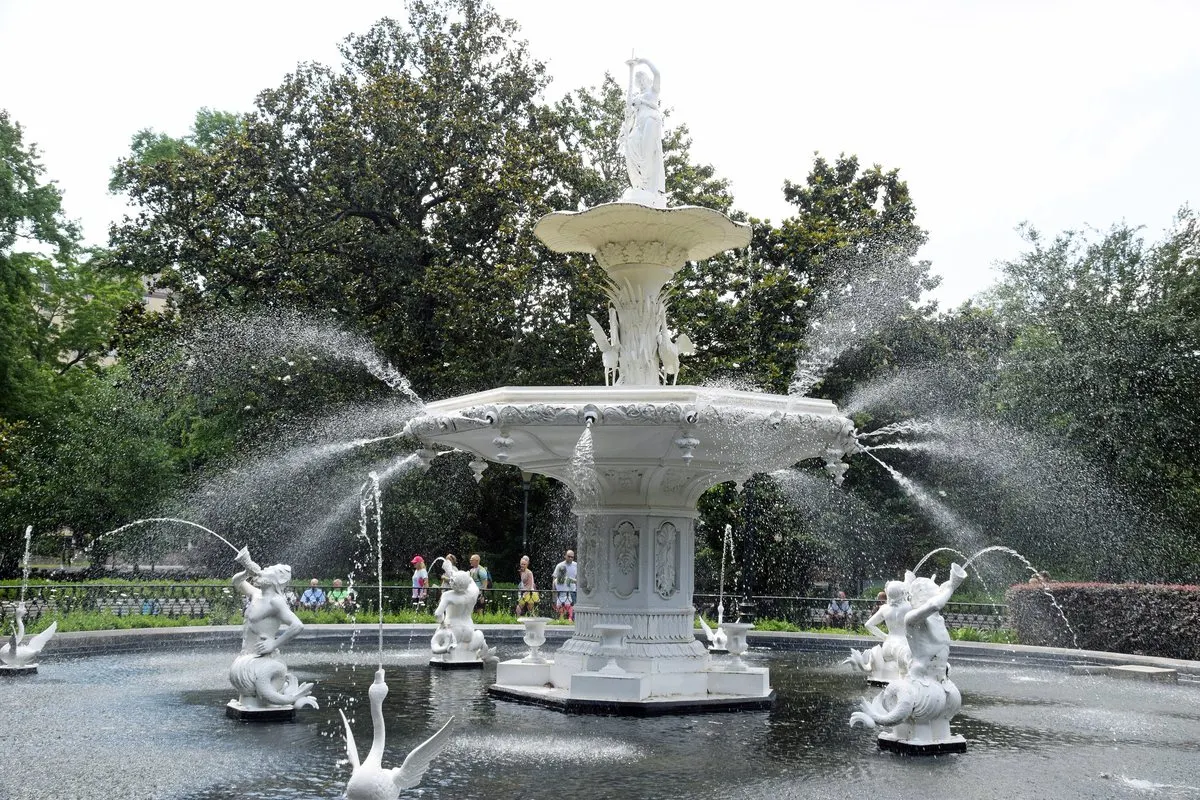
The squares lead to Forsyth Park, a large park bordered by Gaston, Drayton and Whitaker streets and Park Avenue. It was created in the 1840s on land donated by William Brown Hodgson, expanded in 1851 and named after Governor John Forsyth; a parade ground was added at its southern end in the 1850s. Its large fountain is the city's best-known image. The park also has walking paths, a Fragrant Garden for the blind, sports courts and the home pitch of the Savannah Shamrocks Rugby Club, and hosts free concerts from time to time.
04The railway roundhouse
On the western edge of downtown, the Central of Georgia Railway roundhouse complex is the oldest standing antebellum rail facility in the United States. It is now a museum and visitor centre – a good place to start or finish your walk.
05Late afternoon: Bonaventure Cemetery
South-east of downtown, on a bluff above the Wilmington River, lies Bonaventure Cemetery, the largest of the city's municipal cemeteries, on the site of the former Bonaventure Plantation. The first burials took place in 1850, and the city bought it in 1907, making it public. In 1867 the naturalist John Muir, on his Thousand-Mile Walk, spent six nights here sleeping among the graves while waiting for money from home, and wrote a chapter about it called Camping in the Tombs.
The cemetery became famous through John Berendt's 1994 novel Midnight in the Garden of Good and Evil and Clint Eastwood's film of the book. The Bird Girl statue on the cover had stood unnoticed in the cemetery for more than 50 years; it was moved for display elsewhere in 1997. Just inside the gates is the ornate Gaston Tomb. Bonaventure is open daily from 8am to 5pm, and admission is free.
06Planning your visit
Downtown is flat and best explored on foot; take a taxi to Bonaventure. Spring and autumn are the most comfortable seasons. More guides are on our destinations page, the Metro Mode home page and the Metro Mode camera.