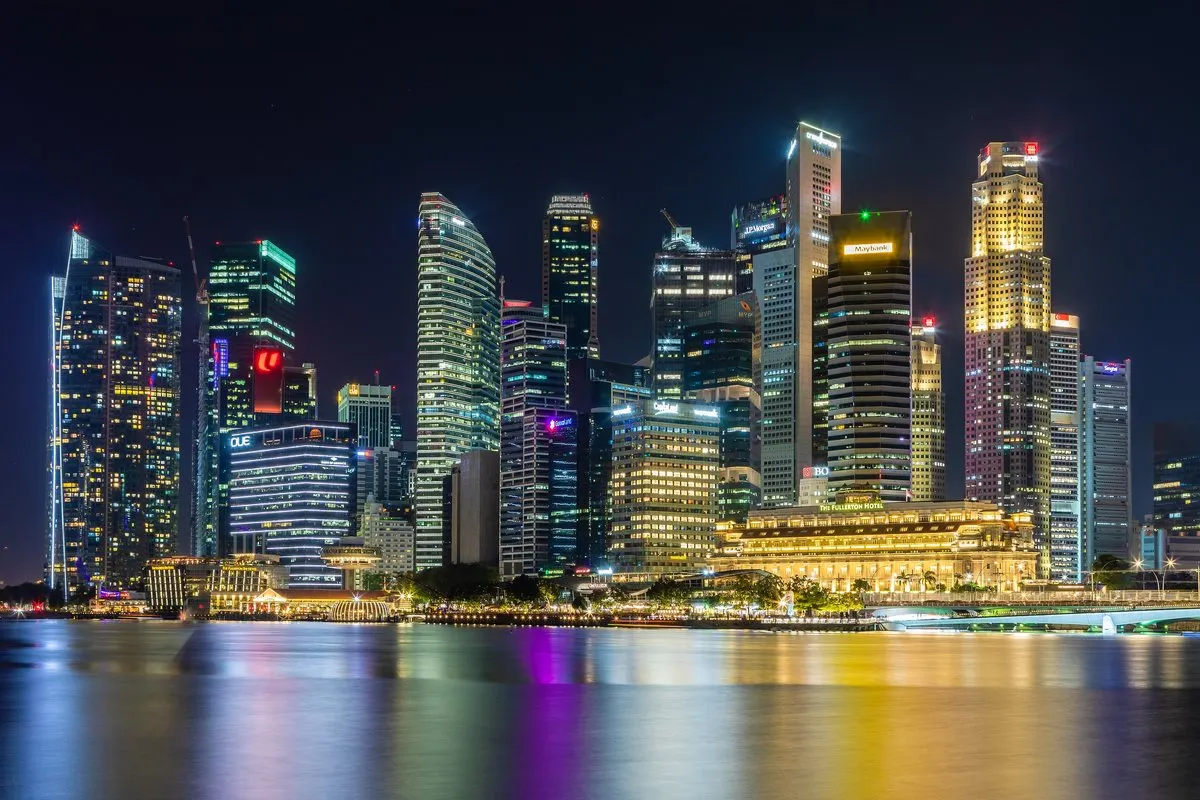
A ten-room hotel by the beach in 1887, a bay reclaimed from the sea over four decades and a garden city that set out to become a city in a garden. A day and an evening between colonial Singapore and its new downtown.
In this story · 5 sections
Few cities have reinvented themselves as deliberately as Singapore. Within walking distance of each other stand a hotel that opened in a beach house in 1887 and a downtown that did not exist until land was reclaimed from the sea in the late twentieth century. This route links the two – colonial Singapore in the morning, the new waterfront by afternoon and evening.
01Morning: Raffles Hotel
Start at 1 Beach Road, at the Raffles Hotel. It began as a private beach house built in the early 1830s, became Emerson's Hotel in 1878, and was taken over by the Armenian hoteliers the Sarkies Brothers, who opened the ten-room Raffles Hotel on 1 December 1887, naming it after Stamford Raffles, founder of modern Singapore. Wings followed in 1890 and the Palm Court Wing in 1894, and in 1899 a new main building by Regent Alfred John Bidwell of Swan and Maclaren gave Raffles powered ceiling fans and electric light – the first hotel in the region to have it.
The hotel's stories are part of its charm. In 1902 a tiger that had escaped from a circus was shot beneath the raised Bar and Billiards Room. When Japanese troops occupied Singapore on 15 February 1942, guests are said to have been dancing a last waltz, while staff buried the hotel silver in the Palm Court; during the occupation the hotel was renamed Syonan Ryokan. Raffles became a national monument in 1987. It is the flagship of Raffles Hotels & Resorts, managed by Accor and owned since 2010 by Qatar's Katara Hospitality.
02Afternoon: the new downtown
Walk south to Marina Bay, where four rivers – the Singapore, Kallang, Geylang and Rochor – meet. Reclamation began in 1954 and was completed in 1992, creating 360 hectares of waterfront land and redirecting the Singapore River into the bay rather than the sea. The 1983 master plan insisted the waterfront be kept open to the public, and a 3.5-kilometre Waterfront Promenade, crossed by the Helix Bridge, now encircles the bay. In 2008 the Marina Barrage turned the basin into a freshwater reservoir. Since 2008 the bay has also been the backdrop for the Formula One Singapore Grand Prix on a street circuit.
03Marina Bay Sands and the SkyPark
The skyline is dominated by Marina Bay Sands, designed by Moshe Safdie and opened in 2010 – at the time the world's most expensive standalone casino property. Its three hotel towers, with 1,850 rooms, are joined at the top by the Sands SkyPark, set on the world's largest public cantilevered platform, with its famous infinity pool. Below are a luxury mall, a 2,183-seat theatre and the ArtScience Museum, whose light, laser and water show, Wonder Full, plays over the bay in the evening.
04Evening: Gardens by the Bay
End the day at Gardens by the Bay, announced in 2005 as part of the plan to turn Singapore from a Garden City into a City in a Garden. Bay South Garden, designed by Grant Associates on the theme of an orchid – Singapore's national flower is the Vanda Miss Joaquim – opened in June 2012. Its two cooled conservatories are the Flower Dome, the largest glass greenhouse in the world, and the Cloud Forest, and its Supertrees glow after dark. The gardens had more than 50 million visitors by 2018 and in 2024 were ranked the best attraction in Asia in TripAdvisor's Travellers' Choice awards.
05Planning
Singapore is hot and humid all year: do the outdoor walking early and late, and the conservatories in the heat of the day. For more, see our destinations, the Metro Mode camera and our list of hotels worth a single night.