In this story · 4 sections
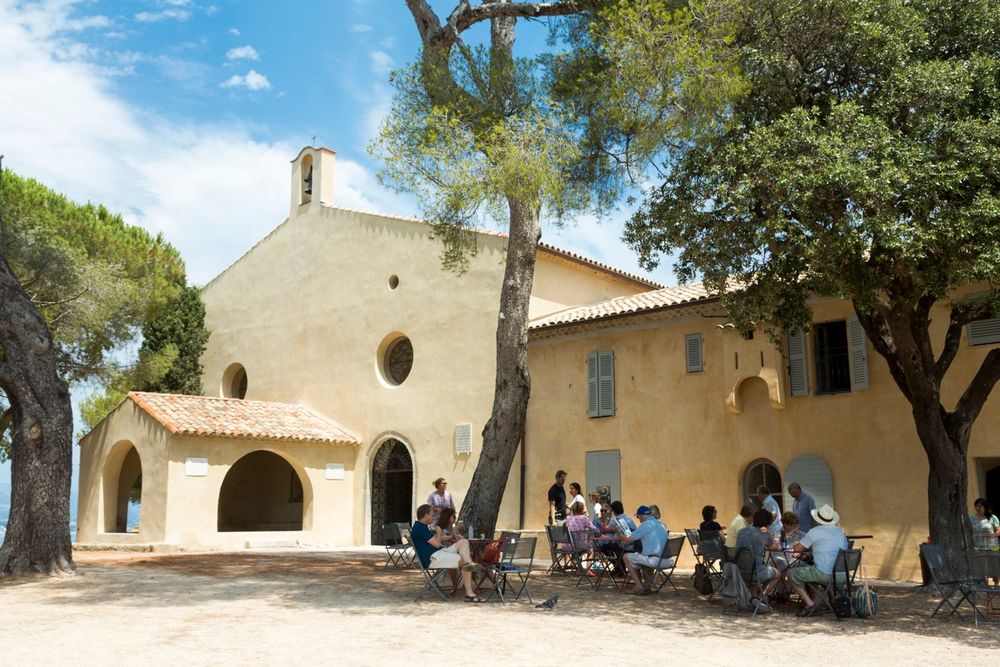
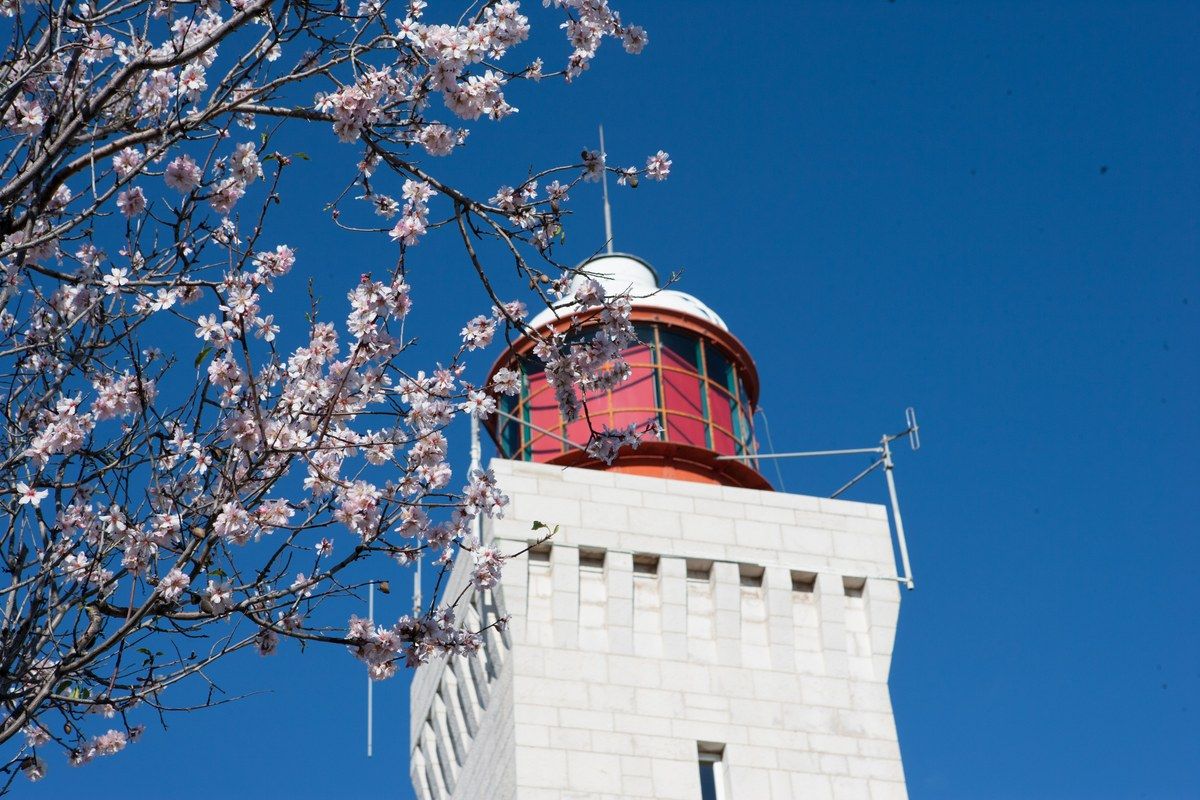
Cap d'Antibes rises gently from the sea to a single high point, and that is where everything on the peninsula seems to meet. The Garoupe plateau stands about 75 metres above the water, a flat crown of pines and holm oaks with three buildings that have watched this coast for a very long time: a square white lighthouse, a French navy semaphore and the twin-naved chapel of Notre-Dame de la Garoupe, its walls hung with some 300 ex-votos left by sailors and their families. Pilgrims have climbed here for around a thousand years, most of them by the stone path that rises from the beach at La Salis, and the reward has not changed: on a clear day the view runs from Italy to Cap Camarat, with the Alps to the north and, early in the morning, Corsica on the horizon. Since the lighthouse reopened to visitors in 2023, after some 25 years behind closed doors, you can climb its 116 steps and take in the same panorama from higher still. Entry to all of it is free.
Plateau de la Garoupe
Sight · Cap d'Antibes
© OpenStreetMap contributors · OpenFreeMap
- Address
- Route du Phare, Plateau de la Garoupe, 06160 Antibes
- Tickets
- Free – chapel and lighthouse
- Time needed
- About two hours on foot from La Salis and back
- Best time
- Early morning, for the clearest view
- Getting there
- Chemin du Calvaire from Plage de la Salis, or Route du Phare by car
- Telephone
- +33 4 93 61 45 32
- Website
- antibesjuanlespins.com
- Altitude
- About 75 m
- Chapel open
- Mon–Fri 2–5.30pm; Sat–Sun 10am–5.30pm
- Lighthouse open
- Sat–Sun 10am–5pm; Wed–Sun in school holidays
- Lighthouse information
- +33 4 93 61 45 32
The high point of Cap d'Antibes, with the Garoupe lighthouse, the chapel of Notre-Dame de la Garoupe and its ex-votos, and an orientation table looking from Italy to Cap Camarat.
01The story
Legend places a sanctuary to Selene, the moon goddess, on the plateau in antiquity, and tradition holds that Saint Helena, mother of the emperor Constantine, asked for a chapel here when she stopped at Antipolis, as Antibes was then called. Christian pilgrimages are recorded from around the year 1000, and the millennium was celebrated in 1981. The tourist office describes three buildings whose order is hard to pin down: a watchtower, first in wood and rebuilt in mortar in the fifteenth century; the chapel of Notre-Dame de la Garde, probably late medieval and enlarged after a donation from René de Savoie in 1520; and the chapel of Sainte-Hélène, joined to it by a porch. The sanctuary came through the Revolution with its contents intact and was listed as a historic monument on 29 October 1926.
The lighthouse has its own history of loss. A round tower was built in 1836 at the request of Admiral Duperré, navy minister under Louis-Philippe, and first lit on 1 July 1837; it was electrified in 1929. On 23 August 1944, the day before Antibes was liberated, German troops destroyed it. Reconstruction was approved in February 1947 and the light shone again in 1948 from the square tower that stands today, 29 metres of white limestone. It is still a working light under the state's Phares et Balises service, flashing twice every ten seconds with an intensity of more than 2.3 million candelas – visible some 60 kilometres out to sea and nearly 100 kilometres from the air. The Conservatoire du Littoral owns it and the city of Antibes runs the visits, after €266,000 of works that added a landscaped garden, a ramp and a virtual tour.
02What you see: the chapel
Inside, each of the two naves keeps its own Madonna. The main nave belongs to Notre-Dame de la Garde, whose statue stands in a gilded altarpiece carved in 1710 by Joseph Dolle – the sculptor also credited with the doors of Antibes cathedral – and restored in 2017. A fresco painted by Jacques-Henri Clergues in 1952–53 recalls Pope Gregory XI's stop in Antibes in 1376 and René de Savoie's gift. The second nave is for Notre-Dame de Bon Port, patron of Antibes and its sailors; her statue, carved from the trunk of a fig tree, holds a three-masted ship, and the wall beside her carries Édouard Collin's 1948 fresco of the town's sailors and citizens. Look out, too, for a Byzantine icon dated 1575, an Assumption from the school of Bréa and objects brought back from the siege of Sevastopol.
Insider tipFree. Chapel open daily; lighthouse at weekends and Wednesday to Sunday in school holidays.
What brings most people inside, though, are the ex-votos – some 300 of them, on every wall. They are paintings, drawings and carved objects left in thanks for a rescue at sea, an illness survived or a war come through, and together they read like a five-century logbook of the town. The oldest dates from 1506. One gives thanks for a shipwreck survived in the Bay of Bengal in 1857; another comes from a survivor of the sinking of the Varyag at Chemulpo Bay in 1904; one, less piously, thanks Notre-Dame de Bon Port for helping a convict escape the penal colony at Toulon and start a new life in the West Indies.
Once a year the sanctuary comes down to the town. On the first Thursday of July, the sailors of the Corporation des Marins d'Antibes carry the statue of Notre-Dame de Bon Port down the Calvaire path to Antibes cathedral, barefoot and dressed in blue and white – a festival said to date from the sixteenth century, in thanks for the Madonna credited with driving the plague out of Antibes. She returns to the plateau on the following Sunday.
03What you see: the lighthouse and the view
The lighthouse visit is short and well organised. Groups of ten go up roughly every 20 to 25 minutes: there is a garden at the foot of the tower, an interactive virtual tour of the interior on the ground floor, then the 116 steps of the spiral staircase to the lookout balcony, 103 metres above the sea, where the great lens now sits under a transparent cover. The garden and the ground floor are accessible to visitors with reduced mobility.
Back on the ground, walk to the orientation table at the edge of the plateau and the coast lays itself out: west past the Esterel as far as Cap Camarat near Saint-Tropez, east to Italy, with the Alps and the Mercantour rising behind. The tourist office advises coming early in the morning if you hope to see Corsica. Around the buildings, the nine-hectare Garoupe wood, a holm-oak forest owned by the Conservatoire du Littoral, is open all year, and a small oratory designed by Raymond Peynet – Notre-Dame des Amoureux protégeant les foyers – stands on the plateau.
04How to visit
Walk up. From the car park at Plage de la Salis, follow the seafront and Boulevard James Wyllie past the little port, then turn right at the bend into the Chemin du Calvaire. This is the old pilgrims' way, a stone path lined with the stations of the cross, climbing about 100 metres through the pines to the orientation table. The tourist office allows two hours for the round trip and rates it medium; wear proper shoes. To come down another way, take the Route du Phare, then Avenue Aimé Bourreau on the left as far as Boulevard Grand Bacon, and rejoin the Chemin du Calvaire towards the sea.
By car, the Route du Phare climbs all the way to the top, where there is paid parking, public toilets and Le Bistrot du Curé, a small café under the pines behind the chapel. The chapel opens every afternoon and from 10am at weekends; the lighthouse opens at weekends all year and from Wednesday to Sunday in the school holidays. Both are free.