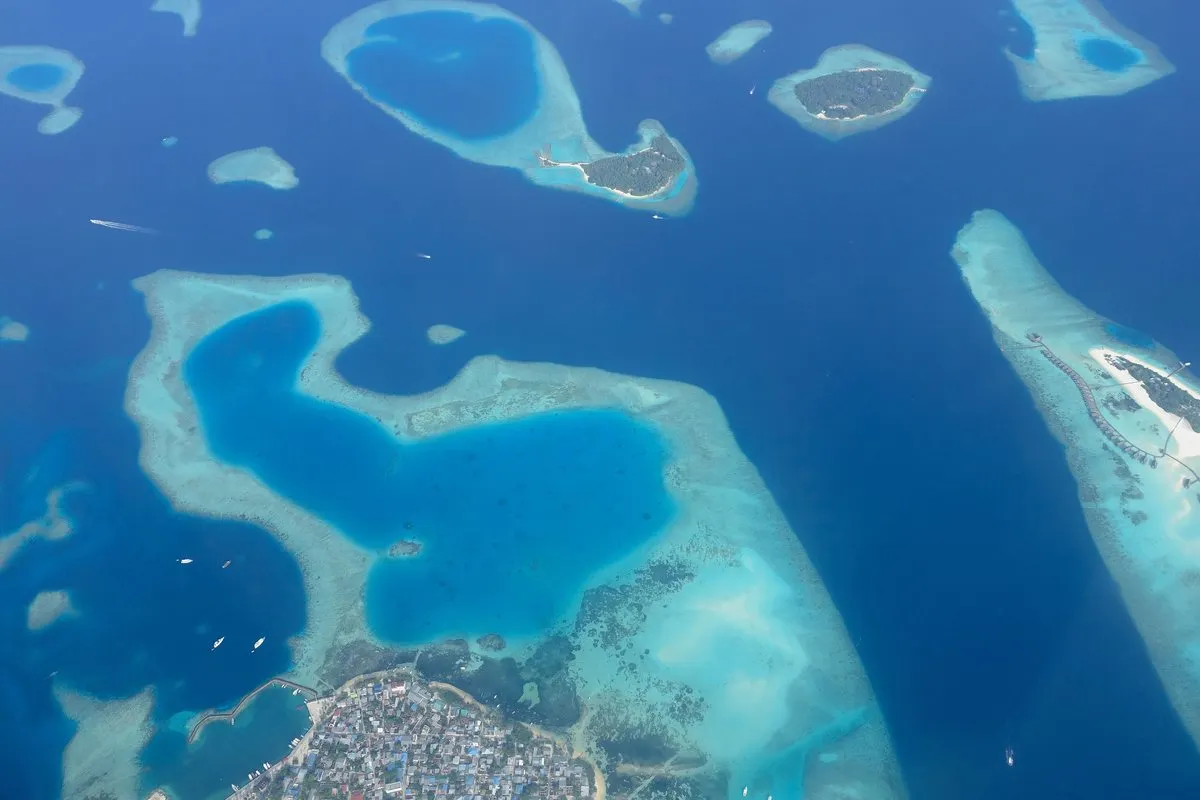
The lowest country on Earth gave the world the word atoll, opened its first resort only in 1972 and now has more than 130 of them, each on its own island. How the Maldives works, how to choose where to stay and why to spend a day in Malé.
In this story · 5 sections
The Republic of Maldives lies in the Indian Ocean south-west of India and Sri Lanka: a chain of 26 atolls stretching across the equator from Ihavandhippolhu in the north to Addu in the south. It is the smallest country in Asia by land area, yet spread over a vast expanse of sea, and with an average ground level of only about a metre and a half, it is the lowest-lying country on Earth. All its land is of coral origin; the very word atoll comes from the Maldivian language.
For most visitors the Maldives means a resort on an island of its own. Understanding how the islands are organised makes it far easier to choose.
01A garland of islands
The name may come from the Sanskrit for garland and island – or, as Malé's historians have it, from the islands of Malé. People have lived here for more than 2,500 years. Arab travellers arrived around 947, Islam took hold in the twelfth century, and the islands became a sultanate trading with Asia and Africa. They were a British protectorate from 1887, became independent in 1965 and a republic in 1968. The atolls were so treacherous to navigate that the charts drawn by the British captain Robert Moresby in 1834–36 were still used by Maldivian pilots until the 1990s.
02One island, one resort
Tourism is a recent arrival. A United Nations mission in the 1960s judged the islands unsuitable, but in 1972 President Ibrahim Nasir backed the first resort, Kurumba Island, followed by Bandos; together they had about 280 beds. The model that grew from them – one resort per island – still defines the country. In 2018 there were 130 island resorts, and today there are more than 130 spread across the atolls. Tourism is the largest industry, and the country welcomes well over a million visitors a year.
Choosing a resort is largely choosing an atoll. Islands in North and South Malé atolls are closest to the international airport and quickest to reach; those further out, in atolls such as Baa, Raa or Lhaviyani, take longer to reach but feel more remote. Since 2009 a change in the rules has also allowed visitors to stay in guesthouses on local inhabited islands – a very different and far more affordable way to see the country.
03A day in Malé
Most visitors fly straight from the airport island to their resort, but the capital deserves a few hours. Malé – traditionally the King's Island, where the royal dynasties ruled – is one of the most densely populated cities in the world, with more than 200,000 people in its city area, and has been enlarged by land reclamation. Its old walls, forts and Royal Palace were swept away after the monarchy was abolished in 1968, but the seventeenth-century Hukuru Miskiy, the Friday Mosque, built of coral stone, survives as one of the oldest mosques in the country. The commercial harbour on the central island is the hub of the nation's trade, and Velana International Airport is on neighbouring Hulhulé.
04The reefs – and their future
The coral reefs are the reason most people come, for snorkelling, diving and the colours of the lagoons. They are also fragile. Few countries are more exposed to climate change: rising seas, stronger storms, coastal flooding and coral bleaching threaten both the islands and the attractions that sustain them. Choose resorts and operators that take reef protection seriously.
05Planning
Arrivals peak in winter and early spring and dip in May and June. The Maldives is a Muslim country, so dress modestly on local islands and in Malé. For more ideas, see our destinations, the Metro Mode home page and our list of hotels worth a single night.