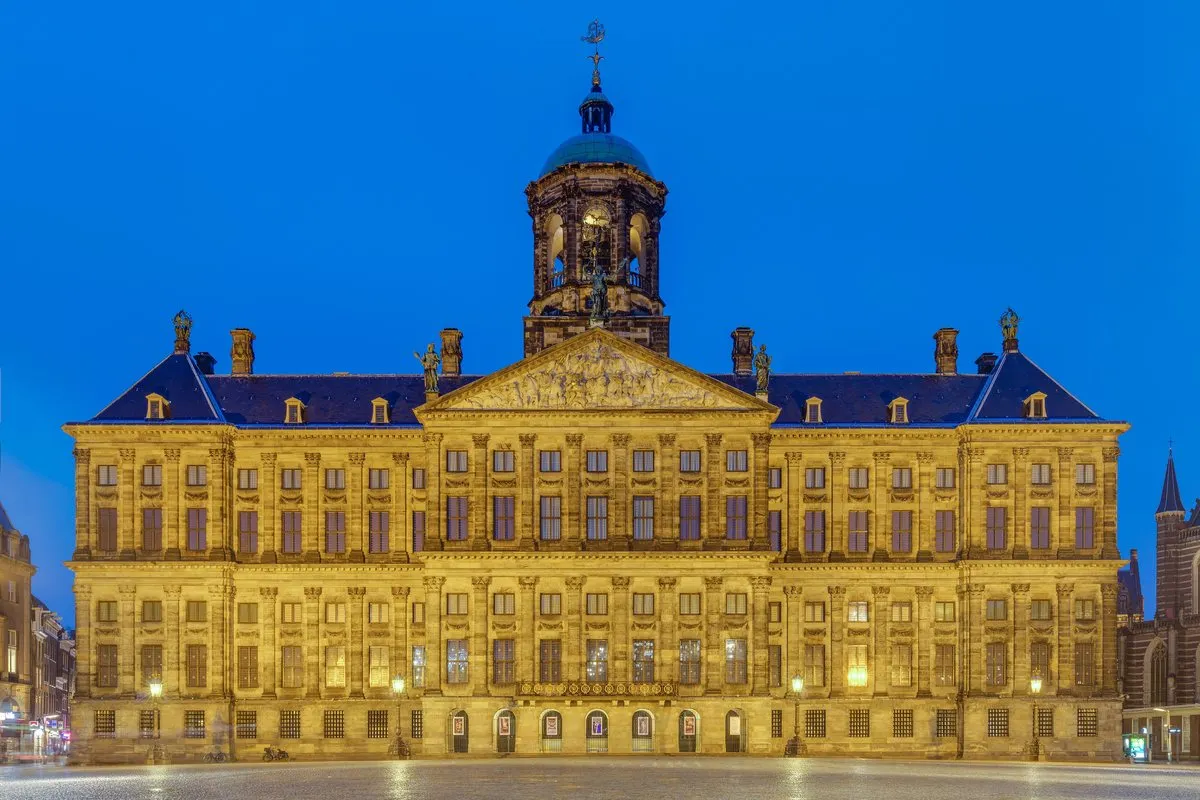
Amsterdam's Royal Palace was built as the city's town hall at the height of the Golden Age and rests on 13,659 wooden piles. Louis Bonaparte turned it into a palace in 1808, and the Dutch monarch still uses it for state visits. Here is the story of the building on Dam Square – and how to visit it.
In this story · 5 sections
The Royal Palace of Amsterdam, the Koninklijk Paleis, stands on the west side of Dam Square in the centre of the city, opposite the National Monument and next to the Nieuwe Kerk. Built in the 17th century as Amsterdam's town hall, it is one of the most important buildings of the Dutch Golden Age. Today the King uses it for state visits and official receptions, and its public floors are open as a museum most days of the year.
Royal Palace of Amsterdam
Palace · Centre
- Address
- Dam, Amsterdam
- Piles
- 13,659
- Owner
- Kingdom of the Netherlands since 1936
- 1648
- Construction begins
- 1655
- Town hall opened
- 1808
- Louis Bonaparte's royal palace
- 1936
- Owned by the Kingdom of the Netherlands
Built from 1648 by Jacob van Campen; royal palace since 1808.
01A Golden Age town hall by Jacob van Campen
At the height of its wealth, Amsterdam wanted a town hall to match its status as one of the richest cities in the world. Work began in 1648, with Jacob van Campen as the main architect, and the mayor Cornelis de Graeff opened the new town hall in July 1655, though building continued for years afterwards. On the marshy Amsterdam ground, the whole structure was built on 13,659 wooden piles.
02Louis Bonaparte's royal palace
In 1806 Napoleon made his brother Louis Bonaparte King of Holland. Louis moved to Amsterdam in 1808 and took over the town hall as his royal palace; the public rooms became a national museum that opened in 1809 – the first home in Amsterdam of the collection that became the Rijksmuseum. After the fall of Napoleon the building remained a royal palace, and it has been owned by the Kingdom of the Netherlands since 1936.
03The palace today
The monarch uses the palace for state visits, official receptions and other royal occasions, and when it is not in use its public floors function as a museum. The vast state rooms are among the most impressive interiors of the Golden Age, built to show off the power and prosperity of the city that paid for them.
04Dam Square and the Nieuwe Kerk
Dam Square takes its name from the dam on the River Amstel around which Amsterdam grew. Next to the palace stands the Nieuwe Kerk, and across the square the National Monument commemorates the Second World War. From the Dam it is a short walk west to the canal ring.
05How to visit the Royal Palace
Check the palace's opening days before you go, as it closes for royal occasions. Combine a visit with a walk along the canal ring and the Rijksmuseum on Museumplein. Read Metro Mode's Amsterdam guide (in Swedish), browse Metro Mode Travel, and find more city guides among metromode.co's destinations.