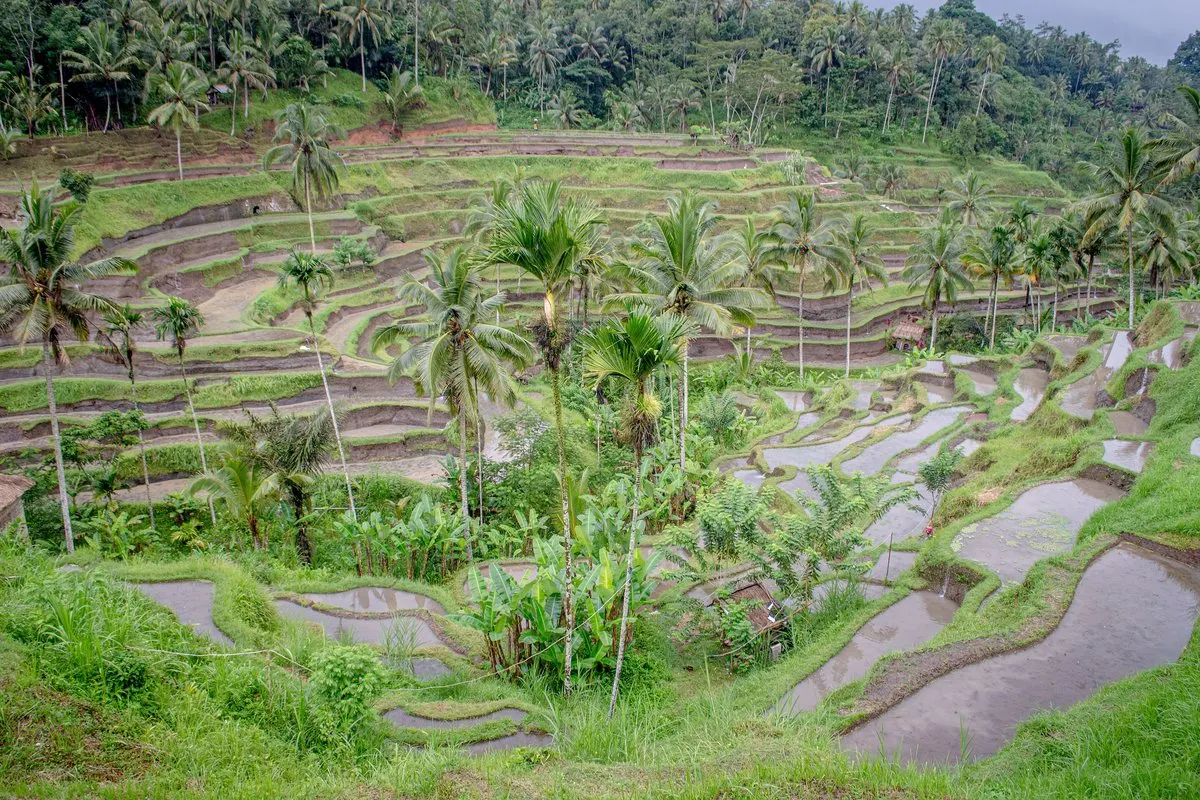
More than three million foreign visitors a year come to a Balinese town whose name means medicine. Ubud beyond the crowds: the river meeting where a Javanese priest built a temple in the eighth century, the palace courtyard where dancers still perform and the rice fields all around.
In this story · 6 sections
Ubud is a town in the Gianyar Regency of Bali, in the island's central foothills, promoted for decades as Bali's centre of arts and culture. Its central village has fewer than 12,000 inhabitants yet receives more than three million foreign visitors a year – since 2018, more than Denpasar. Around it lie farms, rice paddies and plantations. To see beyond the souvenir shops, go back to where the town began.
01Campuhan: the confluence
According to an eighth-century legend, a Javanese priest, Rsi Markandya, meditated at Campuhan, where two rivers meet – an auspicious place for Hindus – and founded the Gunung Lebah temple on the valley floor. It remains a place of pilgrimage, where worshippers come to meditate, bathe and collect holy water. Markandya is also credited with the shared irrigation system for the terraced fields still used by Bali's farmers, and with inspiring the banjar, the village councils that run community and religious life. The town itself takes its name from ubad, medicine, after the healing plants that grew here.
02Puri Saren Agung, the palace
At the crossing of Jalan Raya Ubud and Jalan Monkey Forest stands Puri Saren Agung, the Ubud Palace. Ubud's lords owed allegiance to the kings of Gianyar and were generous patrons of the arts. The palace in its present form was built in traditional Balinese style during the reign of Tjokorda Putu Kandel (1800–1823), restored after the 1917 earthquake and opened to foreign guests in 1928 – one of Ubud's first hotels. Many of its stone carvings are by the artist I Gusti Nyoman Lempad. It still belongs to the royal family, and dance performances and ceremonies are held in its courtyard: an evening show here is the most atmospheric introduction to Balinese dance.
03The Sacred Monkey Forest
Walk south down Jalan Monkey Forest to Mandala Suci Wenara Wana, the Sacred Monkey Forest Sanctuary in Padangtegal. Around 1,260 Balinese long-tailed macaques lived here in 2023, among more than 115 species of trees. The forest is run according to the Hindu principle of tri hita karana – harmony between people, nature and the divine – and holds three temples, apparently built around 1350: Pura Dalem Agung Padangtegal, the temple of death; Pura Beji, a holy-spring bathing temple; and Pura Prajapati, beside a cemetery where bodies rest until the mass cremation held every five years. Do not feed the monkeys, keep bags closed and respect the areas reserved for worship.
04Artists and writers
Ubud's artistic reputation grew in the twentieth century. The Spanish-American painter Antonio Blanco lived here from 1952 until his death in 1999, and in the 1960s the Dutch painter Arie Smit inspired the Young Artists movement. After the 2002 bombings hit tourism across Bali, the town founded the Ubud Writers and Readers Festival, now one of its annual highlights.
05Around Ubud
Spend a day outside town. Goa Gajah, the Elephant Cave, lies in a steep valley near Bedulu; Gunung Kawi is the site of royal tombs; and at Pejeng the Moon of Pejeng, from around 300 BC, is the largest single-cast bronze kettle drum in the world. North of town, the stepped rice terraces show the old irrigation system at work.
06Getting around
Metered taxis and ride-hailing pick-ups are not permitted in Ubud; fares are negotiated with the local taxi cooperative and are much higher than elsewhere, so agree the price before you set off. For more, see our destinations, the Metro Mode home page and our list of hotels worth a single night.