 The Metro Mode 55
In this story · 4 sections
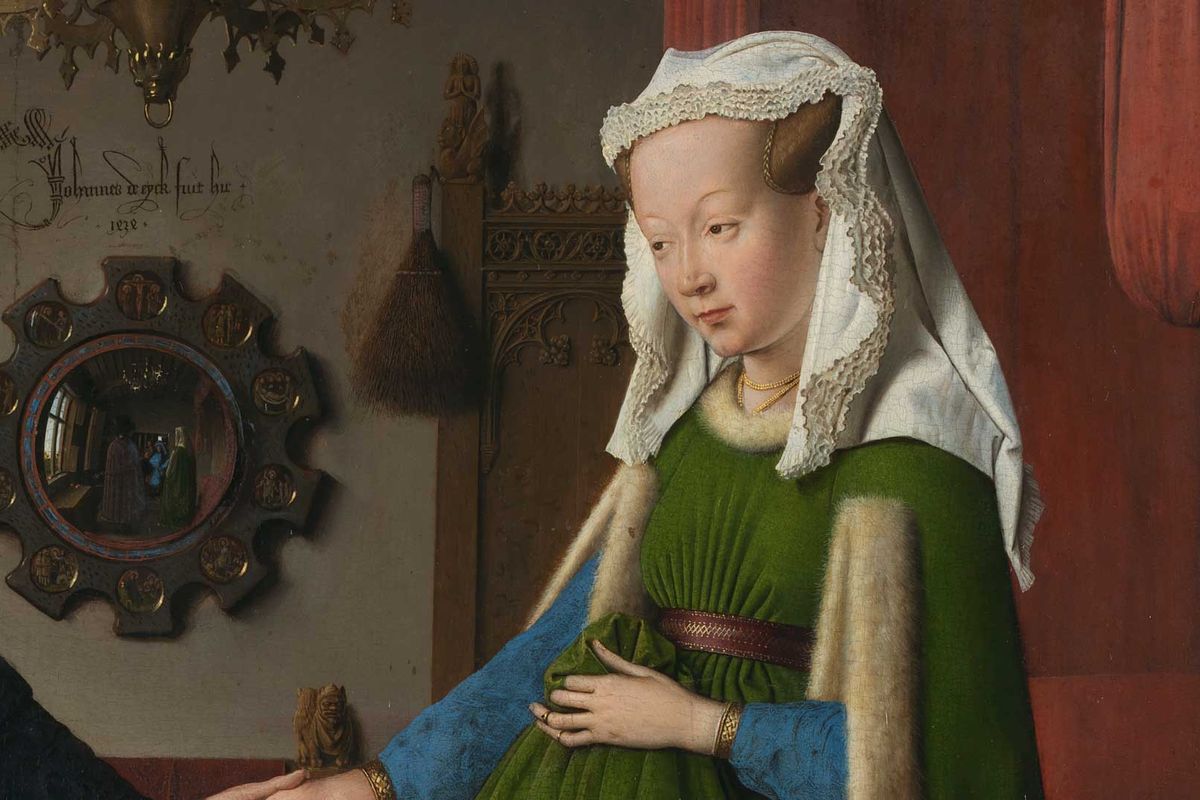
Jan van Eyck was active from 1422 to 1441, and some twenty pictures from his own hand survive. Nine of them are painted portraits, and from 21 November 2026 the National Gallery hangs all nine together, something that has never been done before and that the Gallery says can happen only this once. Van Eyck: The Portraits occupies the Ground Floor Galleries until 11 April 2027, with loans from Vienna, Berlin, Bruges and Dresden beside the Gallery's own Arnolfini Portrait of 1434. The sitters are not kings or queens. They are merchants, craftsmen and the painter's own family, set down with the stubble, the wrinkles and the bloodshot eyes left in, and the National Gallery makes the case that portraiture as it is now understood begins with them.
The National Gallery
Exhibition · Trafalgar Square
© OpenStreetMap contributors · OpenFreeMap
- Until
- 11 April 2027
- Dates
- 21 November 2026 – 11 April 2027
- Venue
- Ground Floor Galleries, the National Gallery
- Open
- Daily 10am–6pm, Fridays until 9pm (Nov 2026)
- Tickets
- £18 (Nov 2026)
- Curator
- Emma Capron
- Works
- Nine painted portraits and four drawings
- Address
- Trafalgar Square, London WC2N 5DN
- Website
- nationalgallery.org.uk
Van Eyck: The Portraits is shown in the Ground Floor Galleries from 21 November 2026 to 11 April 2027.
01The exhibition
The premise is simple and has not been attempted before: every painted portrait by van Eyck, about half of his surviving work, in a single exhibition. The curator is Emma Capron, the Gallery's Curator of Early Netherlandish and German Paintings. Her argument is that the likenesses made before van Eyck favoured elegance or the show of power over character, and that with him the expectation that a portrait should look like its sitter comes into focus. He also changed who was painted. The exhibition presents the 1430s as the moment when portraiture moved beyond dynastic use to craftsmen, merchants, relatives and friends.
The display treats the portraits as objects as well as images. Van Eyck painted the frames and the backs of his panels to imitate precious metals and stones, and the pictures were made to be held, examined closely and discussed rather than hung silently on a wall. Several are shown in the round for the first time, so that the marbling surviving on their reverses can be seen.
Don't miss
Don't miss
- 01
The Arnolfini Portrait of 1434 beside the Berlin portrait of the same sitter
- 02
Margaret, the Artist's Wife, of 1439, lent by the Groeningemuseum in Bruges
- 03
The Dresden drawing of an elderly man, next to the Vienna painting it prepared
- 04
Jan de Leeuw, the goldsmith who meets the viewer's eye
- 05
The painted marbling on the backs of the panels shown in the round
02The works
Two pairings carry the exhibition. The Arnolfini Portrait, dated 1434 and the most visited painting page on the Gallery's website, is displayed for the first time with the Berlin panel thought to show the same man, the Portrait of a Man (Giovanni Arnolfini?) from the Gemäldegalerie. For a painter to portray the same sitter twice was, rulers aside, unprecedented at the time. The newly conserved Portrait of a Man (Self Portrait?) of 1433, also the Gallery's own, hangs beside Margaret, the Artist's Wife, of 1439, lent from Bruges: the first dated, identifiable portrait of a woman who did not belong to the aristocracy.
Insider tipEnter through the Sainsbury Wing. Open daily 10am–6pm, Fridays until 9pm (Nov 2026).
From Vienna come Jan de Leeuw, the goldsmith of 1436 who looks straight at the viewer, and the Portrait of an Elderly Man (A Scholar?). It is the first time the Kunsthistorisches Museum has lent both of its van Eyck paintings at once. The second of them is reunited, for only the second time, with the study made for it: van Eyck's sole surviving drawing, in silverpoint and goldpoint, lent by the Kupferstich-Kabinett in Dresden. Three further drawings include a Portrait of a Young Woman by Rogier van der Weyden from the British Museum.
03The artist
Little is certain about van Eyck's beginnings. The Gallery's account has him probably from Maaseik, near Maastricht, and first recorded in 1422 in The Hague, working for John of Bavaria. In 1425 he became court painter to Philip the Good, Duke of Burgundy, and served him until his death in Bruges in 1441. The duke sent him on diplomatic missions, among them the embassy to Lisbon in 1428–9 that negotiated the marriage to Isabella of Portugal; van Eyck painted her portrait so that it could be sent back to Flanders for approval, and that picture is lost. He signed and dated his work at a time when most painters remained anonymous, sometimes adding his motto, Als ich kan: as well as I can.
04How to visit
Standard admission is £18 and includes an audio guide to the exhibition; under 18s and Members go free (Nov 2026). An exhibition ticket also covers general admission to the collection, which is free in any case. The National Gallery is open daily from 10am to 6pm and until 9pm on Fridays, and is closed from 24 to 26 December and on 1 January (Nov 2026). The entrance for everyone is the Sainsbury Wing, which faces Trafalgar Square at the corner of Pall Mall and Whitcomb Street. The cloakroom takes bags of up to 56 x 25 x 45 cm at £3 an item; wheeled luggage is not allowed.
The catalogue, by Emma Capron and Nicholas Flory, is the first monograph in English on van Eyck's portraits. It costs £40 in hardback, or £35 at the Gallery (Nov 2026).