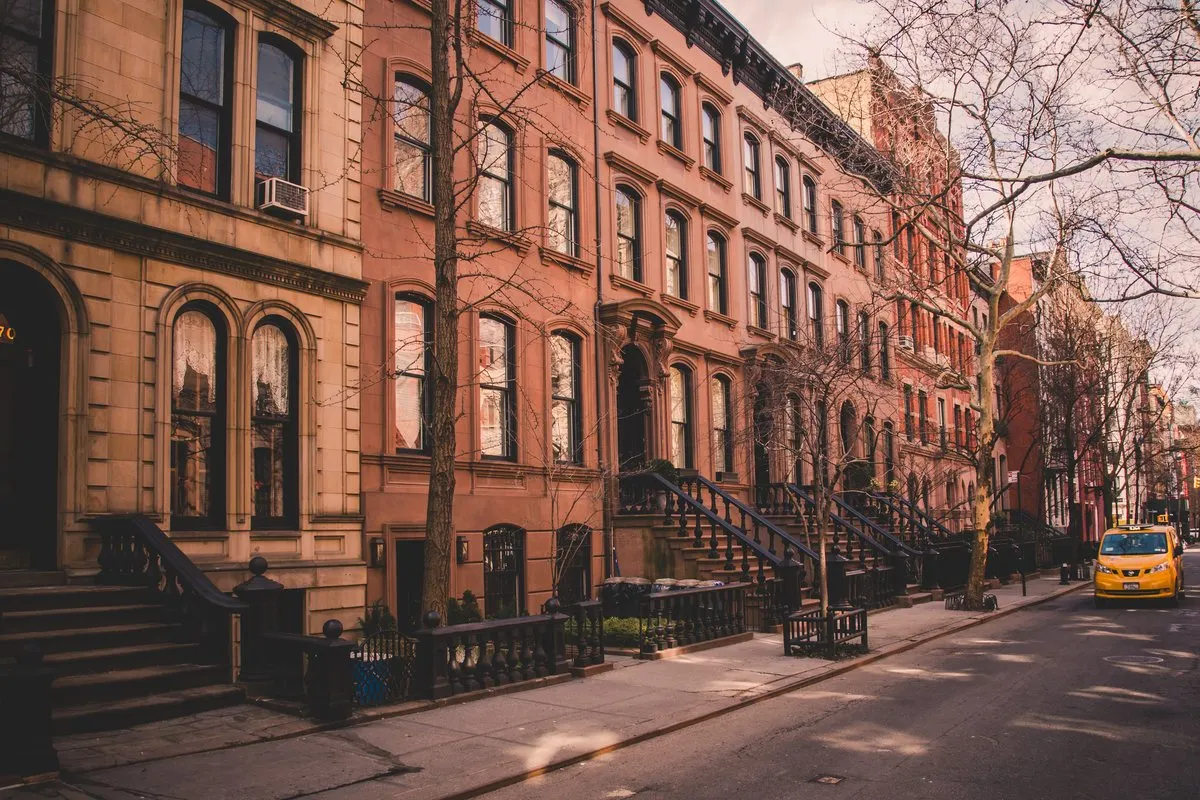
West Village in New York is the part of Manhattan where the grid never took hold. Here the streets lie as they did in the 1700s, the townhouses have been protected since 1969, and every block carries a history – from the city's narrowest house to the theatre that began as a silo.
In this story · 6 sections
The West Village in New York is the western part of Greenwich Village, between the Hudson River and Seventh Avenue, with 14th Street as its northern boundary. The name Greenwich comes from the Dutch Groenwijck, "green district", and in the 17th century it was a remote village north of the European settlement at the southern tip of Manhattan. This is still evident today. When the city laid its grid over the island in 1811, areas that were already built up were allowed to keep their streets – which is why West 4th Street crosses West 10th Street, and why it's possible to get lost three blocks from Seventh Avenue.
It is also one of the USA's most expensive residential areas. In 2017, sale prices in West Village were typically over 2,100 dollars per square foot, just over 23,000 dollars per square metre. What buyers are paying for is to a large extent what must not be changed.
01A neighbourhood that was saved by its neighbours
The very concept of West Village emerged during the preservation battles of the 1950s and 60s. Residents and preservation groups began using the name to distinguish the western part from the blocks around Washington Square Park and New York University, where developers had been more successful in demolishing and building anew.
In 1969, the New York City Landmarks Preservation Commission established the Greenwich Village Historic District, which comprises more than 50 blocks and for four decades was the city's largest. Within the district, facades must be preserved even during renovation. The blocks closest to the river were not included from the outset, but new districts have been added since then – the Gansevoort Market Historic District in 2003, with 112 buildings in the Meatpacking District, and the Weehawken Street Historic District in 2006.
02Bedford Street – the city's narrowest house
Start on Bedford Street, between Commerce Street and Morton Street. At number 75½ stands a three-storey house that is only 2.9 metres wide. The Landmarks Preservation Commission regards it as the city's narrowest townhouse. Inside, it is 2.62 metres at its widest and only 61 centimetres at its narrowest point, and a spiral staircase in the middle divides each floor in two.
The house was built, according to the Commission and the Greenwich Village Society for Historic Preservation, in 1873, on what had been the carriage entrance to the neighbouring property. The poet Edna St. Vincent Millay lived here in 1923–1924 with her husband and had the top floor rebuilt into a studio with a skylight and the stepped gable that can be seen from the street. Later, the illustrator William Steig and the anthropologist Margaret Mead lived here. The wooden house at Bedford Street 77, built in 1799 by Joshua Isaacs, is noted as the oldest house in Greenwich Village.
03Commerce Street and the theatre that was a silo
Around the corner, at 38 Commerce Street, lies Cherry Lane Theatre, the oldest off-Broadway theatre in New York to have run continuously. The building was erected in 1817 as a silo and was then a brewery, tobacco warehouse and box factory before a group of artists – among them Millay – converted it into a theatre, which opened in 1923.
The repertoire has been far from cautious. Samuel Beckett's Happy Days had its world premiere here in 1961, and Sam Shepard's True West premiered in 1982 with John Malkovich and Gary Sinise. The main auditorium has 167 seats, the studio 60. Cary Grant and John Barrymore are said to have lived in the narrow house on Bedford Street when they were performing here.
04Hudson Street and St. Luke in the Fields
Head west towards Hudson Street. At number 487, between Christopher Street and Barrow Street, lies the Church of St. Luke in the Fields, an Episcopal church built in 1821–1822 on land donated by Trinity Church. The name was chosen to capture the rural character of the area – Greenwich Village was at that time a refuge for city dwellers fleeing the epidemics further south.
The complex was laid out by Clement Clarke Moore, the church's first priest, and included terraced houses that the church rented out. The church was completely destroyed by fire in 1981 and was rebuilt by the architect Hugh Hardy, who recreated the Federal details; the work was completed in 1985. The garden was awarded a prize by the Greenwich Village Society for Historic Preservation in 2000.
05Jefferson Market – the courthouse that became a library
Finish at 425 Sixth Avenue, at the corner of West 10th Street, where the Jefferson Market Library rises on a triangular plot. The building was erected in 1874–1877 as a courthouse to designs by Frederick Clarke Withers, in red brick, black stone, white granite and yellow sandstone, with leaded glass and a clock tower. In 1885, a panel of American architects voted it the country's fifth most beautiful building.
In 1958, the house was threatened with demolition. The protests instead led to it becoming a branch of the New York Public Library, and since 1977 it has been a National Historic Landmark. No building sums up the West Village better: a house that seemed to have veered off course in time, and which was saved precisely for that reason.
06Reading the terraced houses
Those who walk slowly can see the layers. The low Federal-style houses from the early 1800s have steep roofs and dormer windows; later came the Greek Revival and Italianate-inspired terraced houses, taller and with heavier cornices. Bedford Street, Commerce Street, Grove Street and St. Luke's Place all have their examples, and because the district protects the façades, it is largely the same streetscape as the one that those who saved the area wanted to preserve.
Data on the city's properties and districts can be found in VERA PI's guide to New York City and on the overview for the state of New York. More city guides can be found among Metro Mode's destinations.