Sanremo, near the French border, was the tsarinas' winter city and Alfred Nobel's final home. A day here goes from the medieval Pigna to the casino from 1905 and the cycle path along the sea.
In this story · 9 sections
Sanremo is a coastal town in Liguria with around 53,000 inhabitants, a few dozen kilometres east of the border with France. The name does not come from any Saint Remus, as is often claimed, but is a contraction of Sant'Eremo di San Romolo, the hermitage in memory of Bishop Romulus of Genoa. For Italians, the town is above all the home of the music festival, for cyclists the finish line of Milan–San Remo, and for historians the place where the victorious powers divided up the mandates in the Middle East in 1920.
For the traveller, Sanremo is a city that can be explored on foot in a day: a medieval old town on a hill, a belle époque city below, and a long promenade by the sea. Here is a day in that order.
6 places
© OpenStreetMap contributors · OpenFreeMap
- 01Santuario della Madonna della CostaChurch and view · La Pigna
- 02Palazzo Borea d'OlmoBaroque palace and museum · Centre
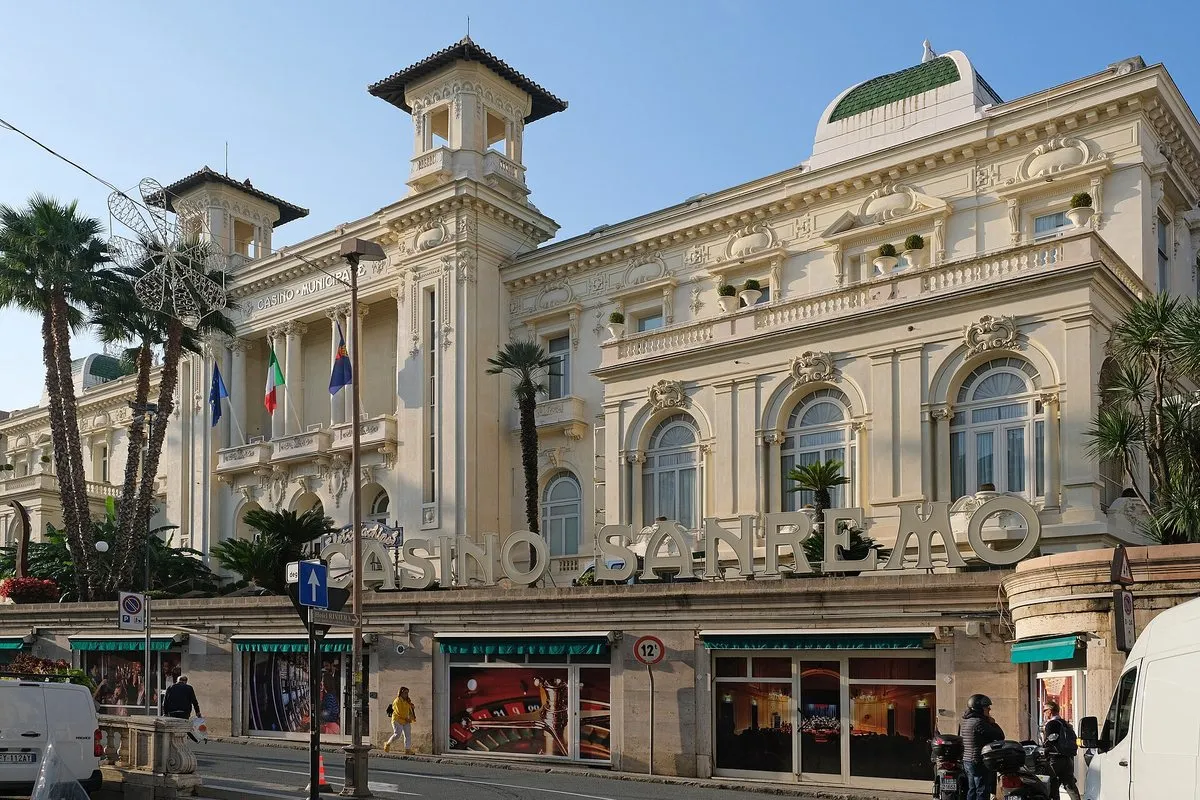
- 03Casinò Municipale di SanremoArt Nouveau casino · Corso degli Inglesi
- 04Villa NobelVilla and museum · Corso Cavallotti
- 05Forte di Santa TeclaFortress · Harbour
- 06Bussana VecchiaArtists' village · Bussana
- January–February
- The flower parade, where the towns of the Riviera display floats decorated with flowers
- Winter, annually
- The Festival della canzone italiana at Teatro Ariston, since 1951
- Usually the third Saturday in March
- The Milan–San Remo cycle race, 298 kilometres, held since 1907
- Second week of August
- International Fireworks Competition around Ferragosto
- Autumn
- Premio Tenco, the songwriting award in memory of Luigi Tenco
Morning: up through La Pigna
Start where the city began. La Pigna, the pine cone, is the old town centre that was built up on the hill in the early Middle Ages in a spiral of alleys, archways and staircases to protect the inhabitants from Saracen raids. The name refers to the shape. The old town is almost completely preserved, and the alleys are so narrow that they can only be walked.
At the top stands the Santuario della Madonna della Costa, built in 1361 to celebrate Sanremo's liberation from the Doria family. The church has always been a landmark for seafarers. The interior is Baroque, with frescoes from the 1600s and 1700s and a Madonna and Child from the 1300s. The view from the terrace takes in the whole town and the harbour.
Late morning: San Siro and Via Matteotti
On the way down, you pass the co-cathedral of San Siro, built in the 1100s on the remains of an early Christian church. It is Romanesque-Gothic with three naves, and the bell tower was rebuilt in the 1600s following a British bombardment from the sea.
Via Matteotti is the town's pedestrian street. Set into the paving are brass plaques bearing the names of the festival's winners and their songs. Here stands Teatro Ariston, where the Festival della canzone italiana has been held every year since 1951, and here stands Palazzo Borea d'Olmo, one of western Liguria's most important baroque palaces, with the town museum on the second floor. It was at the festival in Sanremo that Domenico Modugno performed Nel blu, dipinto di blu in 1958, known as Volare, and the festival was one of the models for the Eurovision Song Contest, which started in 1956.
Lunch: Sanremo's own food
Eat what belongs to the region. Sardenara is Sanremo's version of focaccia, with tomato, anchovies, olives and garlic. Farinata is made from chickpea flour, and torta verde is a vegetable pie. Taggiasca olives come from the valleys inland of the city, and the olive oil from western Liguria has a protected designation of origin.
Afternoon: the casino and the Russian church
The Casinò Municipale was inaugurated on 14 January 1905 under the name Kursaal. The Art Nouveau building was designed by the French architect Eugène Ferret, and the first croupiers came from Ostend in Belgium. Gambling was long merely tolerated, but a royal decree in December 1927 granted the casino the right to remain open, and the official inauguration took place on 21 January 1928. Today it is one of four casinos in Italy. The salons have also hosted chess tournaments and concerts, and the city's symphony orchestra often performs in the casino's theatre.
A couple of hundred metres to the west lies the Chiesa di Cristo Salvatore, the Russian church, with its onion domes. It was built in the late 1800s by the Russian nobility to designs by the architect Aleksej Shchusev and is still used for services today. It is a reminder of why the town grew: in 1864 Tsarina Maria Alexandrovna chose to spend the winter in Sanremo, and the Russian aristocracy followed suit. Empress Elisabeth of Austria, Sisi, visited the town on several occasions.
Late afternoon: Villa Nobel
Along Corso Cavallotti, east of the centre, lies Villa Nobel. The house was built in 1871 in Moorish style for the pharmacist Pietro Vacchieri and was bought in the early 1890s by Alfred Nobel, who had the architect Pio Soli add a floor and named the house Villa Mio Nido, my nest. Nobel lived here during his last years and died in the villa on 10 December 1896, the day that is now Nobel Day. Since 1969 the villa has been owned by the public and is used for cultural events and a museum about the 19th century.
Just nearby lies Villa King, an Art Nouveau villa built by Pietro Agosti in 1909, and along the entire eastern part of the town you can see the hotels and villas that were built when tourism took off during the latter half of the 1800s.
Evening: the cycle path and the harbour
The railway used to run along the shore. When it was moved northwards and into tunnels, the old railway embankment was converted into a cycle and footpath, 24 kilometres long, between Ospedaletti in the west and San Lorenzo al Mare in the east. There is bicycle hire available along the path. An evening walk westwards from the centre reaches Forte di Santa Tecla, the triangular fortress built by the Republic of Genoa in 1576 at the harbour. It was used as a prison into the 1990s and has now been restored as a venue for exhibitions and events.
If you have one more day: Bussana Vecchia
East of the town, in the hills above Bussana, lies Bussana Vecchia. The village was destroyed in the earthquake of 1887, and the inhabitants built a new Bussana down by the coast. The old village stood abandoned until the early 1960s, when artists from several countries moved in and began restoring the stone houses. Today it is an artists' village with studios in the ruins.
Further along the coast
From Sanremo, it's a short distance to Menton, Monaco and the rest of the French Riviera. Read VERA PI's guide at vpios.com/monaco, and find all our city guides among Metro Mode's destinations.
The day's stops
Santuario della Madonna della Costa
The church at the top of the old town, built in 1361. Baroque interior and views over the whole town.
Insider tipA steep walk up through La Pigna
Palazzo Borea d'Olmo
One of western Liguria's most important Baroque palaces, with the city museum on the second floor.
Insider tipA few metres from Teatro Ariston
Casinò Municipale di Sanremo
Opened in 1905, designed by Eugène Ferret. One of Italy's four casinos.
Insider tipThe Russian church is located just west of the casino
Villa Nobel
Alfred Nobel's last home, where he died on 10 December 1896. Today a cultural centre and museum.
Forte di Santa Tecla
The triangular fortress from 1576, restored for exhibitions and events.
Bussana Vecchia
The village that was destroyed in the earthquake of 1887 and was repopulated by artists from the 1960s onwards.