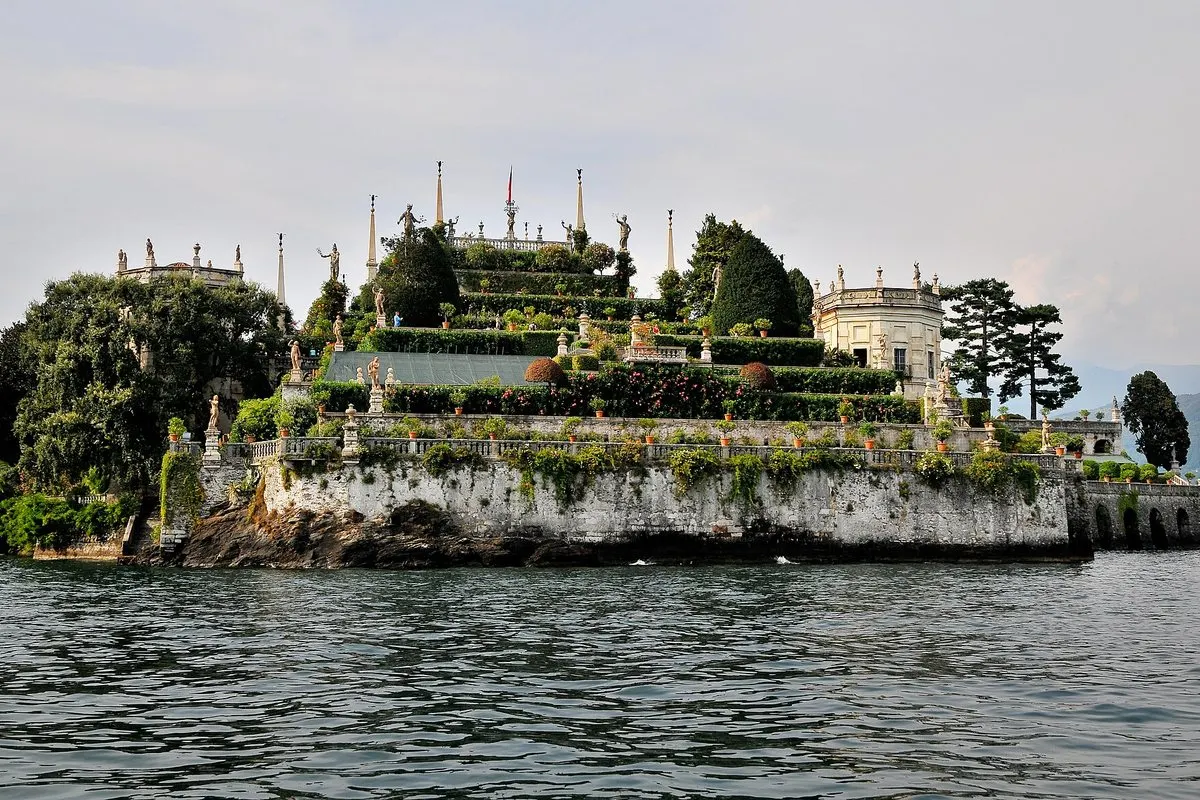
Three small islands off Stresa on Lake Maggiore are home to a baroque palace with ten terraces, an English garden and a fishing village with 25 inhabitants. The Borromeo family still owns most of them.
In this story · 7 sections
Lake Maggiore is Italy's longest lake, roughly 64 kilometres from Locarno in Switzerland to Arona in the south, and the second largest by surface area after Lake Garda. The climate is mild, with Mediterranean vegetation and gardens featuring rare and exotic species. In the western arm of the lake, between Stresa in the south and Verbania in the north, lie the Borromean Islands, Isole Borromee: three small islands and two islets covering a total of around 20 hectares.
The islands are named after the Borromeo family, who began acquiring them in the early 1500s and who still own most of them – Isola Madre, Isola Bella and Isolino di San Giovanni. By boat from Stresa, you can visit all three main islands in a day.
4 places
© OpenStreetMap contributors · OpenFreeMap
Stresa: the starting point
Stresa is a municipality with around 4,600 inhabitants in Piedmont, north-west of Milan, on the road and railway towards the Simplon Pass. The town was a fishing village in the 15th century. Ernest Hemingway set part of his 1929 novel A Farewell to Arms at the Grand Hôtel des Îles Borromées and visited the town in 1948. Conferences of historic significance were held here: in 1935 the Stresa Front against Nazi Germany was formed, and in 1958 the foundation was laid for the EEC's common agricultural policy. The boats to the islands run regularly from the town's two piers.
Isola Bella: the palace on a rock
Isola Bella is situated around 400 metres from Stresa and is divided between the palace, the Italian garden and a small fishing village. Until the 1630s, the island was a bare rock with a small fishing village, called isola inferiore, the lower island. Then Count Carlo III Borromeo began building a palace dedicated to his wife Isabella d'Adda, after whom the island was named. The work was led by the Milanese Angelo Crivelli, but was interrupted around the middle of the century when the plague struck the Duchy of Milan.
Carlo's sons, Cardinal Giberto III and Vitaliano VI, took up the work. Vitaliano had the architect Carlo Fontana complete the palace and turned it into a venue for parties and theatre for the nobility of Europe. For the garden, large quantities of soil were brought out to the island, so that a system of ten terraces could be built. The gardens were inaugurated in 1671. The palace, which was never fully completed, has paintings by Lombard artists and Flemish tapestries.
Under Giberto V Borromeo, around the turn of the 19th century, the island received Edward Gibbon, Napoleon and Joséphine, and Caroline of Brunswick. According to tradition, Caroline tried to buy Isola Madre, and when she was refused, she settled instead on Lake Como, at Villa d'Este. In April 1935, the Stresa Conference was held at the palace.
Isola dei Pescatori: the fishermen's island
Isola dei Pescatori, or Isola Superiore, is the northernmost of the three large islands and the only one inhabited year-round. It has never belonged to the Borromeo family. The island is about 375 metres long and 100 metres wide, with a narrow street along its spine, cobbled alleys and a promenade running around the entire island that often floods – the houses are built for it. In 1971, 208 people lived here, and by 2018 only 25. The San Vittore church has traces of a chapel from the 9th century.
Isola Madre: the English garden
Isola Madre is the largest of the islands, measuring around 330 by 220 metres. In the 9th century there was a church and a cemetery here, and olives were cultivated. In 1501 Lancillotto Borromeo brought citrus plants here from Liguria together with a gardener and began building the family's residence, which in the 1580s was extended in Renaissance style.
The palace is uninhabited but furnished with Italian works from the 16th to the 19th century. Around it spread the Giardini Botanici dell'Isola Madre, an English-style garden laid out from the end of the 18th century on the site of a citrus grove. A particular favourite is the scala dei morti, the staircase of the dead, which in recent years has been given a large collection of wisteria. The family chapel from 1858 has, unlike Isola Bella's, no tombs.
If you have time: Villa Taranto
In Pallanza, on the other side of the bay, lie the Giardini Botanici Villa Taranto, 16 hectares. The garden was laid out in 1931–1940 by the Scot Neil Boyd McEacharn, who felled over 2,000 trees and laid eight kilometres of pipes for water features. It opened to the public in 1952 and today has nearly 20,000 plant varieties. The villa itself is used by the state and is not open.
At a glance
The islands in brief
| Island | Size | Known for |
|---|---|---|
| Isola Bella | Approximately 320 × 400 m | The baroque palace and the ten terraces |
| Isola dei Pescatori | Approximately 375 × 100 m | Fishing village, 25 inhabitants in 2018 |
| Isola Madre | Approximately 330 × 220 m | English garden and wisteria |
More to read
Lake Maggiore is close to Milan – see our walk through Milan's Quadrilatero della Moda. On the neighbouring lake, read 48 hours in Bellagio and Villa Carlotta and Balbianello. All our city guides can be found at metromode.co.
Places
Isola Bella
The Borromeo baroque palace and the ten terraces from 1671, 400 metres from Stresa.
Insider tipBoat from Stresa, Laveno, Pallanza and Intra
Isola dei Pescatori
The only island that is inhabited all year round, with the church of San Vittore.
Giardini Botanici Villa Taranto
McEacharn's 16-hectare garden with nearly 20,000 plant varieties.
Insider tipAdmission charge applies; check the season's opening days