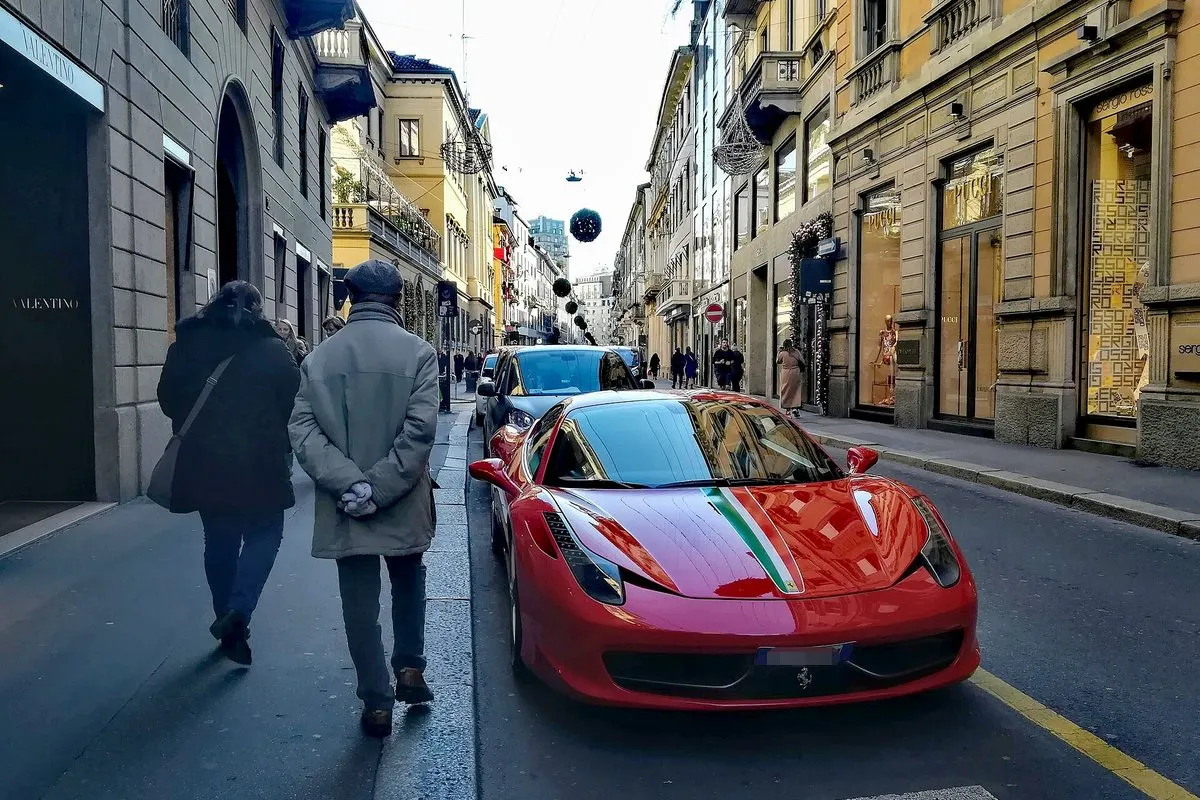
Four streets in central Milan frame one of the world's most concentrated fashion districts. Behind the shop windows of Via Montenapoleone lie neoclassical palazzos, two house museums and a patisserie dating from 1817.
In this story · 10 sections
The Quadrilatero della moda, the fashion quadrilateral, is Milan's fashion district, south of the Porta Nuova arches in the city centre. The quadrilateral's sides are Via Montenapoleone in the south-west, Via Manzoni in the north-west, Via della Spiga in the north-east and Corso Venezia in the south-east. Inside the quadrilateral run the narrow streets Via Borgospesso, Via Santo Spirito, Via Gesù, Via Sant'Andrea and Via Bagutta, and in practice the district extends out to Via Verri, Piazza Meda and Corso Matteotti at Piazza San Babila.
What makes the neighbourhood worth a stroll even for those who aren't shopping is that fashion has moved into one of Milan's best-preserved districts. Here you'll find neoclassical palazzos, two of the city's finest house museums, and one of its oldest cafés. The walk below takes a morning at a leisurely pace.
6 places
© OpenStreetMap contributors · OpenFreeMap
- 01Caffè-Pasticceria CovaCafé and patisserie · Via Montenapoleone
- 02Museo Bagatti ValsecchiHistoric house museum · Via Gesù
- 03Via della SpigaShopping street · Quadrilatero della moda
- 04Museo Poldi PezzoliArt museum · Via Manzoni
- 05Villa Necchi CampiglioVilla and museum · Via Mozart
- 06Galleria Vittorio Emanuele IIShopping arcade · Duomo
- 1786
- The street is named after the Monte bank
- 1817
- Caffè Cova is founded by La Scala
- 1877
- Galleria Vittorio Emanuele II is completed
- 1881
- Museo Poldi Pezzoli opens
- 1958
- The fashion body's predecessor is founded and the fashion weeks begin
- 1978
- Versace opens its first shop on Via della Spiga
- 2008
- Villa Necchi Campiglio opens to the public
Via Montenapoleone: the street named after a bank
Via Montenapoleone follows the Roman city walls that Emperor Maximian had built. The name comes from a bank. In 1783, the Monte Camerale di Santa Teresa, which managed the public debt, opened in Palazzo Marliani, and the street was named after it in 1786. The bank closed in 1796 but reopened in 1804, when Milan was the capital of Napoleon's Italian republic, as the Monte Napoleone.
During the first half of the 19th century, the street was rebuilt almost entirely in neoclassical style, with palaces for the highest nobility: Palazzo Melzi di Cusano, Palazzo Gavazzi, Palazzo Carcassola Grandi and Palazzo Taverna. The older Palazzo Marliani, one of the finest houses from the Sforza era, was destroyed in the Allied bombings of 1943.
After the Second World War, Via Montenapoleone became one of the fashion world's leading streets, in the same class as Rue du Faubourg-Saint-Honoré in Paris and Bond Street in London. The street is regularly ranked among the world's most expensive shopping streets measured by rents, and in 2024 it took first place.
A break at Cova
In the middle of the street lies Caffè-Pasticceria Cova, founded in 1817 by the veteran Antonio Cova next to Teatro alla Scala. The café was a meeting place for Milan's upper class and intellectuals and played a role during the Five Days of Milan in March 1848. After the 1943 bombings damaged the premises by La Scala, Cova moved to Via Montenapoleone in 1950. Today it is owned by LVMH.
Via Gesù: Bagatti Valsecchi
Turn into Via Gesù and look for number 5, the Museo Bagatti Valsecchi. The Bagatti Valsecchi barons collected Italian Renaissance art and craftsmanship – majolica, furniture, tapestries, wrought iron, leather, glass and small ivory caskets – and displayed it in their own home, just as they wished. There are also paintings here, most from the 1400s and 1500s, among them a Santa Giustina by Giovanni Bellini from around 1475 and a portrait of the Blessed Lorenzo Giustiniani by Gentile Bellini in its original frame. The house was never intended as a gallery, and it is this that makes the visit so rewarding.
Via della Spiga and Via Sant'Andrea
Via della Spiga, the street of the ear of wheat, forms the north-eastern side of the quadrilateral and is one of Milan's premier shopping streets. The first Versace boutique opened here in 1978. The parallel streets within the block – Via Sant'Andrea, Via Santo Spirito and Via Borgospesso – are narrower and quieter, with a mix of major fashion houses, small specialists and antique dealers. On Via Pisoni, on the other side of Via Manzoni, lie Armani Casa and Armani Privé.
Via Manzoni: Poldi Pezzoli
At Via Manzoni 12, near La Scala, lies the Museo Poldi Pezzoli. The collection began as the private collection of Gian Giacomo Poldi Pezzoli and his mother Rosa Trivulzio in the 1800s, and several rooms were decorated to suit the paintings on the walls. Poldi Pezzoli bequeathed the house to the Brera art academy, and the museum opened on 25 April 1881. The palace was severely damaged during the Second World War, but the art had been put into storage, and the museum reopened in 1951. The collection is strong in North Italian and Netherlandish masters and also includes weapons, glass, ceramics and jewellery.
A detour: Villa Necchi Campiglio
A few blocks east, at Via Mozart 14, stands Villa Necchi Campiglio, designed by the rationalist architect Piero Portaluppi and built 1932–1935 for Angelo Campiglio and the Necchi siblings. The house had a lift, a dumbwaiter, internal telephones and a heated pool – the second in Milan after the municipal one and the first on private land. From 1938 the architect Tomaso Buzzi redesigned parts of the villa in a softer style inspired by the 18th century. The villa was bequeathed to FAI and opened to the public in May 2008. Luca Guadagnino filmed I Am Love here in 2009.
The fashion weeks
Milan Fashion Week, the Settimana della moda, has been held twice a year since 1958 and is one of the big four along with New York, London and Paris. The autumn and winter collections are shown in February–March and the spring and summer collections in September–October, with separate weeks for menswear. The weeks are coordinated by the Camera Nazionale della Moda Italiana, whose predecessor was founded on 11 June 1958.
The walk ends in the Galleria
Finally, head south towards the Duomo and through the Galleria Vittorio Emanuele II, Italy's oldest operating shopping arcade. It was designed in 1861 and built by Giuseppe Mengoni between 1865 and 1877, with two glass-covered passages crossing beneath a glass dome with an inner diameter of 37.5 metres. In the centre of the floor are the coats of arms of Turin, Florence, Rome and Milan. Tradition has it that you'll have good luck if you spin three times with your heel on the testicles of the bull in Turin's coat of arms – which has meant the mosaic has had to be repaired, most recently in 2026.
More to read
From Milan, Lake Como is close: read 48 hours in Bellagio and our guide to Villa Carlotta and Balbianello, and find more destinations on metromode.co.
Stops on the walk
Caffè-Pasticceria Cova
The patisserie from 1817, on Via Montenapoleone since 1950.
Museo Bagatti Valsecchi
The Bagatti Valsecchi barons' home with Renaissance art and craftsmanship.
Via della Spiga
The quadrilateral's north-eastern side, where Versace opened its first shop in 1978.
Museo Poldi Pezzoli
House museum from 1881 with North Italian and Netherlandish masters.
Villa Necchi Campiglio
Portaluppi's villa from 1932–1935 with garden and pool, managed by FAI.
Galleria Vittorio Emanuele II
Italy's oldest shopping arcade still in operation, between the Duomo and La Scala.