Roman walls, a cathedral cloister kept by geese, a Catalan Gothic church built by the people of the waterfront and the palaces that now house the Museu Picasso. A walk through Barcelona's oldest quarters, from the Barri Gòtic to El Born.
In this story · 6 sections
Barcelona's medieval core is a labyrinth: narrow lanes that bend without warning, sudden squares with a fountain and a palm, stone arches overhead and, everywhere, traces of two thousand years of history. The Barri Gòtic, the Gothic Quarter, contains the oldest parts of the city, including the remains of its Roman wall. To the east, across the broad Via Laietana, El Born was the medieval merchants' and sailors' quarter. This walk links the two in around three hours with stops.
Santa Maria del Mar
Basilica · El Born
© OpenStreetMap contributors · OpenFreeMap
- Address
- Plaça de Santa Maria 1, 08003 Barcelona
- Start
- Barcelona Cathedral
- Finish
- El Born market
- Time
- About three hours with stops
- Highlights
- Cathedral cloister, Temple of Augustus, Santa Maria del Mar
- Museum
- Museu Picasso, Carrer de Montcada
A fourteenth-century basilica built for the seafaring community of La Ribera, with a wide, luminous nave.
01Barcelona Cathedral and its geese
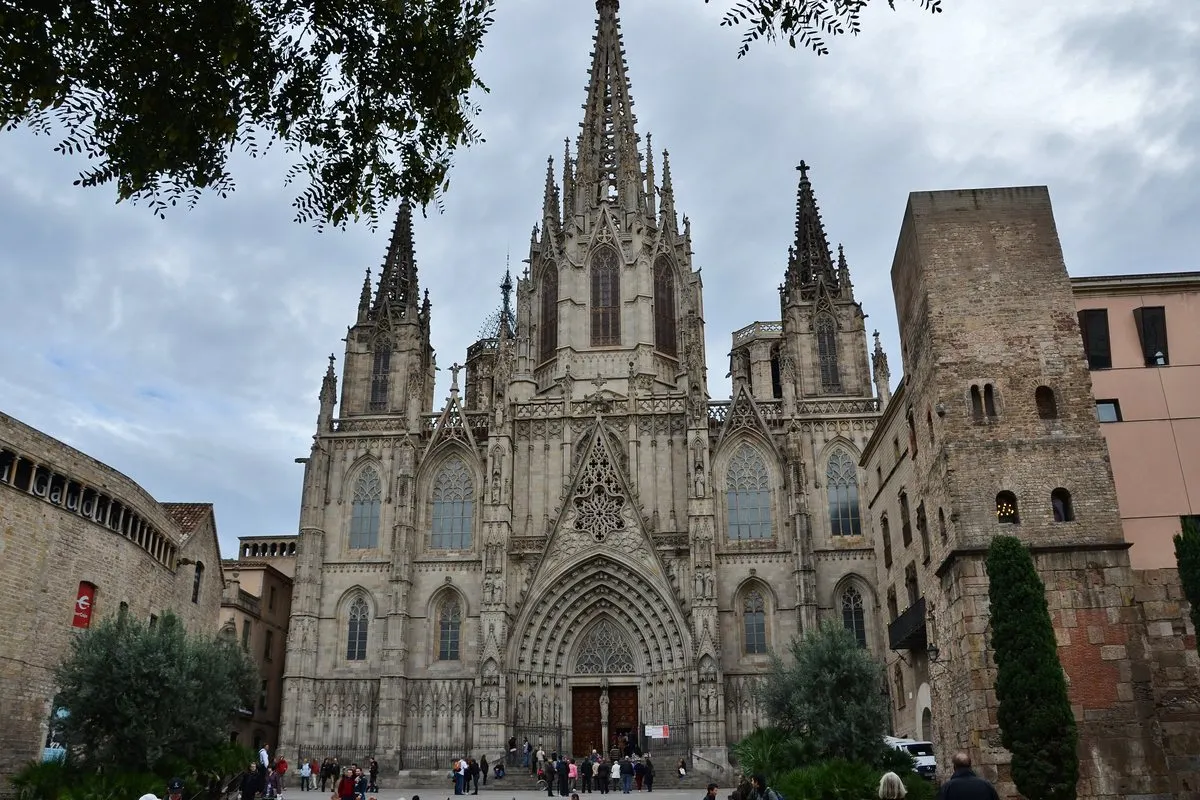
Start at the Cathedral of the Holy Cross and Saint Eulalia. The Gothic church was built over the medieval centuries, but its elaborate main façade is newer than it looks: it was constructed between 1882 and 1913, in the Gothic style, by Josep Oriol Mestres and August Font i Carreras. Step inside for the dim, lofty nave and then into the cloister, where a garden of palms and magnolias surrounds a pond. Thirteen white geese live here, traditionally said to represent the age of Saint Eulalia, the city's young martyr.
Leave by the side door and look up at the Pont del Bisbe, the carved stone bridge across Carrer del Bisbe. It appears medieval but is a neo-Gothic addition of the twentieth century, part of the long effort to give the quarter its Gothic character, which continued as late as the 1960s.
02Roman Barcelona and the Plaça del Rei
A few steps away, in a courtyard on Carrer del Paradís, four Corinthian columns of the Roman temple of Augustus rise unexpectedly between later buildings, a reminder that the city began as a Roman colony on this low hill. Continue to the Plaça del Rei, the medieval royal square, enclosed by the old royal palace and its great hall. Beneath it, the city history museum leads you through excavated Roman streets, workshops and walls.
Insider tipVisiting hours are limited during services; rooftop tours are sometimes offered.
03Plaça Reial and Plaça de Sant Felip Neri
Detour south to two contrasting squares. The tiny Plaça de Sant Felip Neri, with its fountain and church façade, is one of the quietest corners in the quarter. The arcaded Plaça Reial, by contrast, is grand and lively, with palm trees and ornate lampposts designed by the young Antoni Gaudí early in his career.
04Santa Maria del Mar
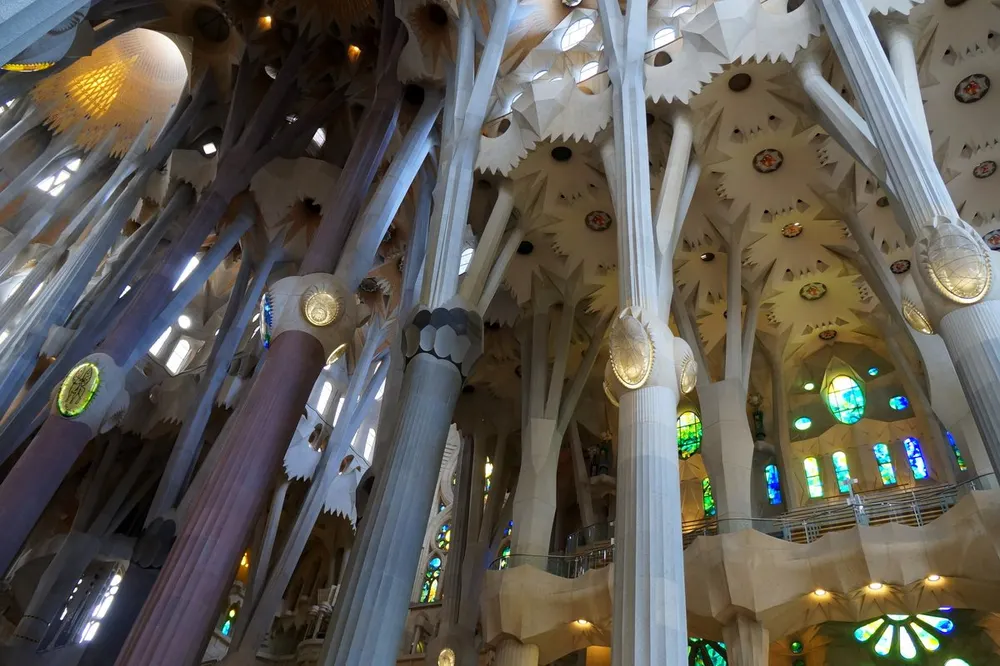
Cross Via Laietana into El Born. Its glory is the Basilica of Santa Maria del Mar, the finest example of Catalan Gothic, built in the fourteenth century for the seafaring community of the district. Inside, slender octagonal columns hold up a nave of remarkable width and lightness, and the bare stone, stripped of decoration by fire in the twentieth century, gives it an almost modern purity. Sit for a few minutes; it is one of the most moving interiors in Spain.
05Carrer de Montcada and the Museu Picasso
Behind the church runs Carrer de Montcada, once the street of Barcelona's merchant aristocracy, lined with medieval palaces built around courtyards. Several now hold museums, among them the Museu Picasso, which occupies a run of these palaces and focuses on the artist's formative years in Barcelona, and the Museu Barbier-Mueller of pre-Columbian art. Book the Picasso in advance.
06The Born market and 1714
End at the former Mercat del Born, a nineteenth-century iron market hall. Beneath it lie archaeological ruins of the streets of La Ribera, demolished after the siege of Barcelona in 1713 to 1714 and the defeat of Catalonia in the War of the Spanish Succession. Nearby, the Fossar de les Moreres marks a mass grave of Catalan soldiers who fell in that siege. Then settle into one of El Born's wine bars as the evening begins.
For the modernista city, find our guide to Gaudí's Barcelona among the Metro Mode destinations, read our Barcelona guide (in Swedish), and browse our travel section in English.