A century after his death, Antoni Gaudí still defines Barcelona, and in 2026 the Sagrada Família finally gained its central tower. An itinerary through his greatest works, in the order that makes most sense on foot and by metro.
In this story · 5 sections
Antoni Gaudí died in Barcelona in June 1926, struck by a tram, with his great church less than a quarter built. A hundred years later his buildings are the reason many people come to the city at all, and UNESCO lists his principal works together as a World Heritage site. In 2026, the centenary of his death, the Sagrada Família reached a milestone its architect never saw. This itinerary links his four essential works in a single long day.
Sagrada Família
Basilica · Eixample
© OpenStreetMap contributors · OpenFreeMap
- Address
- Carrer de Mallorca 401, 08013 Barcelona
- Sagrada Família
- Begun 1882; central tower inaugurated 2026
- Casa Batlló
- Remodelled from 1904, Passeig de Gràcia
- Casa Milà
- 1906–1912; UNESCO 1984
- Park Güell
- 1900–1914; public park since 1926
- Tickets
- Timed entry at all four; book ahead
Begun in 1882 and led by Gaudí from 1883; consecrated in 2010, with its 172.5-metre central tower inaugurated in 2026.
019.00: The Sagrada Família
Begin with the first entry slot at the basilica in the Eixample district. Construction began on 19 March 1882 under the architect Francisco de Paula del Villar; when he resigned in 1883, Gaudí took over and transformed the project, combining Gothic structure with the curving forms of Catalan modernism. He devoted the rest of his life to it and is buried in its crypt. Funded only by donations, building advanced slowly, and in 1936 anarchists set fire to the crypt and destroyed part of his workshop, including original plans and models.
Pope Benedict XVI consecrated the church as a basilica in November 2010. In February 2026 the final piece of the central Tower of Jesus Christ was put in place, and on 10 June 2026, the centenary of Gaudí's death, the tower was inaugurated and blessed by Pope Leo XIV. At 172.5 metres it makes the Sagrada Família the tallest church in the world.
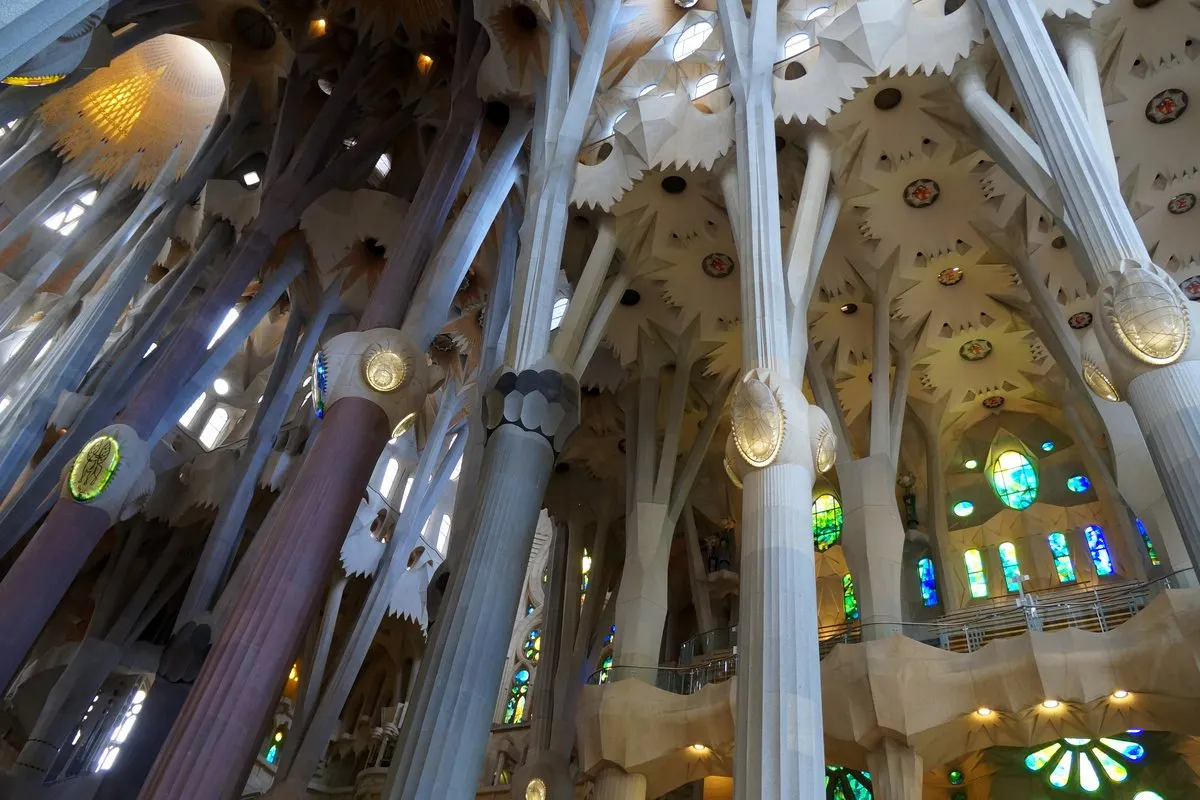
Outside, compare the Nativity façade, built in Gaudí's lifetime and crowded with sculpture, with the stark, angular Passion façade. Inside, columns branch like trees towards the vaults, and stained glass washes the nave in blue and green on the east side and in reds and oranges on the west. Morning light favours the Nativity side.
0211.30: Casa Batlló
Take the metro or walk twenty-five minutes to the Passeig de Gràcia, the grand boulevard of the Eixample and the most expensive street in Spain. Casa Batlló stands on the block known as the Illa de la Discòrdia, where four leading modernista architects built strikingly different houses side by side. Gaudí remodelled an existing house here from 1904, with his assistants, creating a façade of broken ceramic tiles, mask-like balconies and a roof like a dragon's back. There are few straight lines anywhere. Inside, the light well is tiled in blues that deepen towards the top to spread daylight evenly.
Insider tipTimed tickets only; dress modestly, with shoulders and knees covered.
0313.30: Lunch on the Passeig
The streets around the Passeig de Gràcia and the Rambla de Catalunya are full of restaurants serving a set lunch, the menú del dia, on weekdays. Choose one a block or two off the boulevard for better value and calmer surroundings.
0415.00: Casa Milà, La Pedrera
Walk up the boulevard to Casa Milà, the last private residence Gaudí designed, built between 1906 and 1912 for Pere Milà and Roser Segimon. Its undulating, self-supporting stone façade earned it the nickname La Pedrera, the stone quarry, and its wrought-iron balconies were designed with Josep Maria Jujol. The highlight is the roof terrace, a landscape of stairwells and chimneys shaped like helmeted warriors, with views to the Sagrada Família. UNESCO listed it in 1984.
0517.00: Park Güell
End the day on the hill. Park Güell was commissioned by the industrialist Eusebi Güell, Gaudí's great patron, and built between 1900 and 1914 on the southern slope of the Turó del Carmel. Intended as a garden city, it became a public park in 1926. Its monumental zone, with the mosaic dragon on the stairway, the hall of columns and the serpentine bench around the terrace, requires a timed ticket. Come in the late afternoon for the golden light over the city and the sea.
For the medieval city, find our guide to the Gothic Quarter and El Born among the Metro Mode destinations, read our Barcelona guide (in Swedish), and browse our travel section in English.