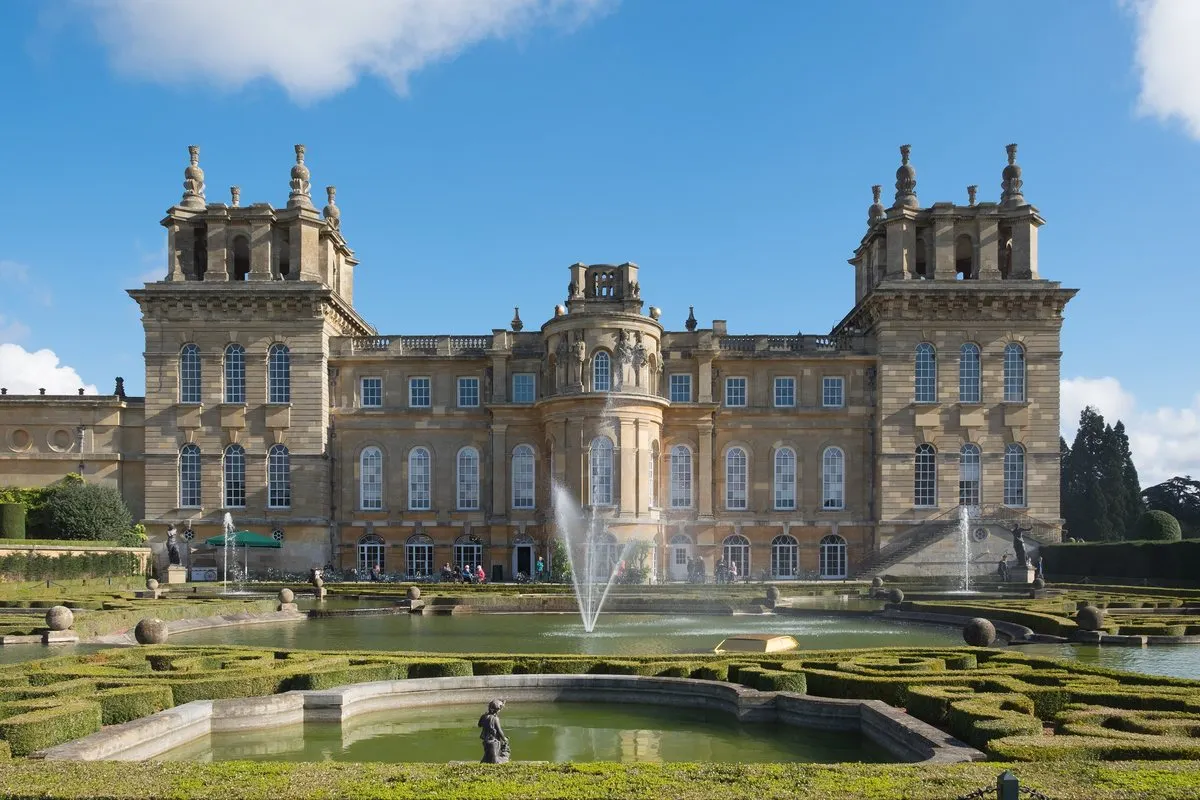
Blenheim Palace in Woodstock, Oxfordshire, was begun in 1705 as the nation's reward to the Duke of Marlborough for his victory at Blenheim. Designed by Sir John Vanbrugh, set in more than 2,000 acres of Capability Brown parkland and the birthplace of Winston Churchill, it has been a UNESCO World Heritage Site since 1987.
In this story · 5 sections
Blenheim Palace stands on the edge of Woodstock in Oxfordshire, north-west of Oxford. It was built for John Churchill, 1st Duke of Marlborough, after his victory over the French at the Battle of Blenheim in 1704, and it has been home to the Dukes of Marlborough ever since. The estate, of more than 2,000 acres, is still owned by the Churchill family, and palace and park were inscribed together as a UNESCO World Heritage Site in 1987.
Blenheim Palace
Palace · Woodstock
- Address
- Woodstock, Oxfordshire
- Begun
- 1705
- World Heritage
- 1987
- 1704
- Battle of Blenheim
- 1705
- Construction begins
- 1730
- Column of Victory completed
- 1874
- Winston Churchill born
- 1987
- UNESCO World Heritage Site
Vanbrugh's Baroque palace, Capability Brown's park and Churchill's birth room.
01A gift from Queen Anne and the nation
Queen Anne gave Marlborough the Royal Manor of Woodstock and promised the money to build a palace there. In 1705 the Duke chose Sir John Vanbrugh as architect, working with Nicholas Hawksmoor, and construction began the same year. Funding soon became political: the Crown restricted the money, work stopped in the summer of 1712, and the Duke finished the building at his own expense. He died in 1722, before it was complete; according to Britannica, the work ran until 1724.
02Sarah Churchill and Vanbrugh
The Duke's wife, Sarah, Duchess of Marlborough, quarrelled with the architect. She wanted a smaller and more comfortable house rather than a monument to status – and what was built was very much the monument, a Baroque palace with a Great Hall and State Rooms that today display paintings, porcelain and tapestries.
03Capability Brown's park and the Column of Victory
Queen Anne's gardener Henry Wise first laid out formal grounds inspired by André Le Nôtre. Few of his elements survived: in the mid-18th century Lancelot "Capability" Brown reshaped the landscape in his pastoral style. Vanbrugh's Grand Bridge crosses the park, and the Column of Victory, completed in 1730, rises about 40 metres to a lead statue of the 1st Duke.
04Winston Churchill's birth room
Winston Churchill was born at Blenheim on 30 November 1874, after his mother went into labour unexpectedly while attending a St Andrew's Day ball at the palace. The birth room was part of the former apartments of Dean Jones, the 1st Duke's chaplain. Churchill spent much of his early childhood at Blenheim, proposed to Clementine there, and is buried with her in Bladon churchyard on the edge of the estate, according to Experience Oxfordshire.
05How to visit Blenheim Palace
Blenheim makes an easy day out from London or a stop on a Cotswolds weekend. Give the State Rooms and Churchill's birth room the morning, then walk across the Grand Bridge to the Column of Victory. Plan the rest of the trip with VERA PI's London guide and Metro Mode's London weekend (in Swedish), browse Metro Mode Travel, or find more among metromode.co's destinations.