In this story · 7 sections
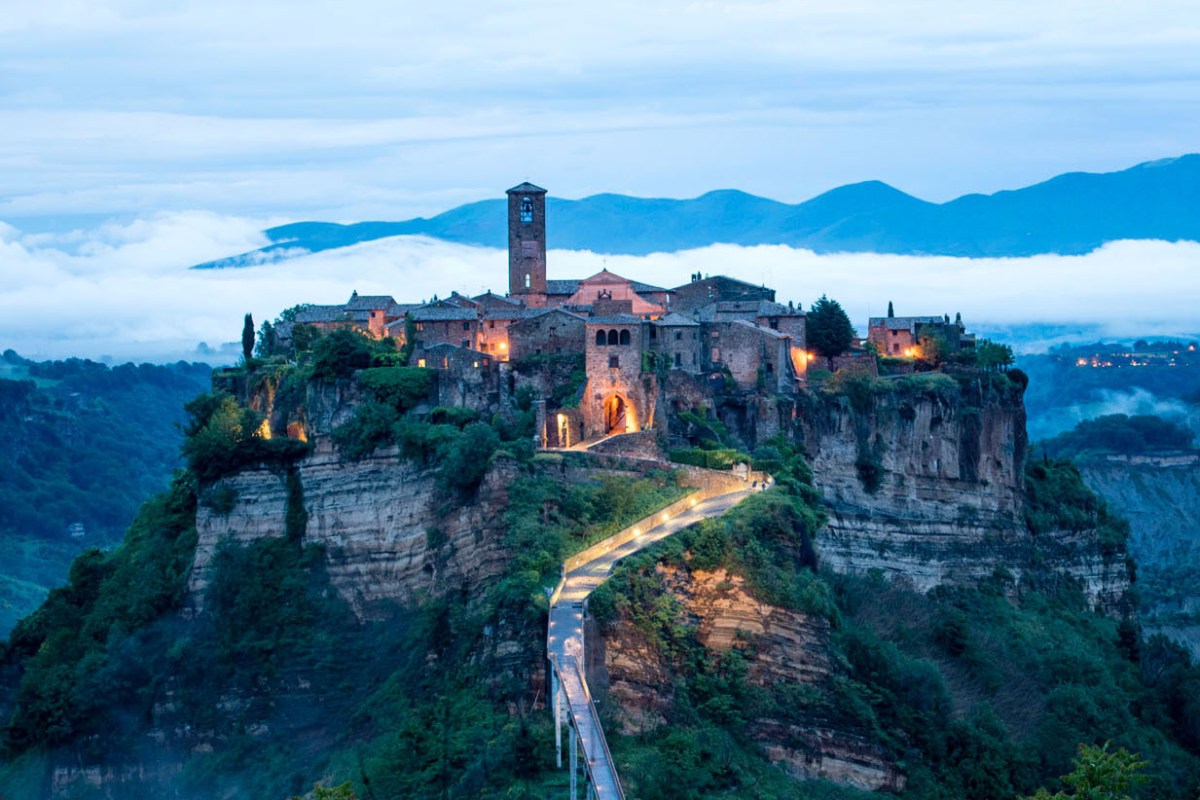
Behind the church of Civita di Bagnoregio, through a green gate beneath a tunnel of roses, stands Corte della Maestà, the only hotel inside a village Italians have nicknamed the dying city for the way its clay cliffs keep crumbling beneath it, reachable only by a long pedestrian footbridge. The MICHELIN Guide awards the house its Three MICHELIN Keys, the Guide's highest distinction, for four suites built into the historic rooms of Civita's fourteenth-century Episcopal Palace. The owners, psychiatrist and author Paolo Crepet and his wife Cristiana, spent decades assembling the antiques, mirrors and art that now fill the arched stone passageways, keeping part of the old bishop's quarters as their own home and turning the rest into this small, theatrical guesthouse. There is no restaurant and no conventional reception, only a kitchen, two gardens laid over Roman remains, and a stillness that settles over the village each evening once the day's visitors cross back over the bridge.
Corte della Maestà
Hotel · Civita di Bagnoregio, Lazio
© OpenStreetMap contributors · OpenFreeMap
- Address
- Vicolo della Maestà, 01022 Civita di Bagnoregio (VT)
- Rooms
- 4
- Spa
- Relaxation Room (40 sqm): bio-sauna, double whirlpool, massage, for two by reservation
- Telephone
- +39 335 879 3077
- Website
- cortedellamaesta.com
- MICHELIN Guide
- Three MICHELIN Keys
Four antique-filled suites behind a green gate in Civita di Bagnoregio, the hilltop village reached only by footbridge.
01The house
Corte della Maestà occupies part of Civita's fourteenth-century bishop's palace and continues the art collection Paolo and Cristiana have built up for decades, gathering pieces from across Italy and abroad. Room by room they restored the arched stone passageways and vaulted ceilings, filling them with mirrors, chandeliers and the kind of baroque opulence the owners describe as never twice the same.
The heart of the house is La Cucina di Fratta, named after Ippolito Nievo's novel The Confessions of an Italian: a kitchen of high stone vaults, rustic antiques and crystal chandeliers, where the two family Labradors greet guests over breakfast and the owners hand out tips on the hidden corners of Civita and the dishes of Tuscia worth seeking out.
02Rooms and suites
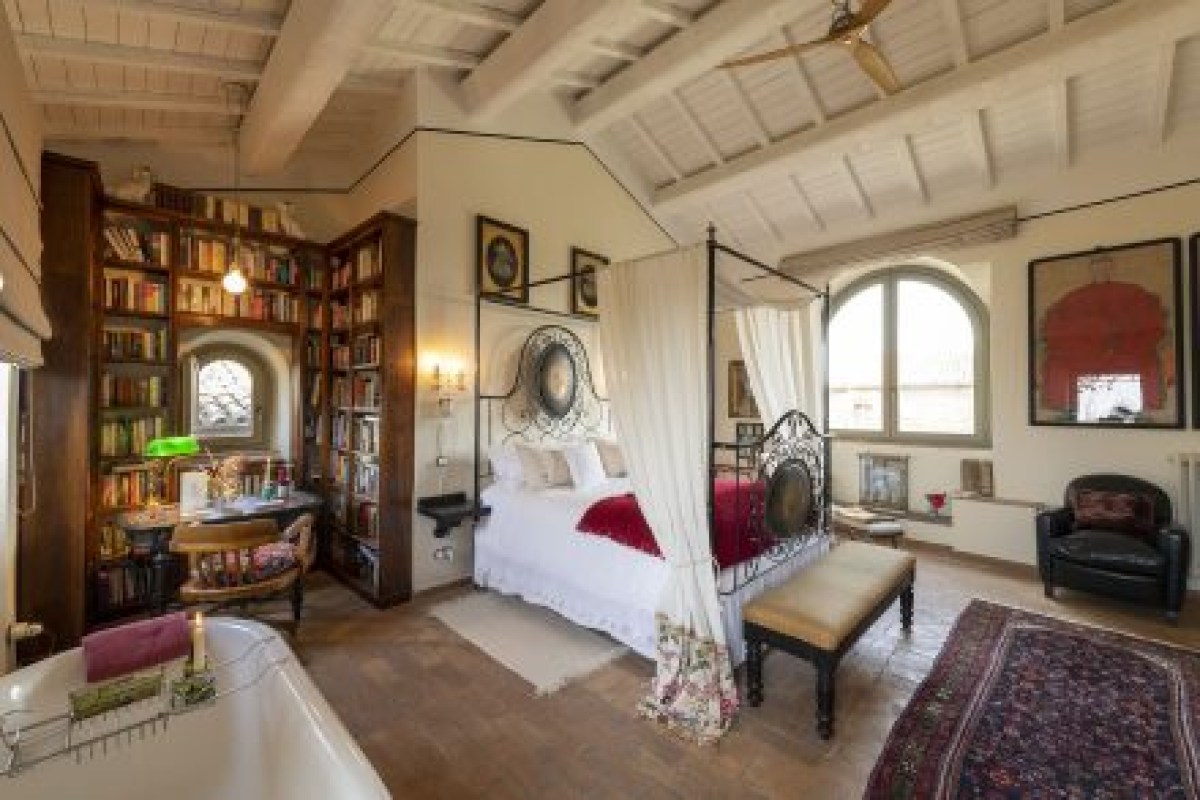
The four suites, each around 35 to 40 square metres, are named for literary or operatic heroines. La Badessa, a tribute to Stendhal's The Abbess of Castro, is built around a wrought-iron canopy bed that once belonged to an abbess, found by Cristiana and Paolo at an antique dealer's in Bologna, alongside a nineteenth-century French walnut fireplace and a freestanding cast-iron bathtub; it opens onto a private balcony over the Vescovado garden.
Insider tipNo restaurant; breakfast only. Spa for two guests at a time, by reservation.
La Sonnambula, honouring Bellini's opera, occupies what was once the house's medieval tower, its bed set beneath a theatrical backdrop and its windows looking over both the inner courtyard and the garden. La Scrittrice is covered wall to wall in hand-painted flowers reflecting, as the house puts it, her wild and untamed spirit. La Intrusa, a quiet ground-floor room dedicated to a Jorge Luis Borges story, hangs a painting by the French artist Pierre Sallé above its wooden fireplace and looks out through an old fig tree toward the house once lived in by the Argentine writer Rodolfo Wilcock.
03Breakfast and the kitchen
With no restaurant on site, the day's one fixed ritual is breakfast, laid each morning with English china, French silverware, antique teapots and crystal gathered from across old Europe. Depending on the season it is served beneath a large fig tree in the Vescovado garden or at the long table in La Cucina di Fratta, with freshly baked cakes, aged cheese, moka coffee, eggs, hand-sliced prosciutto and seasonal fruit.
04The lounge
A few steps down from the kitchen lies La Tana del Lupo, a fifty-square-metre lounge carved out of what was once a Roman cistern, its soaring tuff-stone arches and stone fireplace furnished with sofas, an old Forneris piano and a small handpicked library — the house's answer to a bar, better suited to a glass of wine by candlelight than a cocktail list.
05Wellbeing
A forty-square-metre Relaxation Room is kept for a maximum of two guests at a time, by reservation only, with a bio-sauna, a double thermal whirlpool tub and the option of a massage — an intimate alternative to a full spa, in keeping with a house that has only four rooms to begin with.
06The neighbourhood
Civita di Bagnoregio sits on a crumbling tuff plateau that has earned it the nickname the dying city for centuries, its only link to the modern world a long pedestrian bridge that empties out by dusk, leaving the cobbled lanes to the handful of residents and overnight guests. Rooms at Corte della Maestà look out over the calanchi, the pale clay badlands below, toward the neighbouring town of Lubriano. Guests wanting to extend the mood can continue to the owners' second address, Corte al Lago, on the shore of Lake Bolsena.
07Making the most of a stay
The house is set up for couples rather than families: its own listings describe it as ideal for couples and small groups, and not suited to children. Because the spa takes only two guests at a time and the garden breakfast is prepared fresh each morning, it is worth confirming timings with Cristiana and the team directly when booking rather than on arrival.
Don't miss
Don't miss
- 01
Breakfast under the fig tree in the Vescovado garden, laid with English china and antique silverware
- 02
The Roman-cistern lounge La Tana del Lupo, with its Forneris piano and small library
- 03
La Badessa's wrought-iron canopy bed, found at an antique dealer's in Bologna
- 04
The private Relaxation Room spa with bio-sauna and whirlpool, booked for two at a time
- 05
The view toward Lubriano across the calanchi from the upper rooms