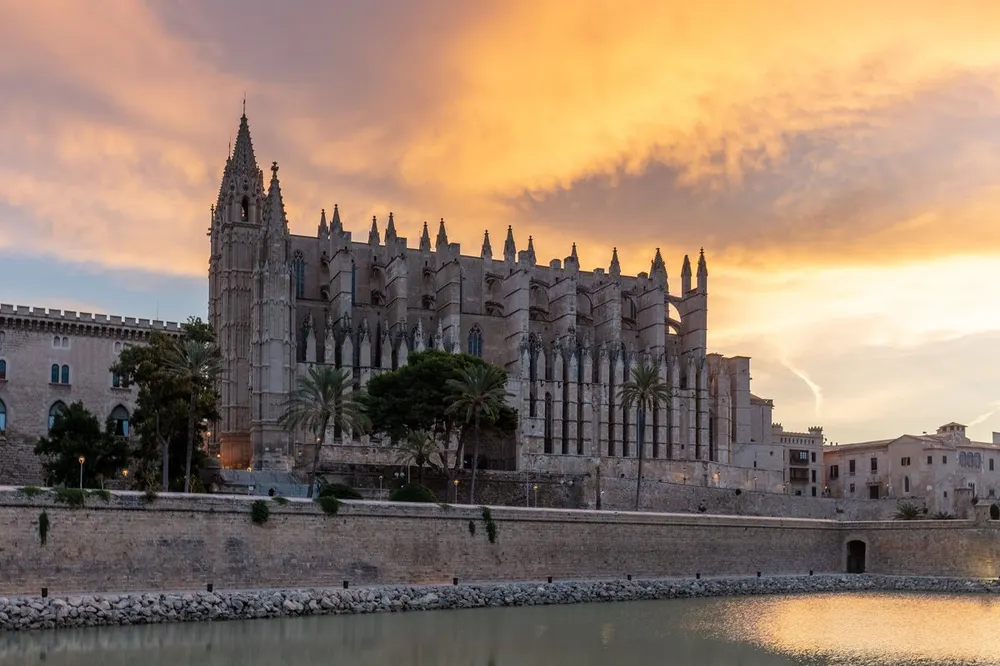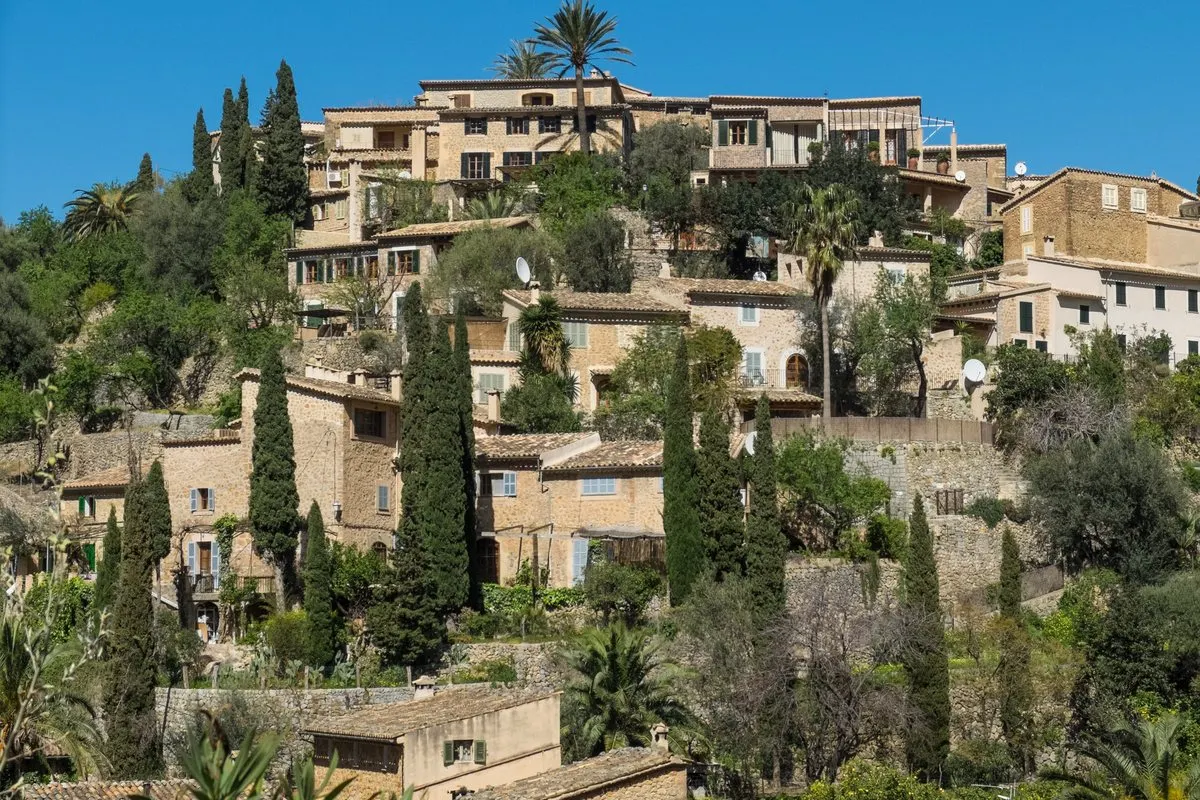
Robert Graves came to Deià in the 1920s and never really left. A day's journey through Mallorca's UNESCO-listed mountains, from Chopin's charterhouse in Valldemossa to Deià's hilltop church and the orange groves of Sóller.
In this story · 4 sections
Mallorca's northern coast is a different island. The Serra de Tramuntana, the mountain range that forms its backbone, drops steeply into the sea in a landscape of terraced olive groves, stone villages and pine-scented cliffs. In 2011 UNESCO inscribed it as a World Heritage site for its physical and cultural significance. At its heart lies Deià, a village of honey-coloured houses on a hill that has drawn writers, painters and musicians for a century. This itinerary follows the mountain road from Valldemossa to Sóller in a single, unhurried day.
Ca n'Alluny, Robert Graves's house
House museum · Deià
- Address
- Carretera Deià–Sóller, 07179 Deià, Mallorca
- Route
- Valldemossa – Son Marroig – Deià – Sóller
- UNESCO
- World Heritage site since 2011
- Highest peak
- Puig Major, 1,436 m
- Literary link
- Robert Graves, Chopin and George Sand
- Best season
- Spring and autumn
The house where Robert Graves lived and wrote, kept with his study, printing press and garden.
01Morning: Valldemossa and its charterhouse
Start early in Valldemossa, about half an hour's drive from Palma. The village is known for one landmark, the Royal Charterhouse. In 1399 King Martin of Aragon gave his summer residence here to the Carthusian monks, and their cells and cloisters still dominate the village. In the winter of 1838 to 1839 the composer Frédéric Chopin and the writer George Sand stayed in the charterhouse with Sand's children; she described the visit, unflatteringly, in A Winter in Majorca, and the rain that season did Chopin's health no favours. The cells associated with them can be visited.
Walk the steep lanes afterwards, with their potted plants and tiles dedicated to Catalina Thomas, Mallorca's patron saint, who was born here in 1533. Try a coca de patata, the local potato bun, with coffee.
02Late morning: Son Marroig and the coast road
The road north to Deià is one of the most beautiful in Spain, threading along the cliffs high above the sea. Stop at Son Marroig, the estate of the Austrian Archduke Ludwig Salvator, who did much to promote this coast in the nineteenth century. From its marble belvedere you look down on Sa Foradada, a rocky peninsula pierced by a great hole.
Insider tipCheck opening days before you go; hours are seasonal.
03Lunch and afternoon: Deià
Deià lies about 16 kilometres north of Valldemossa, among orange and olive groves on cliffs above the Mediterranean. After the First World War it drew German, English and American expatriates, and the English poet and novelist Robert Graves was one of the first to settle, working here with Laura Riding on their Seizin Press. He returned after the Second World War and lived in Deià until his death. His house, Ca n'Alluny, is now a museum, preserved much as he left it, with his study, printing press and garden.
Following Graves, an artistic community of painters, writers and musicians gathered here from the 1950s to the 1980s, and the village has kept a bohemian, cultured air. Climb to the church of Sant Joan Baptista at the top of the hill, where Graves is buried in the small cemetery with a view of the sea. Then follow the path down through the terraces to Cala Deià, a rocky cove with clear water and two simple restaurants serving fish. The walk down takes about half an hour; the climb back is steeper.
Deià is also home to Belmond La Residencia, a hotel in a pair of old manor houses in the hillside groves, which has long been the village's grand address.
04Evening: Sóller, the tram and the port
Continue to Sóller, a town of about 14,000 in a bowl-shaped valley of orange and lemon groves. Its wealth came from the citrus trade, which paid for the Ferrocarril de Sóller, the railway to Palma completed in 1911. The town centres on the Plaça de la Constitució, with plane trees, cafés and a fountain, and the tram rattles through it on its way down to Port de Sóller, three kilometres away. Take it to the harbour for a sunset drink by the water before dinner.
If you have more time, the mountain villages of Fornalutx and Biniaraix are nearby, and the range rises to the Puig Major, at 1,436 metres the highest mountain in the Balearic Islands. For the capital, see our Palma city guide among the Metro Mode destinations, and our travel section in English. Considering a home on the island? Read why Swedes are buying everyday homes in Spain (in Swedish).