Mallorca's capital is far more than an airport on the way to the beach. Palma has a Gothic cathedral reworked by Gaudí and Miquel Barceló, a circular royal castle, Moorish baths and an old town of hidden patios. How to spend two days there.
In this story · 5 sections
Most visitors to Mallorca pass through Palma on the way to a villa or a cove. That is a mistake. Palma de Mallorca, on the south coast of the island facing the Bay of Palma, is one of the most handsome small cities in the Mediterranean: a Gothic cathedral standing on the old sea walls, a medieval quarter of honey-coloured stone and hidden courtyards, and a long waterfront lined with palms. With a population of around 440,000, it is a real city, lively all year round.
Catedral de Mallorca (La Seu)
Cathedral · Old town
© OpenStreetMap contributors · OpenFreeMap
- Address
- Plaça de la Seu, 07001 Palma
- Role
- Capital of the Balearic Islands
- Population
- About 438,000 (2024)
- Cathedral
- La Seu; begun after 1229; nave 44 m high
- Don't miss
- Almudaina, Arab Baths, Bellver Castle
- Best season
- April–June, September–October
A Gothic cathedral with a 44-metre nave, one of Europe's great rose windows, a Gaudí canopy and Miquel Barceló's ceramic chapel.
01La Seu: the cathedral by the sea
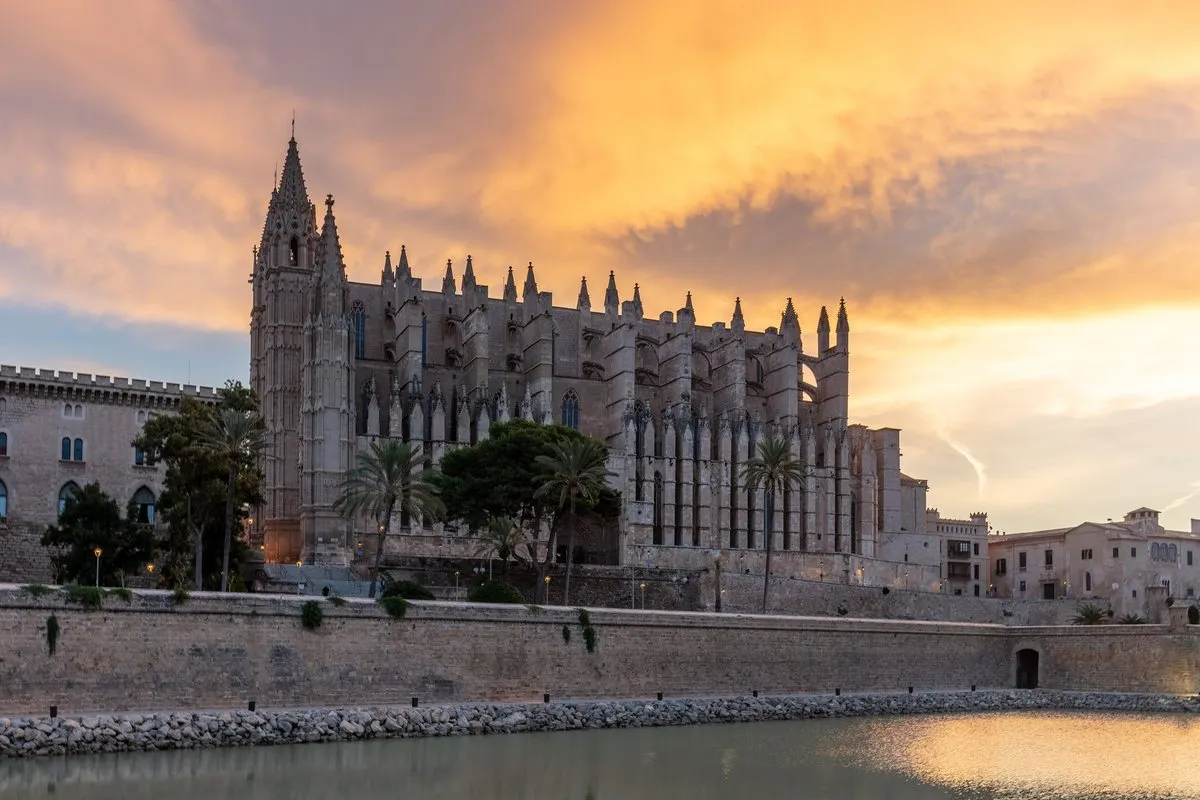
The Cathedral of Santa Maria, known as La Seu, is the image of Palma. King James I of Aragon took the city, then called Madina Mayurqa, from its Almohad rulers in 1229 and immediately ordered a cathedral on the site of the largest mosque. Construction continued into the seventeenth century. The result is a Gothic church of extraordinary height: its nave rises 44 metres, and its great rose window, nearly 14 metres across, is among the largest Gothic rose windows in existence.
Inside, two artists separated by a century left their mark. From 1903, Antoni Gaudí oversaw a wide-ranging renovation: he moved the choir stalls from the centre of the nave, opened bricked-up windows to flood the interior with light and designed a vast canopy to hang above the altar. He left in 1914 after disputes with the authorities, his plans unfinished. Between 2001 and 2006 the Mallorcan artist Miquel Barceló transformed a side chapel with a ceramic installation of sea creatures, fish and fruit that covers its walls. Go in the morning, when light falls through the stained glass and paints coloured circles on the stone.
02The Almudaina and the old town
Beside the cathedral stands the Royal Palace of La Almudaina, a former Moorish fortress rebuilt by the Christian kings and still used for official ceremonies. Behind both lies the old town, a tangle of lanes best explored without a plan. Palma's noble families built their houses around stone courtyards, the patios, with grand staircases and loggias; some open their gates during the day, and glimpsing them is one of the quiet pleasures of a walk.
Insider tipVisiting hours are limited on Sundays and during services.
Look for the Banys Àrabs, the Arab Baths on carrer de Can Serra, one of the few remnants of Palma's Moorish past, with a small domed chamber and a garden. Then wander down to the Passeig del Born, a tree-lined promenade with cafés and shops that links the old town to the sea.
03Bellver Castle
Three kilometres west of the centre, on a wooded hill, Bellver Castle is one of the few circular castles in Europe. It was built in the fourteenth century for King James II of Majorca, with round towers and double arches showing Islamic influence, and later served as a military prison for two centuries. It now houses the city's history museum. Come in the late afternoon for the view from the roof over the bay, the harbour and the cathedral.
04Along the waterfront
The seafront promenade runs for kilometres around the bay. Walk west from the cathedral past the marina, or east towards the old fishing quarter of Portixol, where small restaurants serve grilled fish by the water. In the evening, the cathedral is lit and reflected in the pool of the Parc de la Mar beneath it, the most romantic view in the city.
05When to go
Palma is at its best in spring and autumn, when the streets are calm and the sea still warm. Summer brings heat and cruise-ship crowds to the old town at midday; plan sightseeing for early morning and evening. For the rest of the island, see our guide to Deià and the Serra de Tramuntana among the Metro Mode destinations, and browse our travel section in English. If you are tempted to stay, read why Swedes are buying everyday homes in Spain (in Swedish).