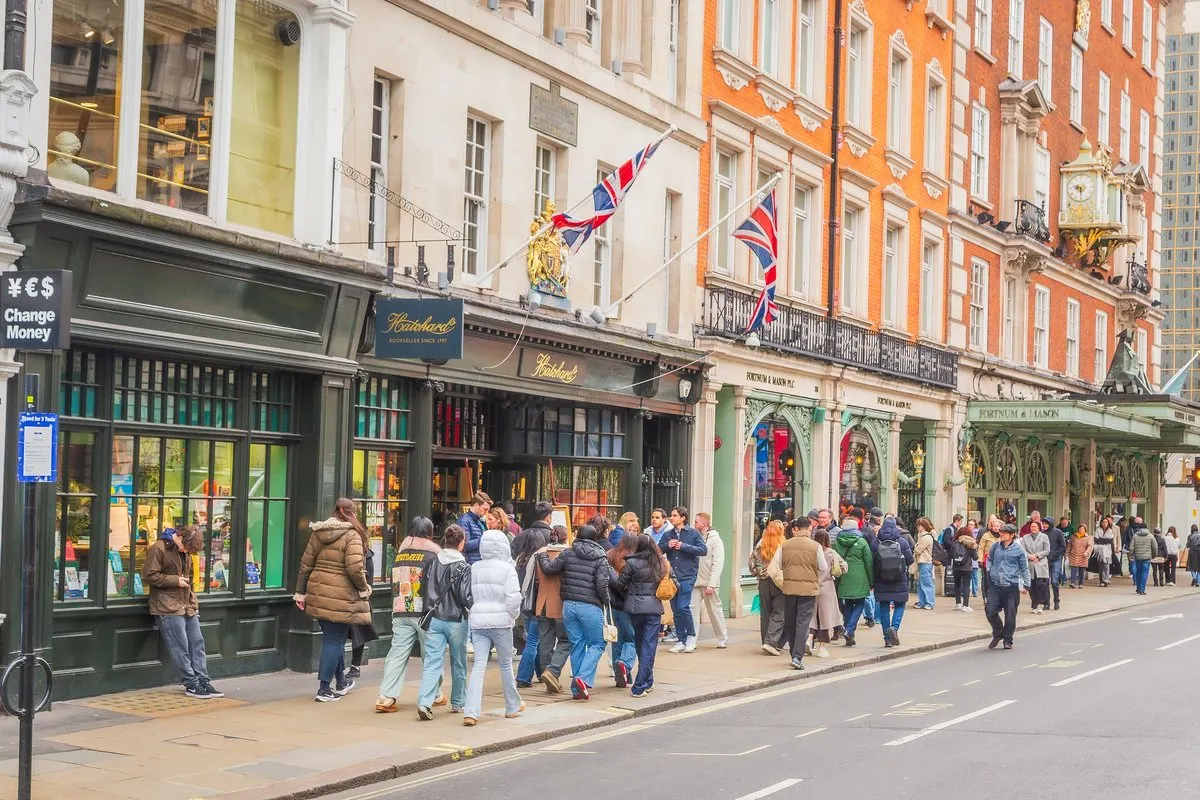
Fortnum & Mason has sold groceries on Piccadilly since 1707, and Hatchards, next door, has sold books there since 1797. Together they are the oldest shops on one of London's grandest streets. Here is their history – from Queen Anne's candles to Oscar Wilde's table.
In this story · 4 sections
Fortnum & Mason, at 181 Piccadilly in London's St James's, is the department store that began as a grocer more than three centuries ago. It is still best known for food – tea, hampers and speciality provisions – and it stands next door to Hatchards, which claims to be the oldest bookshop in the United Kingdom. Few places in London show so clearly how the city's royal suppliers grew into institutions.
2 places
© OpenStreetMap contributors · OpenFreeMap
Fortnum & Mason in dates- 1707
- First shop opens at St James's Market
- 1886
- First shop in Britain to sell baked beans
- 1910
- First royal warrant, from Queen Alexandra
- 1926–27
- Piccadilly store rebuilt
- 1964
- Fortnum and Mason clock installed
From Queen Anne's footman to Piccadilly grocer
William Fortnum was a footman in the household of Queen Anne. According to Wikipedia, the royal household insisted on new candles every night, and Fortnum resold the half-used wax. He also ran a small grocery business on the side, and he persuaded his landlord, Hugh Mason, to become his partner. In 1707 they opened the first Fortnum & Mason shop in Mason's premises at St James's Market.
In 1761 Fortnum's grandson Charles entered the service of Queen Charlotte, and the court connection brought more business. The shop claims to have invented the Scotch egg in 1738, and it began selling ready-to-eat luxuries such as poultry and game in aspic. During the Napoleonic Wars it supplied dried fruit, spices and preserves to British officers, and Queen Victoria sent its concentrated beef tea to Florence Nightingale's hospitals in the Crimean War. In 1886 Fortnum & Mason bought the entire stock of a new product from H. J. Heinz and became the first shop in Britain to sell tins of baked beans.
The 1920s building and the famous clock
The store at 181–184 Piccadilly was rebuilt in 1926–27 to a Neo-Georgian design by Wimperis, Simpson and Guthrie, and it reaches back to Duke Street and Jermyn Street. In 1951 the Canadian businessman W. Garfield Weston acquired the company, and in 1964 he commissioned the four-ton clock above the main entrance. Every hour, 1.2-metre figures of William Fortnum and Hugh Mason emerge and bow to each other to chimes and 18th-century-style music. The store was refurbished for £24 million for its tercentenary in 2007, and in 2012 Queen Elizabeth II opened the Diamond Jubilee Tea Salon on the fourth floor.
Fortnum & Mason holds two royal warrants, granted by King Charles III and Queen Camilla. Its first royal warrant came from Queen Alexandra in 1910. The company is owned by Wittington Investments and is run by two granddaughters of Garfield Weston.
Hatchards – Piccadilly's bookseller since 1797
Hatchards was founded by John Hatchard at 173 Piccadilly in 1797 and moved in 1801 to the address it still trades from today, now numbered 187 Piccadilly. Hatchard's portrait hangs on the staircase. The shop has a long-standing reputation for attracting well-known authors, and it was Oscar Wilde's favourite bookshop: he signed his books at the main table on the ground floor, still known as Oscar's table. Like its neighbour, Hatchards holds royal warrants from King Charles III and Queen Camilla, and the two shops are neighbours at St Pancras station too.
How to visit Fortnum & Mason and Hatchards
Time your visit for the hour to see the clock, then work your way up through the food halls to the tea salon on the fourth floor. Hatchards is a few steps west. Burlington Arcade and the Royal Academy are across the road, and Jermyn Street runs behind the store. Explore the street in VERA PI's street files for Piccadilly and Jermyn Street, see all of Westminster, or start with VERA PI's London guide.
Fortnum & Mason
Piccadilly's grocer since 1707
Food halls, hampers and the Diamond Jubilee Tea Salon.
- Founded
- 1707
- Building
- 1926–27
181 Piccadilly, London W1A
Hatchards
Bookseller since 1797
At the same address since 1801, with Oscar's table on the ground floor.
187 Piccadilly, London W1J