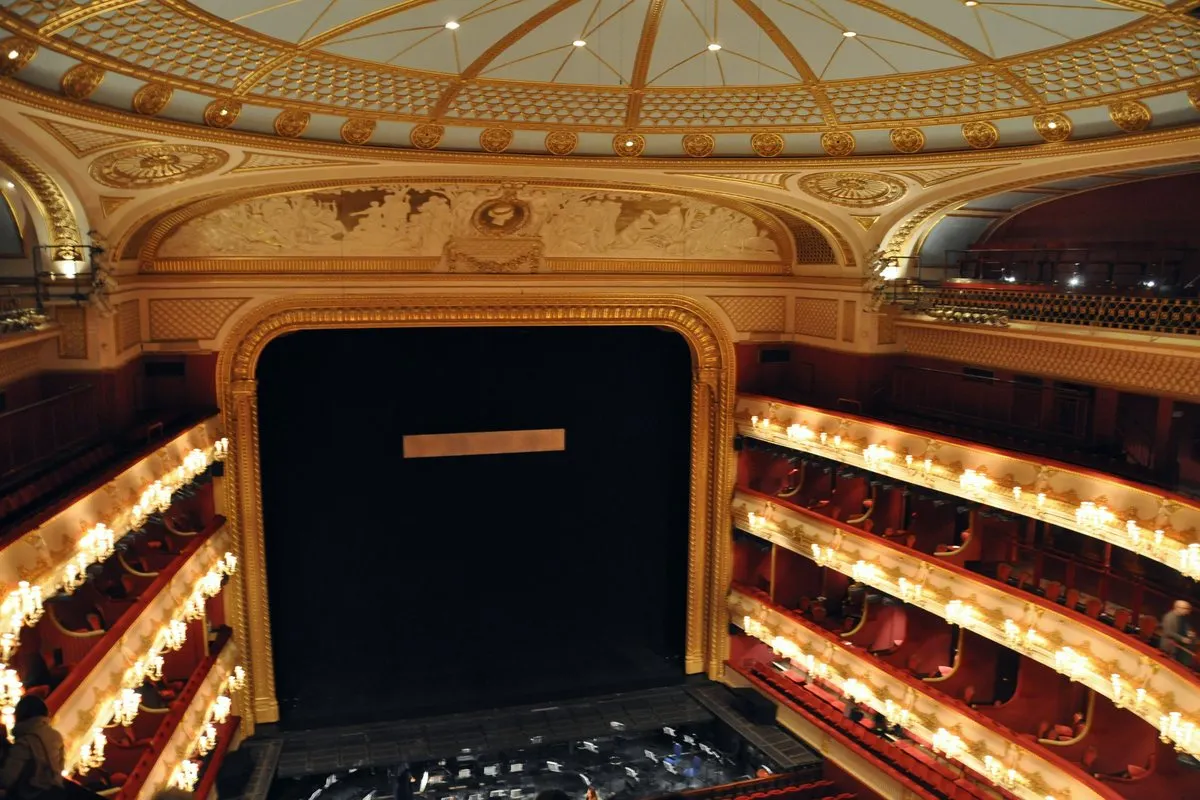
A theatre has stood on Bow Street since 1732, when the profits of The Beggar's Opera paid for it. Today's Royal Opera House, from 1858, is home to the Royal Opera and the Royal Ballet, and beside it lies Covent Garden – London's first modern square, laid out by Inigo Jones in 1630.
In this story · 4 sections
The Royal Opera House on Bow Street in Covent Garden is the main home of the Royal Opera, the Royal Ballet and the Orchestra of the Royal Opera House. Its Grade I listed auditorium, with four tiers of boxes and balconies and an amphitheatre gallery, seats 2,256 – the third largest in London. Next door lies Covent Garden itself: Inigo Jones's piazza, St Paul's Church and the old market halls.
Royal Opera House
Opera house · Covent Garden
- Address
- Bow Street, London WC2
- Seats
- 2,256
- Listed
- Grade I
- 1630
- Inigo Jones lays out the piazza
- 1732
- Theatre Royal opens
- 1858
- Present building opens
- 1892
- Renamed the Royal Opera House
- 1997–1999
- £213 million rebuilding
E. M. Barry's opera house from 1858, with the Paul Hamlyn Hall and the Linbury Theatre.
01From The Beggar's Opera to Handel's seasons
The Theatre Royal, Covent Garden was paid for by the success of John Rich's production of The Beggar's Opera in 1728. Designed by Edward Shepherd, it opened on 7 December 1732 with William Congreve's The Way of the World, and the first ballet, Pygmalion, was staged in 1734. Handel gave regular opera seasons at the theatre from the mid-1730s until his death in 1759.
02Two fires and E. M. Barry's opera house
Fire destroyed the first theatre on 20 September 1808; Robert Smirke's replacement opened within a year and burned down in March 1856. The present building, designed by Edward Middleton Barry, opened on 15 May 1858 with Meyerbeer's Les Huguenots, and its façade, foyer and auditorium date from then. The theatre became the Royal Opera House in 1892. Barry also designed the Floral Hall next door, opened in 1860 as a flower market and acquired by the opera house in 1977; it is now the Paul Hamlyn Hall.
Between 1997 and 1999 the complex was rebuilt for £213 million to designs by Dixon Jones, keeping the historic auditorium, and the underground Linbury Theatre, with up to 400 seats, opened in 1999. In 2024 the companies' public name changed to Royal Ballet and Opera, while the building remains the Royal Opera House.
03Covent Garden – the convent garden and London's first square
The name comes from the garden of the Abbey and Convent of Westminster, recorded in the 13th century; “Covent Garden” first appears in a lease of 1515. Edward VI granted the land to the Earl of Bedford in 1552, and in 1630 the 4th Earl commissioned Inigo Jones to design a church and three terraces around a square – the first modern square in London. St Paul's Church, consecrated in 1638, is known as the Actors' Church.
A market grew up here from the 1650s and received a royal charter from Charles II in 1670. Charles Fowler's neo-classical market building followed in 1830. The fruit and vegetable market moved to Nine Elms in 1974, and in 1980 the central building reopened as a shopping centre, with the London Transport Museum in the old flower market. Licensed street performers still play the piazza every day except Christmas Day.
04How to spend an evening in Covent Garden
Arrive early to see the piazza and St Paul's Church in the evening light, then take a drink in the glass-roofed Paul Hamlyn Hall before the curtain rises. Floral Street, which traces one edge of the medieval walled garden, and the independent shops of Seven Dials are a few minutes' walk away. Explore the streets in VERA PI's street files for Bow Street and Floral Street, see all of Westminster, or start with VERA PI's London guide.