Cardinal Wolsey built Hampton Court to rival the palaces of Rome, then gave it to Henry VIII to save his own life. A century and a half later William III and Mary II asked Christopher Wren to rival Versailles. Here is the guide to the Tudor and Baroque palace on the Thames.
In this story · 5 sections
Hampton Court Palace is a Grade I listed royal palace on the River Thames in the London Borough of Richmond upon Thames, about 19 kilometres south-west of central London. Two palaces meet here: the red-brick Tudor palace of Cardinal Wolsey and Henry VIII, and the Baroque wing that Christopher Wren built for William III and Mary II. It is cared for by the charity Historic Royal Palaces and displays works from the Royal Collection.
Hampton Court Palace
Palace · Richmond upon Thames
© OpenStreetMap contributors · OpenFreeMap
- Address
- Hampton Court, East Molesey KT8
- Begun
- 1514
- Cared for by
- Historic Royal Palaces
- 1514
- Wolsey takes over the site
- 1529
- Palace given to Henry VIII
- 1532–1535
- Great Hall built
- 1690s
- Wren's Baroque rebuilding
- 1763
- Great Vine planted
- 1986
- Fire in the King's Apartments
Great Hall, Tudor kitchens, Wren's state apartments, maze and Great Vine.
01Cardinal Wolsey's palace and Henry VIII's gift
Thomas Wolsey, Archbishop of York and Henry VIII's chief minister, took over the site in 1514 and spent seven years building what was meant to be the finest palace in England. The Base Court with its 44 guest lodgings and the inner gatehouse leading to Clock Court are his; his seal is still visible over the clock tower arch. Italian craftsmen added Renaissance ornament, including Giovanni da Maiano's terracotta busts of Roman emperors set into the Tudor brick. In 1529, knowing his enemies and the king were engineering his downfall, Wolsey gave the palace to Henry VIII. He died the following year.
02The Great Hall, the kitchens and the astronomical clock
Henry VIII's court numbered more than a thousand people, and one of his first projects was to quadruple the kitchens in 1529 so that he could feed them all. Between 1532 and 1535 he added the Great Hall, the last medieval great hall built for an English monarch, with its carved hammerbeam roof, and the Royal Tennis Court. In 1540 the inner gatehouse received the Hampton Court astronomical clock, which still shows the time, the phases of the moon, the sun sign and high water at London Bridge – essential knowledge when courtiers travelled by barge. The future Edward VI was born here in 1537, and Jane Seymour died here two weeks later.
03Wren's Baroque palace – an English Versailles
In the early 1690s William III and Mary II began a vast rebuilding intended to rival the Palace of Versailles. Sir Christopher Wren drew the plans, with William Talman as master of works, and much of the Tudor palace was demolished. Work stopped in 1694, which is why the palace today shows two contrasting styles – domestic Tudor and Baroque – held together by pink brick. Queen Anne later had Antonio Verrio paint the Baroque ceiling of the Queen's Drawing Room, and Wren remodelled the Chapel Royal for her, though its Tudor timber and plaster ceiling survives. George II was the last monarch to live here.
04The gardens, the maze and the Great Vine
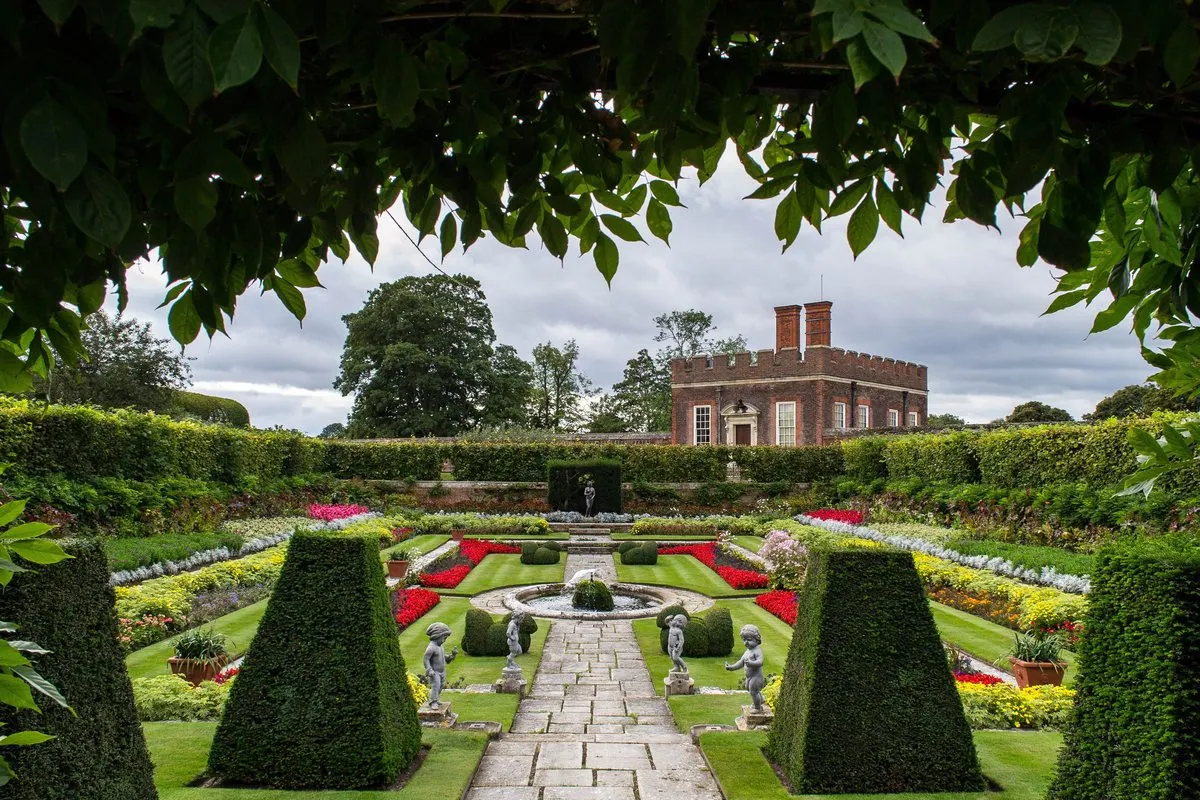
The grounds are dominated by the great landscaping scheme laid out for Wren's intended new palace. They include the Hampton Court Maze, the royal tennis court and the Great Vine, planted in 1763 and described as the world's largest grape vine as of 2005. Home Park hosts the annual Hampton Court Palace Festival and the Hampton Court Garden Festival. In 1986 a major fire damaged the King's Apartments; the restoration was completed in 1990.
05How to visit Hampton Court Palace
Allow a full day. Start with the Tudor courts, the Great Hall and the kitchens, then walk through Wren's state apartments and out into the gardens, ending at the maze. Elizabeth I's privy kitchen is now the palace tea room. See the borough in VERA PI's Richmond upon Thames pages, read our guide to Greenwich for another royal riverside day, or start with VERA PI's London guide.