A German prince's hotel, a marina opened with beluga caviar and Princess Grace among the guests, and six kilometres of villas between the mountains and the sea. How Marbella's Golden Mile was made, and how to enjoy it with some discretion today.
In this story · 4 sections
Between Marbella's old town and the marina of Puerto Banús runs the stretch of coast that made the Costa del Sol famous. It is called the Golden Mile, though it is closer to six kilometres, and it holds some of Marbella's most luxurious villas and estates, with mountain and sea views, along with the hotels that drew the international set here in the first place. To understand it, start with a prince.
Marbella Club Hotel
Hotel · Golden Mile
- Address
- Bulevar Príncipe Alfonso von Hohenlohe, 29602 Marbella
- Length
- About 6 km, Marbella to Puerto Banús
- Marbella Club
- Opened 1954 by Prince Alfonso of Hohenlohe
- Puerto Banús
- Opened May 1970; 915 berths
- Visitors to the marina
- Nearly 5 million a year
- Málaga airport
- About 60 km from Puerto Banús
Prince Alfonso of Hohenlohe's 1954 resort, with rooms, suites and villas in beachfront gardens and its own golf course.
01A prince and his club
In the years after the Second World War, Marbella was a modest fishing and farming town. Prince Alfonso of Hohenlohe-Langenburg, from a high-ranking European family, acquired an estate on the coast, Finca Santa Margarita, and in 1954 he opened the Marbella Club, originally his private residence, as an international resort for film stars, business leaders and the nobility. Where he led, his friends followed.
The Marbella Club Hotel remains the Golden Mile's most storied address. Renovated and enlarged from the mid-1980s to 2000, it has bedrooms and suites spread through beachfront gardens, together with Andalusian-style villas, and its own 18-hole golf course in the hills, opened in 1999. It still has the air of a private estate rather than a resort: low buildings, mature trees, a beach club and a sense of old-fashioned hospitality.
02The opening of Puerto Banús
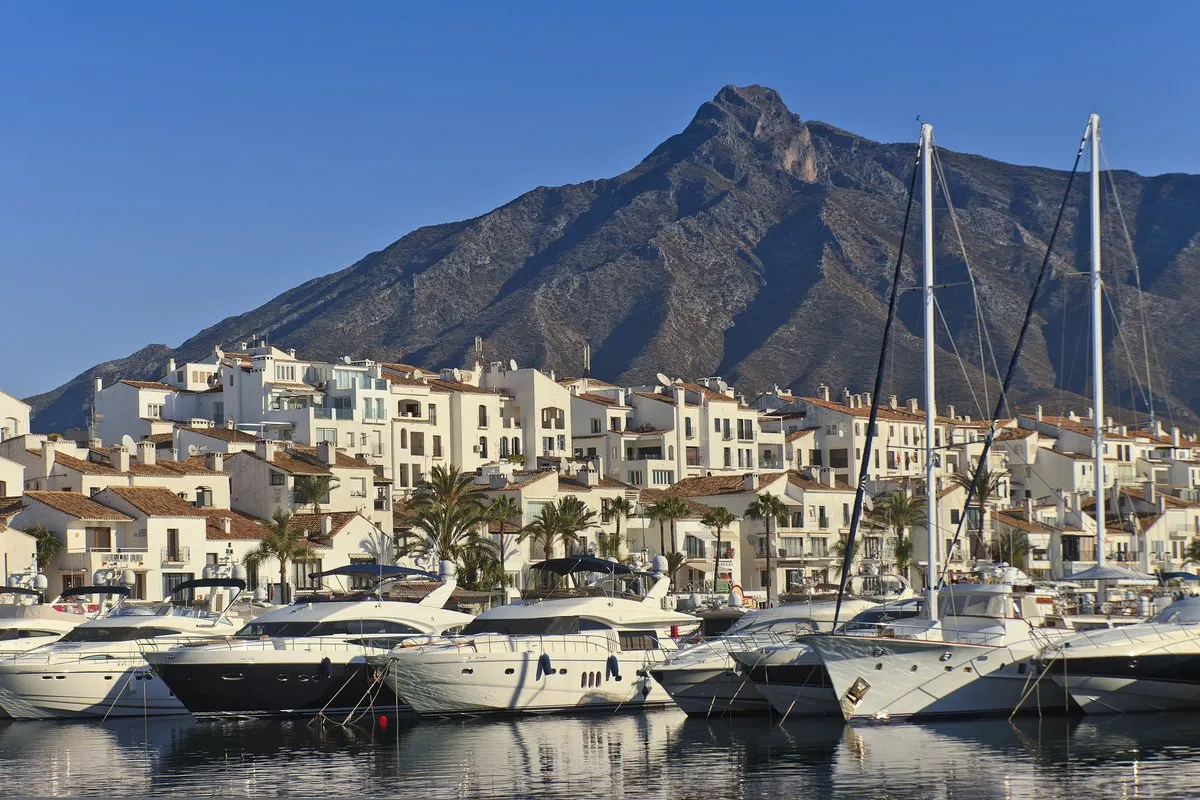
At the western end of the Golden Mile, Puerto Banús was built by the developer José Banús and opened in May 1970. The architect Noldi Schreck, who had worked in Beverly Hills, persuaded him to abandon plans for high-rise towers in favour of a design, made with the young architect Marcos Sainz, inspired by a traditional Andalusian village around a luxury marina.
Insider tipBook well ahead for July and August.
The opening party has passed into legend. Guests included the Aga Khan, Roman Polanski, Hugh Hefner, the heart surgeon Christiaan Barnard, and Prince Rainier and Princess Grace of Monaco. A young Julio Iglesias was hired to sing, and three hundred waiters from Seville served beluga caviar to 1,700 guests. The tone of Marbella for the next half-century was set that night.
03Puerto Banús today
Today the marina has berths for 915 boats, from eight to fifty metres, and receives nearly five million visitors a year. The quayside is lined with luxury boutiques, and the parade of supercars and superyachts is part of the spectacle. It is busiest on summer evenings. For a calmer experience, come in the morning for a coffee by the water, when the crews are polishing the decks and the light on La Concha mountain is at its softest, or visit outside July and August.
04Hotels of the Golden Mile
Besides the Marbella Club, the Golden Mile is home to other landmark hotels, among them the Puente Romano and the Meliá Don Pepe. Behind them, the hills hold large private estates, including the palace built for King Fahd of Saudi Arabia. A motorway divides the area in two: the seaward side has the beach and the hotels, the inland side the residential streets climbing towards the Sierra Blanca.
The pleasure of the Golden Mile lies less in sightseeing than in rhythm: a morning swim, a long lunch at a beach restaurant, a siesta, then dinner late and outdoors. Walk part of the seafront promenade towards the old town in the evening for a sense of how the coast fits together.
For the historic centre, read our guide to Marbella old town among the Metro Mode destinations, browse our travel section in English, and see why Swedes are buying everyday homes in Spain (in Swedish).