In this story · 7 sections
On the Bygdøy peninsula, a short ferry ride from Oslo's harbour, Norsk Folkemuseum has spent over a century collecting Norway itself, one building at a time. Founded in 1894 by the librarian and historian Hans Aall, who was inspired by Artur Hazelius's Skansen in Stockholm, the museum opened its gates to visitors in 1901 and grew, under Aall's 52-year directorship, into the country's largest museum of cultural history. Its open-air site now holds 160 buildings gathered from farms, fjords and city streets, arranged into three sections so that a visitor can walk, within a single afternoon, from a medieval storehouse to a 1950s Trøndelag farmhouse to a Pakistani family's 2002 flat in a reconstructed Oslo tenement. At its centre stands the museum's oldest and most celebrated structure: the Stave Church from Gol, a dim, tar-scented survivor of around 1200 that once belonged to a Hallingdal parish and now belongs, in a sense, to everyone who climbs its worn threshold.
Norwegian Museum of Cultural History
Sight · Bygdøy
© OpenStreetMap contributors · OpenFreeMap
- Address
- Museumsveien 10, Bygdøy, 0287 Oslo
- Open
- Tue–Sun 11–16 (winter); daily 10–17 (summer)
- Tickets
- Adults 200 NOK; under-18s free (Oct 2026)
- Time needed
- 2–4 hours
- Built
- Founded 1894; open-air museum opened 1901
- Architect
- Portal: Holm Hansen Munthe (1883)
- Telephone
- +47 22 12 37 00
- Website
- norskfolkemuseum.no
- Style
- Open-air museum of relocated historic buildings
- Collection
- 160 buildings; Sámi, folk art and textile collections
- Highlights
- Gol Stave Church (c. 1200), Oscar II's Portal
- Visitors
- Around 312,000 a year
160 relocated buildings on Bygdøy trace Norwegian life from the Middle Ages to 2002.
01The story
Hans Aall was twenty-five and on a collecting trip through Hallingdal, Numedal and Telemark for a Trondheim museum when, in the summer of 1894, he conceived the idea of a museum for the whole of Norway. With support from the folklorist Moltke Moe, he founded the Foreningen Norsk Folkemuseum at a meeting in Oslo on 19 December 1894. The museum acquired the core of its present grounds on Bygdøy in 1898, and after building temporary exhibition halls and re-erecting its first rural buildings, it opened its gates to the public in 1901.
The museum's reach expanded dramatically in 1907, when it absorbed the neighbouring Collections of King Oscar II. Those collections had themselves been established in 1881 at the King's summer residence at Bygdøy, on an idea credited to the court chamberlain Christian Holst, with Oscar II financing the relocation of five historic buildings there, among them the Gol stave church, a farmhouse from Hove in Heddal and a storehouse from Rolstad dating to around 1300. Opened to the public the year after, in 1882, this royal assembly is recognised as the world's first open-air museum. Hans Aall led Norsk Folkemuseum for 52 years, until his death in 1946, overseeing its growth in buildings, staff and collections.
02What you see
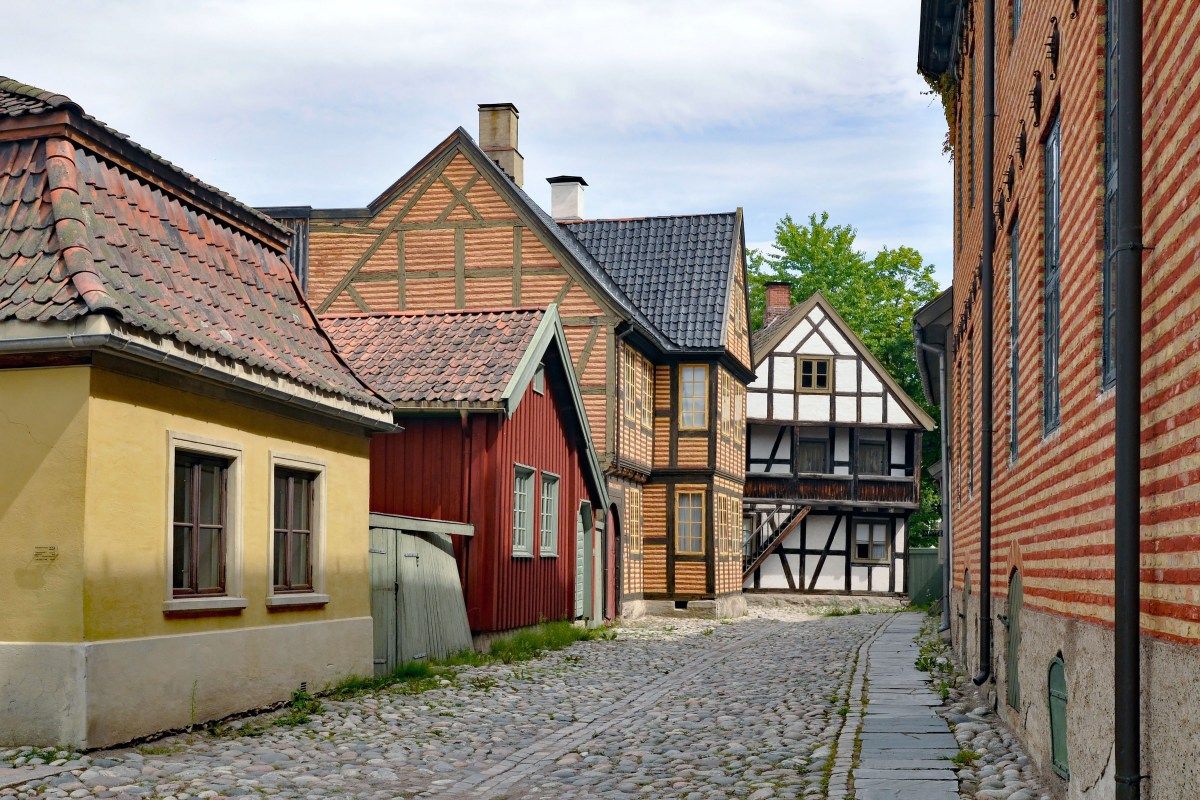
The open-air museum is organised into three parts: King Oscar II's Collection around the stave church, The Countryside with farmsteads grouped by region, and The Old Town recreating streets from Oslo, Brevik and Kragerø. Among the buildings on show are a loft from Telemark built around 1750–60, a liquor store relocated from Holmestrand dated 1904, and a 1928 Standard Oil petrol station. One tenement flat has been furnished twice over: as a home from 1865 and again as the Pakistani household it became in 2002, a deliberate pairing that extends the museum's timeline into the present.
Insider tipTue–Sun in winter, daily in summer; the stave church tour is free with admission.
Indoors, the exhibitions trace daily life and living conditions in Norway from the 16th century to today, drawing on the museum's own collections of artefacts, photographs and archives. The Sámi collection, numbering roughly 2,600 cultural-historical objects gathered between 1860 and 1980 along with 4,500 photographs and recordings of language, joik and oral history, sits alongside a reference library of some 2,000 titles. In 2019, as part of the Bååstede repatriation project carried out between 2014 and 2019, the museum transferred ownership of 1,639 Sámi objects back to Sámi museums in Norway.
Don't miss
Don't miss
- 01
The Stave Church from Gol, built around 1200 with its original carved west portal
- 02
The Oscar II's Portal, a Viking-revival gateway by architect Holm Hansen Munthe
- 03
The Trøndelag Farmstead's recreated 1950s farmhouse kitchen
- 04
The Old Town's working potter, silversmith and weaver
- 05
The Sámi collection of around 2,600 objects and its oral-history recordings
03The highlights
The Stave Church from Gol is the reason most visitors come. Built in Hallingdal around 1200, it was bought by the Society for the Preservation of Norwegian Ancient Monuments when the Gol congregation wanted a larger church, and King Oscar II paid for its re-erection at Bygdøy in 1884. Its west portal, carved with entwined dragons and vines, is original; the south portal is a copy made in 1884, and the whole structure was restored to its supposed 1200s form using the sister church at Borgund as a model. Inside, runic inscriptions carved into the nave's beams by medieval worshippers can still be read on close inspection.
Close by stands the Oscar II's Portal, a Viking-revival gateway designed by the architect Holm Hansen Munthe for the 1883 Kristiania industrial fair, later presented to the King and re-erected at Bygdøy; dismantled through disrepair in 1951, it was rebuilt for the museum's 1994 centenary. The Trøndelag Farmstead recreates a 1950s farm, complete with its own imagined family and a vintage tractor nicknamed Gråtass, while the Old Town's resident potter, silversmith and weaver work their crafts in the open air. A new exhibition, EMALJE, traces 150 years of Norwegian enamel goldsmithing, and the Living Crafts Yard, Håndverkstunet, is due to open on site in summer 2026.
04Visiting
In October 2026, Norsk Folkemuseum publishes winter hours (5 October–30 April) of Tuesday to Sunday, 11.00–16.00, closed Mondays, and summer hours (1 May–4 October) of every day, 10.00–17.00; it is closed on 1 January, 17 May and 24–25 December. A free 30-minute English-language guided tour of the stave church and the 1738 Hove farmhouse runs several times daily, departing from the Museum Square.
05Getting there
The museum sits at Museumsveien 10 on Bygdøy, about 5 km from central Oslo. Bus 30 runs directly to the Folkemuseet stop, while a seasonal ferry from Rådhusbrygge 3 to Dronningen (from 14 March 2026) leaves visitors a ten-minute walk away; drivers and cyclists can follow signs from the E18 or Bygdøy Allé, with municipal parking, including accessible spaces, just outside the main entrance.
06Around it
Bygdøy concentrates much of Oslo's maritime and exploration history within walking distance: the Norwegian Maritime Museum, the Fram Museum and the Kon-Tiki Museum all stand close by, making the peninsula an easy day combining Norway's rural past with its seafaring one.
07Making the most of a visit
Most visitors spend two to four hours on site, though the grounds reward a full day. Weekends in autumn, running through late November, bring a themed journey through different historical periods with craft demonstrations and farm animals, while the stave church's dark, unheated interior is at its most atmospheric with few other visitors inside; dress for the weather, since the paths are gravel and largely uncovered, and finish at Café Arkadia by the entrance.