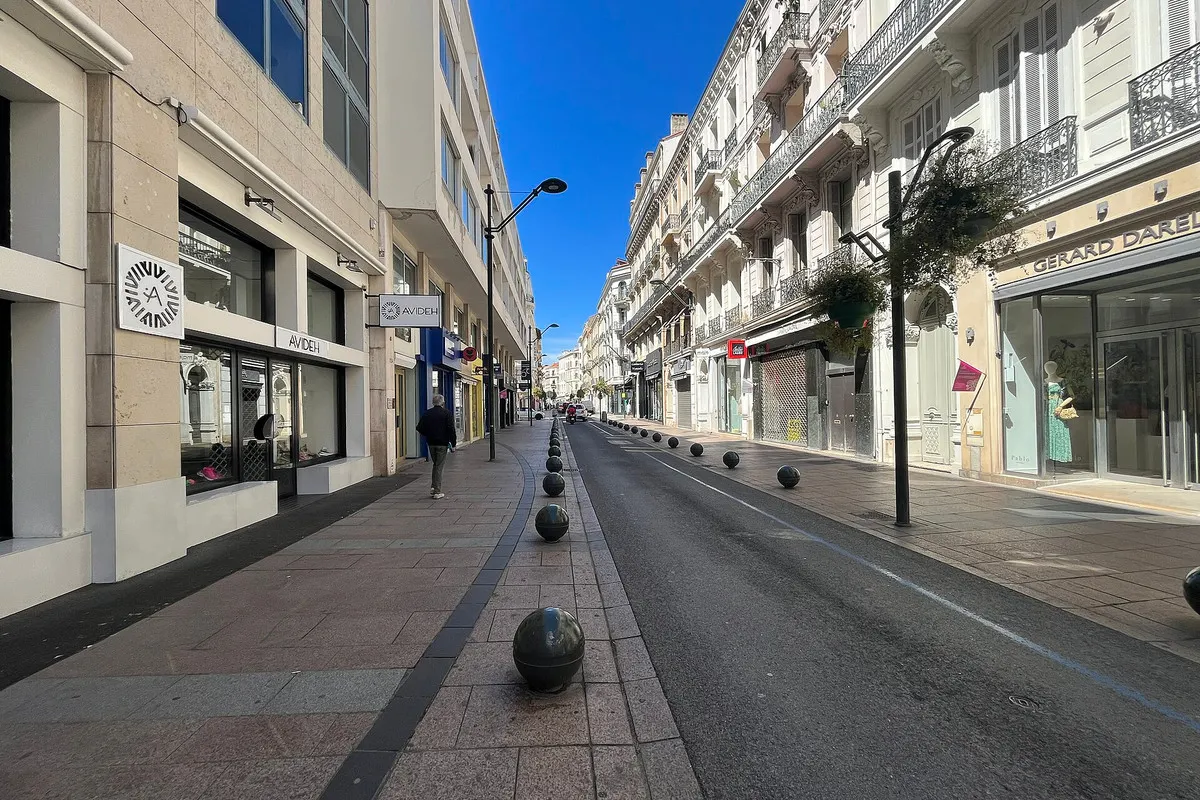
One block behind the Croisette, the Rue d'Antibes is where Cannes actually shops. Laid out around 1830 on the old royal road to Antibes, it is also a gallery of Belle Époque and art deco buildings – once you look up from the shop windows.
In this story · 3 sections
The Croisette is where Cannes shows itself; the Rue d'Antibes, one block inland and parallel to the sea, is where it shops. Running through the town centre from the rue du Maréchal-Joffre to the Général-Maubert roundabout, it is lined with shops and agencies and is, with the Croisette, the liveliest street in town. It is not pedestrianised.
The whole street is also recorded in France's general inventory of cultural heritage, as part of the survey of Cannes's seaside heritage – a reminder that the shop fronts sit in buildings worth looking up at.
Rue d'Antibes
Shopping street · Centre–Croisette, Cannes
© OpenStreetMap contributors · OpenFreeMap
- Address
- Rue d'Antibes, 06400 Cannes
- c. 1830
- Present line laid out on the royal road to Antibes
- 1852
- Named Rue d'Antibes by the town council
- 1872
- Pavements laid
- 1875
- Street paved
- 1899–1933
- Tram line along the street
- 1914
- 119 buildings line the street
Shopping street laid out around 1830 on the old royal road to Antibes, with buildings from the 1880s to the 1940s, among them a 1929 bank, a former theatre of 1881 and a caryatid façade.
01From royal road to high street
The street is the stretch east of Le Suquet of the old royal road number 97 from Toulon to Antibes. Its present line was laid out around 1830, under Louis-Philippe, but Cannes only began to spread east of Le Suquet in the second half of the nineteenth century. The council gave it the name Rue d'Antibes in November 1852, and until 1861 no house stood beyond today's rue des États-Unis.
It reached Les Gabres around 1876–1878. The first houses had only two storeys; pavements arrived in 1872 and paving in 1875. A tramway ran along the street from 1899–1900 until 1933, and by 1914 there were 119 buildings.
02What to look up at
At number 11, the Crédit Lyonnais building dates from 1929, designed by the architect Félix Biasini just before the crash; the bank had been on the plot since before 1883. At number 21 is the former shop of L. Rouff, a Parisian house of luxury lingerie founded in 1925, which moved its business to Cannes in 1932.
Insider tipLook for the theatre masks on the piers of number 102.
Number 40, at the corner of the rue des Belges, was built in 1928 for the Sigrand company by the architect Maurice Rondoni. At number 77, between the rue d'Alliéis and the rue Teisseire, stands the Hôtel Mondial, built in 1928 by César Cavallin. Number 101, the Résidence Le Cid of around 1885, has a Haussmann-style façade with a balcony running its full length and four caryatids.
Number 102 began life in 1881 as a theatre by the Cannes architect Charles Baron – who also designed the Villa Rothschild – built for the industrialist Loubet. It failed within a year, became apartments around 1900, and masks of ancient theatre still decorate the piers of its second floor. At number 120, the Hôtel Canberra, formerly the Hôtel de Russie and then the Hôtel Cosmopolitain, was built in 1943 by Eugène Lizero.
03Shopping, then the sea
Today the ground floors are given over to shops, cafés, banks and agencies, fashion boutiques among them, while the most expensive boutiques face the sea on the Croisette, a block to the south. Shop along the Rue d'Antibes, then turn down any of the cross streets and you are on the Croisette in a minute or two.
At a glance
Buildings to look for
| No. | Building | Date | Architect |
|---|---|---|---|
| 11 | Crédit Lyonnais bank | 1929 | Félix Biasini |
| 21 | Former L. Rouff shop | In Cannes from 1932 | – |
| 40 | Sigrand building | 1928 | Maurice Rondoni |
| 77 | Hôtel Mondial | 1928 | César Cavallin |
| 101 | Résidence Le Cid, four caryatids | c. 1885 | – |
| 102 | Former theatre with stone masks | 1881 | Charles Baron |
| 120 | Hôtel Canberra | 1943 | Eugène Lizero |